Old World

Tartarian

A fallen analog civilization buried by mud, memory loss, and deliberate forgetting. Steam, brass, sacred geometry, ruined civic stone, and buried underworks define a world rebuilding atop its own broken bones.

The Last Height

Before the fall, Tartarian reached its highest flowering not through electronics, but through analog precision. Steamworks, pressure systems, survey relays, civic stone, water engineering, clockwork logic, medicinal radium practice, archive guilds, and transport rails formed a civilization that was disciplined, beautiful, and terrifyingly capable.

Its architecture did not separate beauty from utility.

A station could be a basilica. A market could be a geometry lesson. A lodge could be a machine. A window could be both scripture and instrument.

The old masters believed that structure, number, and harmony could bind society together. They built pipe organs into civic halls not for ceremony but for resonance. They cut rose windows to precise sacred ratios. Their rail lines followed survey geometries that doubled as territorial mathematics. Giants walked among them — or what could only be giants, given the scale of the stonework that survives. The trees they planted still stand, impossibly large, impossibly old, outlasting every institution that tended them.

Perhaps the old masters were right to believe that harmony was the foundation. Perhaps that is precisely why the world had to be broken.


The Mud Flood

No one agrees on the Mud Flood. That disagreement is, itself, a form of evidence.

Theory One
Natural Catastrophe
Seismic collapse, inland seas, and drainage failure on a civilizational scale. The geology does not lie, say those who favor this reading. It simply accumulated at a rate no living record captured.
Theory Two
Judgment
The old world grew too capable, too reaching, too proud. The flood was not geological but theological — the end of one age and the deliberate beginning of another, overseen by something that does not explain itself.
Theory Three
Deliberate Burial
Not mud at all. A civilizational reset carried out by hands that feared what the old world had become. The streets are too perfectly buried. The books are too precisely gone. Someone cleared the table.

What every witness agrees on: the flood buried basements as ground floors, turned halls into foundations, left processional roads half-submerged, opened underworks where streets once stood, and tore memory so completely that even survivors began inheriting false histories. The forgetting was thorough. The evidence that survived is precise enough to be either random or deliberate, and no one can determine which.


The Broken Inheritance

The people of Tartarian live among fragments of institutions. Guild halls with no guilds. Watchtowers with no empire. Relay dais platforms with no official signal service. Ruined workshops still stocked with impossible fittings. Civic plazas reclaimed as camps. Cathedrals cut open to the sky. Underworks that feel less like caves than like buried infrastructure.

This is why trade, salvage, books, instruments, ledgers, and relics matter so much. In Tartarian, knowledge is not flavor. It is currency, leverage, and often survival.

Memory & The Wipe
Many citizens cannot fully account for their lineage, origin, or first loyalties. Some memories are merely lost. Others feel washed smooth, as if an entire layer of identity has been erased and replaced with something more survivable. This is especially visible among the ancient and wandering automata — some still patrol ruined roads using survey routes no living mapmaker authored. Some repeat broken ceremonial actions. Some pause at ward stones as though awaiting instructions from a vanished chain of command. Players, citizens, and factions all search for the same thing in different language: what really happened, who were we before the reset, and who benefits if we never remember?
Radium — The Contested Element
To automatons, radium is function, endurance, and continuity. To humans, radium is recovery, treatment, and controlled healing. To merchants, it is leverage. To smugglers, it is power. To zealots, it is danger. To scholars, it is proof that the old world knew things the present age has only inherited in fragments. Because both humans and automatons require it, radium is one of the few resources that creates forced cooperation and constant suspicion at the same time. No one can ignore it. No one fully trusts those who control it.

The Three Great Alignments

Tartarian works best when its living politics come in threes. Below are the three broad public alignments of the rebuilding age, and the silent fourth that no one can quite classify.

Brass Concord +
Order & Charter
The Concord believes civilization must be restored through charter, market reliability, civic order, contracts, and visible institutions. They favor the overworld, lawful trade, planned expansion, and the rebuilding of towns into cities. They are not saints. They tax, regulate, and exclude. But they keep roads open, weights honest, and walls repaired.

Best for: planners, builders, governance-oriented operators, and those who want the world to look like what it used to be.
Stability is the only currency that does not devalue.
Hollow Compact
Salvage & Nerve
The Compact believes the world is too broken for polite fiction. They thrive in salvage, secrecy, underworks operations, hostile logistics, hard bargaining, and high-risk extraction. They respect strength, nerve, and results over ceremony. They are not merely villains. They know truths the surface forgets. But they profit from danger and rarely give anything freely.

Best for: aggressive operators, extraction specialists, raiders, and those who understand that the old world did not fall by accident.
The honest price of anything is what it costs to take it back.
Middle Covenant =
Broker & Witness
The Covenant walks between the other two. They are brokers, treaty-runners, survey clerks, auction witnesses, intelligence carriers, and pragmatic neutrals. They are trusted by no one for long, but needed by everyone eventually. They do not rule the world. They make it possible for enemies to keep using it.

Best for: diplomats, traders, information agents, and those who understand that the most powerful position is often the one nobody is watching.
We do not choose sides. We choose when to become necessary.
Legacy Remnants ?
Memory & Route
Outside the three living alignments move the memory-wiped remnants: ancient survey automata, underworks patrol constructs, and route-bound machines that still follow forgotten duties. They are not a normal faction. They are evidence. Some carry information. Some carry warnings. All of them were given instructions that no surviving institution can decode, and all of them are still carrying them out.
We were told to continue. We have continued. We are still waiting for new orders.

Overworld, Underworld & Outerworld

The Overworld
The known face of Tartarian. Visible remains of civilization — reclaimed ground, road traces, forums, watchlands, bind stones, the early shells of towns. Wealth, legitimacy, and long-term civic projects live here. The surface is slower, more watched, more taxable, and more dependent on systems that can be blocked — but it is also the place where names become institutions. The Overworld has resources. It needs what the Outerworld finds.
  • Safer trade and access to established vendors
  • Full building rights across zone boundaries
  • Better civic reliability and social standing
  • Visible legitimacy with the Brass Concord
  • Standardized market for rare Outerworld salvage
The Underworld
Not a dungeon — the buried body of the old civilization. Worked galleries, transit cuts, processional ruins, ore seams, warded halls, and reclaim pads in stone. Those who bind below gain a slight active capability increase while underground. The trade-off is real: heavier vendor taxes above, outsider status on the surface, limited build space. The Underworld needs Outerworld rare finds and Overworld surface goods. It offers ore, radium, and cave-salvage traces in return.
  • Active stat increase (+0.05) while operating below
  • Build-site binding lets more players share fewer structures
  • Deeper ore, harder salvage, richer extraction zones
  • Native advantage in all underworks combat
  • Higher vendor costs and outsider treatment above ground
🌌 The Outerworld
The forgotten land beyond the edge of the known 3×3 surface grid. Where the faction maps run out and the old world's geometry runs clean. Hard to live in. Valuable to visit. The Outerworld is not simply wilderness — it is where the pre-Flood engineers built the things they didn't want found. Sparse in survival resources, dense in salvage. Few safe build sites. Long travel pressure back toward the known world. Outerworld operators need Overworld goods to survive and Underworld ore to repair. What they offer in return is rare.
  • Higher salvage density — rare and exceptional grades more common
  • Sparse basic resources — wood, iron, and radium present but uncomfortable
  • Every second tile has build sites; the rest are fully desolate
  • Three frontier bind stones at Far West, North Edge, Far East
  • Three cave entrances to the Underworld (inverted triangle geometry)
  • Creates the third corner of the trade triangle

Overworld Zones — The Known 3×3

Surface · Central
Central Frontier
Forum shells, broken colonnades, old road plinths. Most new stories begin here. The Central Bind Stone still holds stable significance — which is why camps, caravans, and first ventures gather at its feet. Locals say the market colonnade still remembers the sound of lawful trade. Others say the first public descent was never meant to be public.
Surface · North
Watchland Ruins
Northern remains of towers, gatehouse stubs, and exposed defense lines. It feels like a border long after the state that built it vanished. Winds move strangely there. Those who patrol the Watchlands say the stone is still listening — and sometimes answers.
Surface · Northeast
Windscar Bastion
Lookout country meets relay-country. Broken arches and a battered signal dais suggest this was once a zone of command and long-distance communication. The air there always feels like a message has just been missed. Surveyors love it. Scavengers distrust it.
Surface · East
Eastern Scar
Hard frontier of quarry cuts, relay traces, and one of the harsher known routes toward the underworld. The Relay Bind Stone makes it strategically important to anyone moving goods, ore, or secrets. People who live near Eastern Scar learn quickly that every road is also an argument.
Surface · Southeast
Silt Quarry Reach
Broken industry in slow collapse. Quarry faces and settled mud basins mark a place where labor once bit deeply into the earth and then vanished beneath the flood. A profitable place. An unlucky place. Usually both at once.
Surface · South
Lowwater March
Soft expansion country of drowned foundations and muddy causeways. One of the easiest places to begin building and one of the easiest places to lose everything to neglect. The March teaches the first lesson of Tartarian: if you do not keep building, the world resumes burying.
Surface · Southwest
Drowned Oldstone
Megalith country under water stress. Rings and plaza geometry rise from mud and reeds as if the land itself were trying to remember a language older than the flood. Many relic hunters come for proof of giants. Many leave with silence, geometry, and more questions.
Surface · West
Oldstone Verge
Sunken plazas, buried facades, and old rings visible enough to suggest purpose but not enough to explain it. Even the wandering remnant automata slow here. Children are warned not to sleep inside the old rings. Adults pretend that warning is for children.
Surface · Northwest
Wardstone Heights
Austere upland ground of civic remnants, standing stones, and survey cuts that imply old authority. Overlooks the frontier like a memory of judgment. No one agrees on what the ward stones once guarded. Everyone agrees they guarded something.

Cave Zones

Cave · Entry
Entry Galleries
The first real threshold below. Braced walls, shallow blackwater, and the first ore markers. Many parties swear their first true fear began here. The Return Shaft offers mercy. The dark beyond it does not.
Cave · North
High Galleries
Worked stone that still feels orderly. Chambers are taller, scars cleaner. One of the first places that makes explorers suspect the underworld was not formed — but designed. Some call it beautiful. That is usually when something goes wrong.
Cave · Northeast
Echo Relay Cut
Full of markers and seams that feel intentionally measured. Sounds travel poorly unless they matter. More than one delver has claimed the chamber repeats footsteps that were never taken. If the old world ran messages underground, Echo Relay Cut remembers the route.
Cave · East
Oreward Traverse
Practical, severe, and rich with labor history. Where ore, pressure, and ambition meet. The routes are harder, the seams better, and the reclaim pads worth fighting over. This is the kind of place that makes fortunes and buries crews.
Cave · Southeast
Blackwater Descents
Heavy lower chambers of flooded cuts, dark basins, and sunken processional stone. The air sits wrong. Lamps feel smaller. Reflections sometimes look delayed. The wise do not linger. The desperate do.
Cave · South
Silt Hollows
Softer chambers of pooled mud and quieter routes. The calm is deceptive. Sediment hides danger better than open stone ever could. Many routes disappear here — not with drama, but with softness.
Cave · Southwest
Support Vaults
Old engineering holding against age. Massive braces and transit piers keep the deeper underworks from collapsing. Everyone who lives below depends on these whether they know it or not. To damage a support vault is not sabotage. It is blasphemy against survival.
Cave · West
Warded Oldworks
Strange geometry and markers that feel ceremonial. The stone suggests it was watched for reasons no one now understands. Some believe these halls were administrative. Others believe they were custodial. No one likes lingering alone at the Warded Dais.
Cave · Northwest
Broken Procession
An ancient ceremonial route shattered by collapse. It feels older than the rest of the underworld grid, as if the later builders tunneled around something sacred or dangerous and only partly won. Every faction wants to control it. No faction feels entirely welcome there.

The Forgotten Margin

The Outerworld is not a separate place so much as a continuation of the surface in a direction the recovering world stopped mapping. The 3×3 known Overworld sits at the center of a 7×7 surface travel plane. Surrounding it — two rings deep, forty tiles in total — is the Outerworld: the forgotten margin where the old civilization built its most remote infrastructure and where the Mud Flood was, apparently, least thorough about burying it.

Every outerworld tile shares a single generated profile. No one has named them individually. The Surveyor lodges use directional coordinates. Everyone else just says "far out" and points.

Outerworld · Inner Ring
The Near Margin
The first step beyond the known overworld edge. Still reachable in a day's walk from the frontier zones. Signs of the old world here feel like echoes — recognizable architecture, salvage concentrations that suggest buried workshops. The inner ring is where most Outerworld operations begin and most cautious salvagers stay.
Outerworld · Outer Ring
The Deep Margin
A full day from any known overworld tile. Wood is scarce. Iron is present but not comfortable. The salvage density climbs noticeably. Some outer-ring tiles are fully desolate — no build pads, no resource nodes, nothing but the terrain and whatever the old world left under it. The three frontier bind stones are here for a reason: without them, returning from the deep margin is a long, heavy walk.
Outerworld · Build Sites
The Sparse Clusters
Not every outerworld tile can be built on. Approximately half have a small cluster of two or three build pads, placed away from transition points and bind stones. The rest are fully desolate by design. A build site in the Outerworld is a statement of intent — and a logistical problem, because everything that structure needs has to be carried in from somewhere else.
Outerworld · Cave Access
The Inverted Triangle
Three cave entrances in the Outerworld form an inverted triangle: Far North Overworld edge, Far West, and Far East. Each drops directly into the Underworld cave network. Each has a matching cave exit. This geometry was not accidental — it mirrors the bind stone triangle and creates a predictable triangular movement pattern across all three realms.

Settlements & Camps

Every city in Tartarian's recorded history began as a decision by one person to stop moving and build something. That progression — tent to lodge to hall to outpost to town to city to the rare Great Metropolis — is not metaphorical. It is a literal sequence of construction, investment, and defended persistence. The world does not award settlement status. It recognizes what already exists and cannot be ignored.

Settlement
Settlement Alpha
The model of reclaimed safety: reused stone, retrofitted timber, ordered storage, workshop corners, and disciplined civic reuse. It shows what Tartarian can become when people hold the line long enough to build properly. It is not glorious. It is more important than glory.
Field Camp
The Field Tent
The smallest honest victory in Tartarian. Canvas, lashings, packed earth, a trunk, a table, a lamp, and the right to say: this patch of danger is mine for tonight. Every city in Tartarian began with something this humble.
Lodge
The Lodge Hall
Timber and iron. A named threshold. The place where an Order's presence becomes an institution. Lodge Halls are where vote rights first appear, where workshop stations are first installed, and where the first binders begin to form a community around shared stakes.
Aspiration
The Great Metropolis
Tartarian's most ambitious civic achievement. It has happened exactly twice in the documented record — and both records disagree on whether the same event is being counted. A Great Metropolis has a World Auction, a Governor's office, and the weight of history. It is never safe to own one. It is never wise to ignore one.

The full seven-tier progression — from Field Tent to Great Metropolis — is documented in the Craft & Build section of this Codex, along with binding capacity, station unlocks, and the economic loop that connects extraction to auction to civic growth.


The Brass Trees

The impossibly large trees — the ones predating the Flood, outlasting every institution that ever tended them — have been examined closely by scholars curious enough to request samples and guild-connected enough to get them processed.

The bark has metallic properties. Not figuratively. Small shavings, when placed in proximity to a weak electrical source of the kind Gearwright lodges routinely use for instrument calibration, conduct a mild response. This is not botanically possible. Wood does not conduct. The samples are not contaminated — the metallic response is distributed through the bark structure itself, not deposited on the surface.

This finding has been reported formally four times in the post-Flood record. In three of those cases, the reporting scholar subsequently revised their findings — in two cases very shortly after a guild review, in one case without any review at all, which is in some ways more notable. The fourth report remains in the archive unrevised, filed by a scholar who retired from formal guild work the following season and has not published since.

Folk who live near the great trees have names for the phenomenon. They call the conducting bark cold brass or deep grain and consider it a mark of an old-growth tree rather than a young one. They do not find it alarming. They find it ordinary. This is, to the scholars who are still looking, the most interesting data point of all.

The trees were planted before the Flood. Whatever was planted with them did not wash away. It grew.

Consensus Geography

In the first two generations after the Mud Flood, when serious mapmaking resumed, surveyors encountered a specific practical problem that took decades to resolve and was never, strictly speaking, explained: the same road measured differently on different surveys. Not by much. A few yards here, a hundred yards in certain regions, occasionally more. But consistently, and — strangest of all — consistently in the same direction for each survey team's separate work.

It was not instrument error. The teams checked. It was not calculation error. The math held internally. The measurements simply did not agree with each other, and in certain zones — notably near what are now identified as active ley junctions and major node sites — the disagreement was large enough to matter for construction and route-planning.

The solution, after several decades of heated guild correspondence, was Consensus Geography: a standardized correction framework that adjusts all regional measurements to agree with an accepted baseline established at six anchor points distributed across the mapped world. Maps now agree with each other. The system works for practical purposes. Roads can be built. Caravans can navigate. Distances are reliable within stated tolerances.

Whether the maps agree with the underlying terrain — particularly near active ley junctions, where the original measurement anomalies were largest — remains an open technical question that the Consensus Framework was, in effect, designed to stop people from asking.

The Surveyor's Private View
Senior Surveyors learn early that the Consensus corrections are not uniform. In most zones they are negligible. Near certain node sites and convergence regions, they are surprisingly large. A skilled Surveyor who has memorized the correction tables can, in principle, reverse-engineer from the size of the correction to the likely strength of the underlying node. This is not an officially documented use of the framework. It is, however, a well-known one.
The map says the road is there. The road agrees. Whether the ground beneath it agrees is a question the Consensus Framework was built to make unnecessary. It is not, unfortunately, the same as making it untrue.

Proportions

The old stonework is not merely large. It is proportioned.

This is a precise distinction. A stone that is twice as large as needed is waste. A stone cut to fit a different stride length, a different door clearance, a different stair riser height, a different column reach — that is design. The architecture of the pre-Flood world is full of design decisions that assume a body somewhat taller, somewhat longer in the limb, and somewhat heavier in the frame than any human in the post-Flood record.

Some scholars attribute this to the Old Masters having different physiology than the current population — an interesting conclusion that raises the immediate question of where they went and why they left no direct descendants in the surviving record. Others argue the architecture was simply built to impress, with proportions deliberately exceeding human scale for psychological effect, as large civic monuments often are.

The automaton evidence complicates both readings. Several deep underwork recovery expeditions have documented automaton chassis — pre-Flood manufacture, not post-Flood reconstruction — at scales inconsistent with any known human or standard automaton frame. Not dramatically larger. Perhaps fifteen to twenty percent, in most documented cases. But consistently. In the same direction. In structures that were clearly designed for their use, not merely capable of accommodating them.

The theory that the old masters built to serve a larger population, rather than being that population themselves, is considered impolite in academic settings. That is usually a sign that it has evidence behind it that the field has not yet decided how to process.
The doors were built for something. That something is not here anymore. The doors remember it anyway.
Tartarian — The Old World · Lore Codex v3.3 · World Lore
Discipline & Oath

The Six Orders

The Orders are not fantasy classes. They are working traditions of a civilization trying to stand back up — professions, oaths, survival disciplines, and cultural identities that outlasted the institutions that created them.

Any Order may be played by its default automaton vessel, a human man, or a human woman. The Order is identity. The vessel is how that identity walks. And now — thanks to the art of Masquerade — the vessel you walk in need not be the one you were sworn into.

🛡️
Order · Tank / Frontline
Ironwarden
Ironwarden — Bastion Pattern
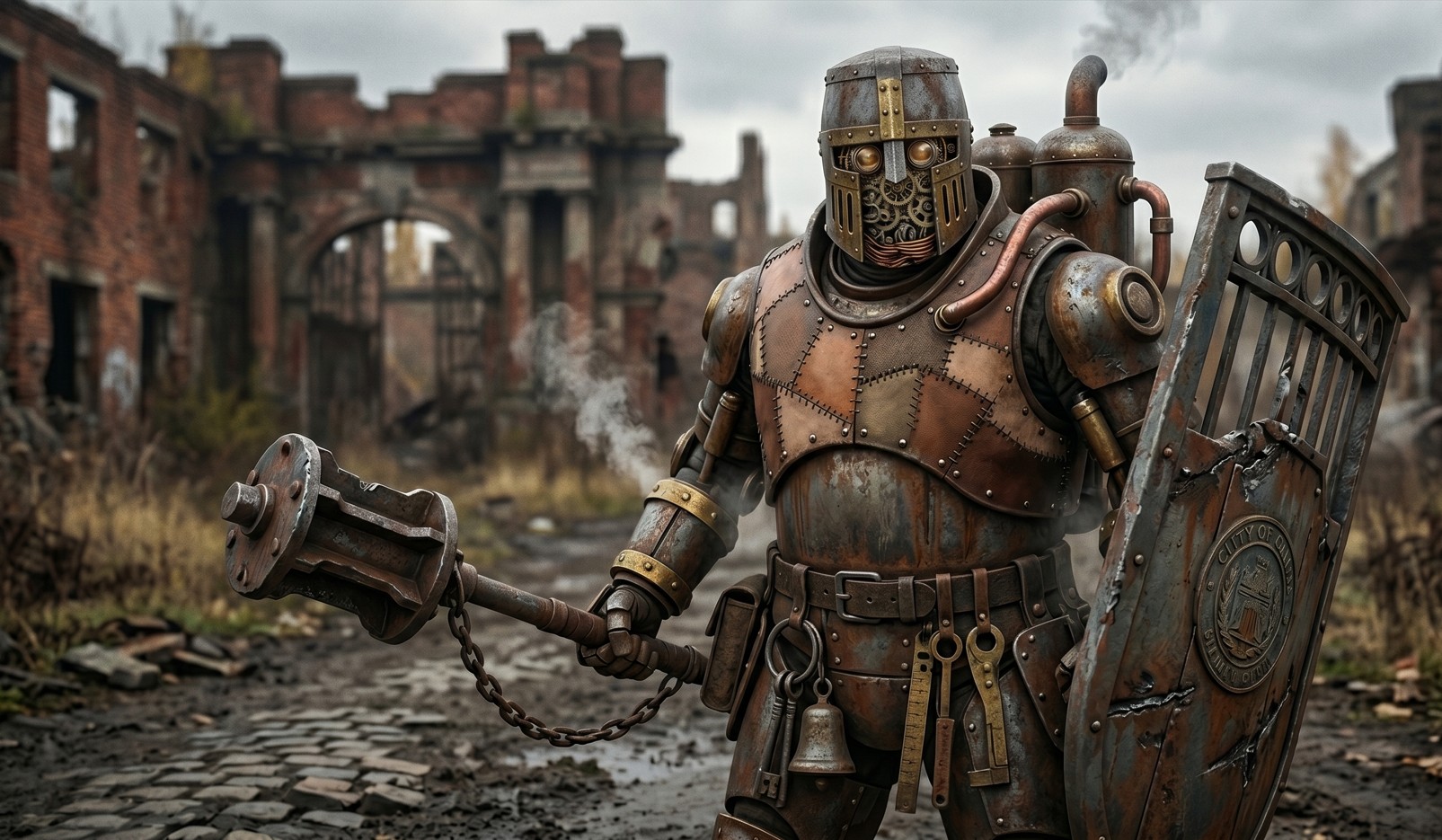
Before the Flood silenced the old bells, Ironwardens were civic guardians — wardens of bridges, gates, and the great colonnaded promenades. When the mire rose, survival meant standing in a doorway and refusing to move. Their heavy-plated regalia is assembled from salvaged pre-Flood iron. No two look alike, yet all are unmistakable.

Ironwardens are the wall that moves. They hold chokepoints, escort vulnerable labor, keep caravans alive, and stand where collapse would otherwise enter the party. Their culture prizes steadiness, witness, and the plain dignity of not breaking first. In settlements, they are respected as protectors. In politics, they are courted and feared — whoever stands nearest the gate often decides how safe a principle really is.
Combat Tank · chokepoint anchor · caravan guard · formation shield
World Escort builders · secure worksites · lead cave entry · stabilize expedition fronts
Default Frame Bastion Pattern
Human Title Warder of the Line
Hold until the line becomes a road.
Core Stats — Ironwarden · Total 30
Force
8
Precision
4
Vigor
8
Wit
6
Aether
4
Hull72
Armor13
Insulation10
Initiative10
Resolve11
Resistances · Starting Default
⚙️ 8 🗡️ 8 🔥 6 ⚡ 3 ☁️ 4 🌀 3
Universal Actions
Strike ManualBasic melee attack, available to all Orders.
BraceSelf-only. Reduces incoming damage until the next turn. Not a guard — personal discipline.
StepSmall repositioning. No defensive tether.
Take KneeIn-combat rest. Restores a small measure of resolve and stamina. Leaves the unit vulnerable.
Signature Offense
Bastion Hammer
A heavy melee strike that gains bonus damage against pressured or Fractured targets. Tests Force + half Precision vs target Armor. The Warden's impact is felt in the joints of whatever stands across from it.
Signature Defense
Interpose Guard
The only ally-guard skill at launch. Redirects a portion of incoming damage aimed at one nearby ally. Only one guard link per target. Expires if the Warden moves too far, is staggered, or disabled. This is a class privilege — not shared action.
Training Progression
Guard Mastery Path
Training deepens the Ironwarden's guard interception percentage, extends guard range, and increases hold time under pressure. Elite wardens may eventually project Interpose Guard over wider distances or sustain it through light stagger. Identity remains: the anchor who does not move.
Signature World Minor Enticement
🔔 Taunt
Forces or strongly compels hostile mobs to redirect aggression toward the Ironwarden. In PvE, an activated Taunt locks mob target priority for the duration — pulling dangerous enemies away from Chirurgeons, Aetherists, or any vulnerable ally. The mechanic is built for the world's reality: the wall moves so the builders don't have to.

A future PvP tier of Taunt may interrupt another player's triggered ability when it fires mid-cast — but this is balance-phase work, not first-implementation territory. One thing at a time.
PvE: Mob aggro redirect · Duration: sustained stance · Range: area · Cost: vigor · PvP interrupt: future phase
Passive Identity
⚖️ High Vigor / Carrying Capacity
Ironwardens carry more than other Orders. Their stat distribution — heaviest Force and Vigor in the world — translates to genuine carrying weight advantage. This is not an abstract number. It means more iron ore per extraction run, more supplies per expedition, more resources before a return trip is forced. In a world where every trip to a cave is a cost, that difference compounds.
Vigor 8 → highest base carry weight · scales with degree advancement
🛠️
Order · Engineer / Builder
Gearwright
Gearwright — Rivethand Pattern
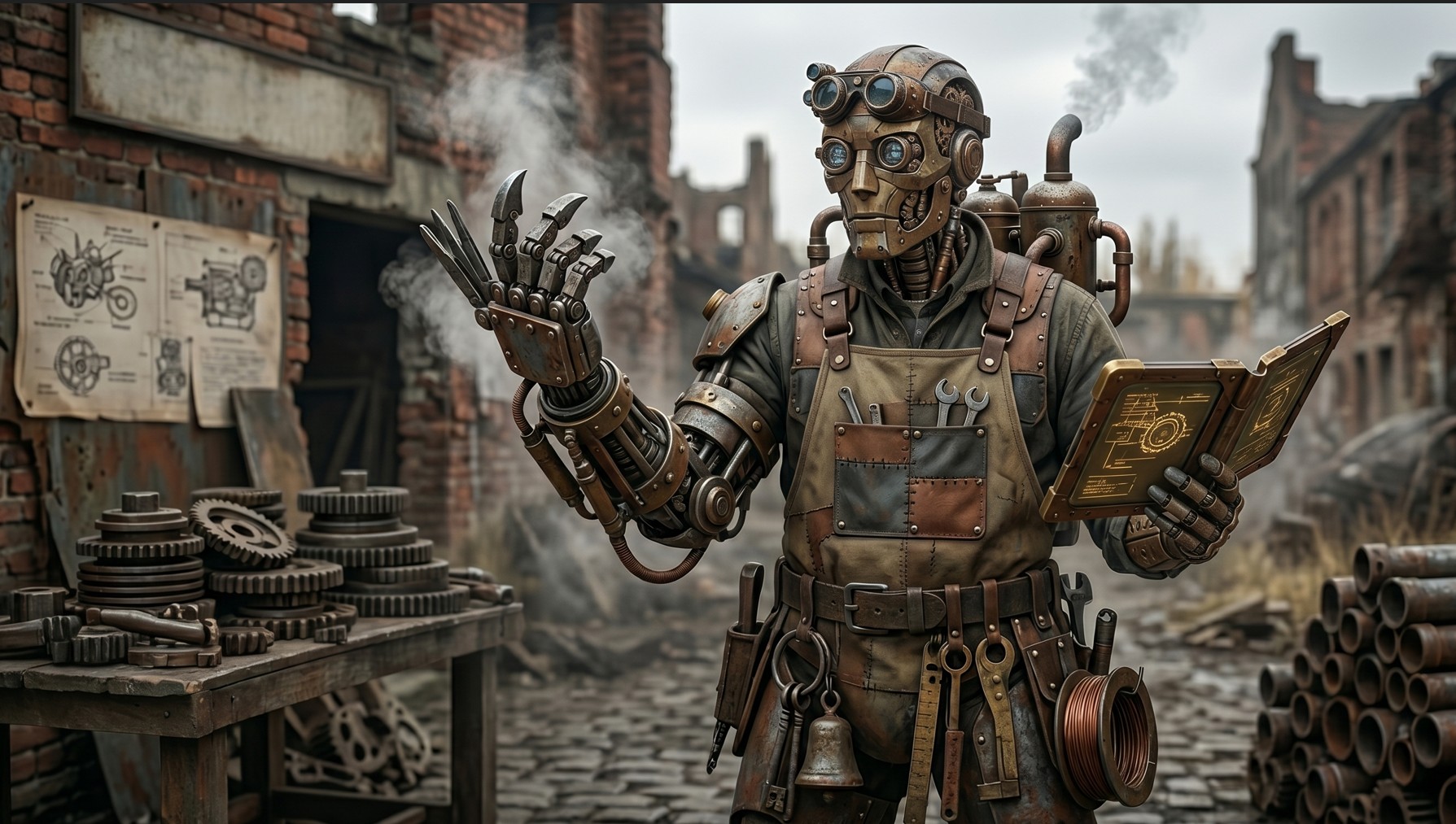
Tartarian did not fall for lack of resources — it fell because the knowledge of how to use them drowned. Gearwrights are the living answer: a discipline built from the recovery of lost mechanical understanding. Their lodges double as archives. Partial machine diagrams paper every wall. To be welcomed inside one is a mark of serious regard.

Where others see rubble, a Gearwright sees parts. Where others see inconvenience, a Gearwright sees bad planning. They repair machinery, raise structures, refit salvage, set traps, build workshops, and turn junk into advantage. They are the most visibly practical Order in the setting — and one of the most essential, because Tartarian is about rebuilding a broken world through tools, systems, and stubborn industry.
Combat Deploy field devices · repair constructs · traps and barriers · convert salvage to utility
World Speed up building · repair structures · improve camp quality · maintain machinery
Default Frame Rivethand Pattern
Human Title Artisan of the Reclaim
Nothing broken is finished yet.
Core Stats — Gearwright · Total 30
Force
5
Precision
8
Vigor
5
Wit
8
Aether
4
Hull60
Armor10
Insulation11
Initiative16
Resolve9
Resistances · Starting Default
⚙️ 5 🗡️ 6 🔥 8 ⚡ 8 ☁️ 4 🌀 4
Universal Actions
Strike ManualBasic melee attack, available to all Orders.
BraceSelf-only. Reduces incoming damage until next turn.
StepSmall repositioning. No defensive tether.
Take KneeIn-combat rest. Restores small resolve/stamina. Leaves the unit vulnerable.
Signature Offense
Rivet Burst
A mechanical burst attack deploying pressurized fasteners or explosive rivets. Deals moderate damage and applies light Fracture to the target's Armor rating. Tests Precision + half Wit vs target Armor.
Signature Support
Deploy Cover
Places a temporary cover object — a plated barrier, brace shield, or salvaged panel — on the field. Environmental defense, not body-guarding. Cover changes line-of-sight and absorbs ranged pressure for any ally positioned behind it.
Training Progression
Workshop Mastery Path
Training improves cover object durability and placement range, reduces the action cost of field repairs, and eventually allows the Gearwright to deploy two cover objects simultaneously. Rivet Burst can be upgraded to apply deeper Fracture or a brief stagger on armored targets.
World Ability Minor Enticement
📍 Map Markers (M-Button)
Gearwrights receive entitlement to place up to eight named markers on the world map via the M-button. Markers can tag mob spawn sites, build candidates, resource seams, town locations, rally points, fallback positions, and discovered leylines. Marker placement is fast, intentional, and visible on the group or guild map when sharing is enabled.
Cap: 8 markers (adjustable post-testing) · Shared with: Surveyor · Party/guild sharing: supported · Minor: full access at reduced cap
Signature World
📦 Sealed Brass Boxes
Bosses may drop sealed brass boxes — locked containers that require Gearwright skill or sufficient degree to open. No lockpick. No universal bypass. A group without a Gearwright leaves the box on the floor. A group with one watches them work it open and distributes what was inside. This is the mechanic that makes parties want one, and why a Gearwright minor is genuinely tempting for any hybrid build that intends to run contested content.
Required: Gearwright major or minor · Scales with degree · Cannot be bypassed by other Orders
Structure System
🔑 Keys, Locks & Structure Permissions
Gearwrights can craft and install mechanical locks, keys, and structure-control devices that regulate access within a player's building. An owner can grant storage access to bound residents, revoke it, sell or gift keys to trusted allies, and unlock further structure capabilities through crafted mechanical upgrades. The workshop station inside a player's structure can be tier-locked behind a Gearwright key — protecting tools, recipes, and interior access for those who've earned it.
Draft: permission economy design in progress · Integration with bind/recall structure system · Key trade creates economic identity
Craft Industries
⚙️ Gearwright Craft Catalogue
Beyond structures and machines, the Gearwright tradition produces precision personal goods: pocket watches, rings, walking canes, pendants, emblems of office, mechanical accessories, reinforced bags, and specialized workshop stations no other Order can build or service. These are not merely cosmetic — they represent industry, reputation, and the proof that Tartarian's knowledge survived the Flood in working hands.
🧭
Order · Scout / Pathfinder
Surveyor
Surveyor — Transit Pattern
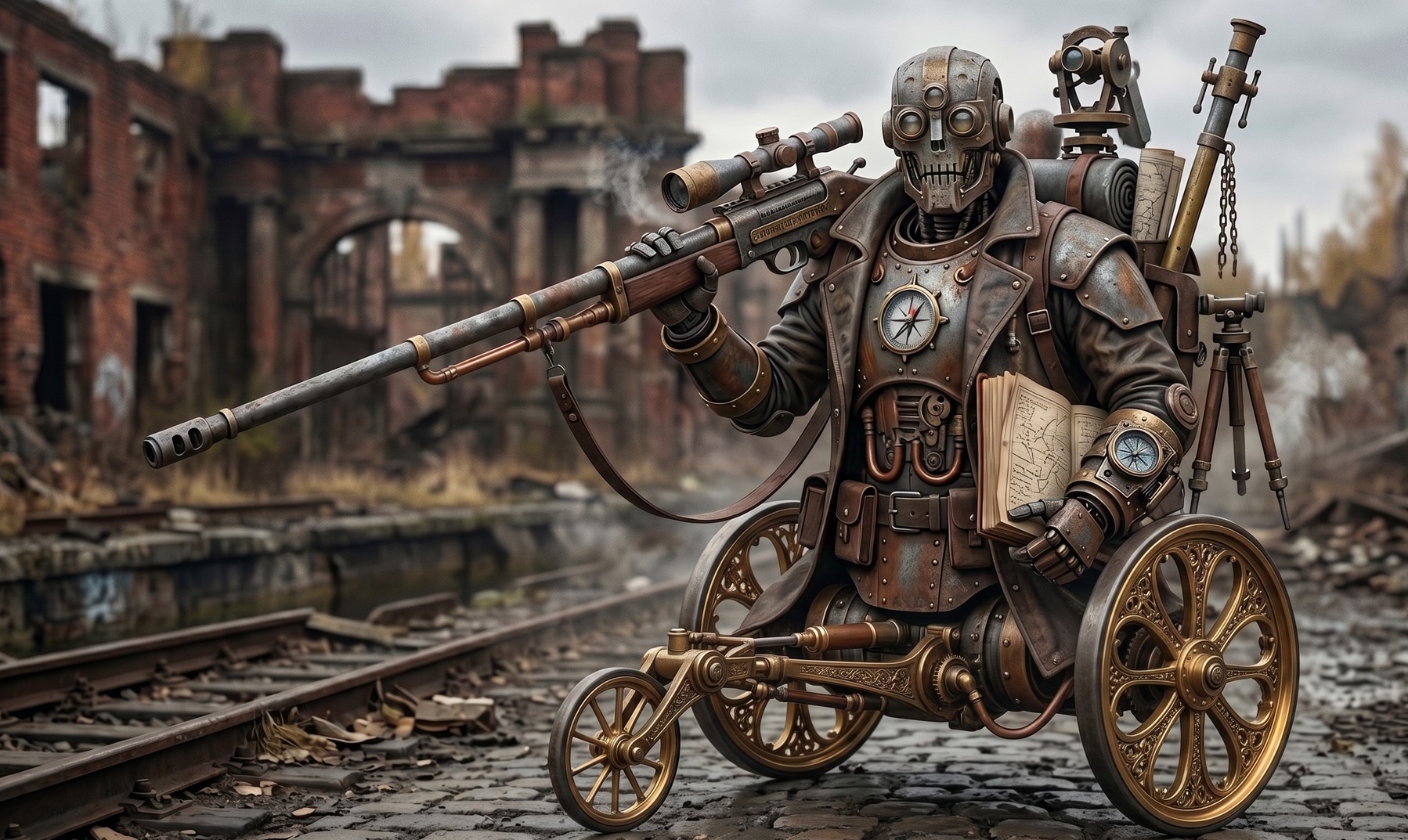
The roads are still there beneath the mud. The old canal lines, the railway foundations, the sacred geometry of a civilization that built in straight lines — all of it waits. Surveyors inherited theodolites, compasses, and transit levels from the ruins of Tartarian engineering institutions. In a world without trusted records, a Surveyor's mark on a map is treated as legal testimony.

Their lodges keep route books, corrected maps, rumor lines, and technical marks that outlast governments. They are often first to discover something and last to be believed. They understand that in Tartarian, knowing where you are is often more valuable than raw strength — and that a named path is the first act of civilization.
Combat Ranged attacks · target marking · line-of-sight control · battlefield awareness
World Fog reveal · cave scouting · route planning · hazard detection · navigation bonuses
Default Frame Longglass Pattern
Human Title Keeper of Bearings
A named path is half-survived.
Core Stats — Surveyor · Total 30
Force
4
Precision
8
Vigor
5
Wit
8
Aether
5
Hull60
Armor9
Insulation11
Initiative16
Resolve9
Resistances · Starting Default
⚙️ 5 🗡️ 6 🔥 5 ⚡ 5 ☁️ 6 🌀 6
Universal Actions
Strike ManualBasic melee attack, available to all Orders.
BraceSelf-only. Reduces incoming damage until next turn.
StepSmall repositioning. No defensive tether.
Take KneeIn-combat rest. Restores small resolve/stamina. Leaves the unit vulnerable.
Signature Offense
Longglass Shot
A precise ranged strike with bonus accuracy against marked or exposed targets. Tests Precision + half Wit vs target Armor. The Surveyor's knowledge of angles and sightlines gives this shot qualities that raw strength never could — it lands where it was supposed to.
Signature Support
Survey Mark
Applies the Marked status to a target. All allied attacks against a Marked target gain improved hit quality — not stacking raw damage, but improving the exploited threshold and extending it. Marks expire on timer, movement, or disruption.
Training Progression
Sightline Mastery Path
Training improves Survey Mark duration and the range at which marks can be placed. Advanced Surveyors can maintain two marks simultaneously or apply marks through partial cover. Longglass Shot can be trained to reach Exploited band from greater distances.
Signature World Pure Mastery
🧱 Bind Stone Discovery & Navigation
Surveyors are the Order most closely tied to the bind stone network. Through field work and degree advancement, a Surveyor finds, records, and navigates bind stones with capabilities no other Order can match.

Find: Active Surveyors can detect bind stone locations through field survey and ley-line geometry — discovering stones that others would walk past.

Record: Discovered stones are added to the Surveyor's personal stone ledger, enabling selection of known bind points for respawn and travel planning.

Navigate: Higher degrees open faster stone identification, multiple known-stone navigation, and group bind-point intelligence.

Group Recall (Pure Mastery): At sufficient pure degree, a Surveyor may recall a party to a known bind stone once per Tartarian day — an ability available only to those who refused the minor path.
Bind stone ledger: personal record · Group recall: pure Surveyor only · Production bind timer: once per 24hr Tartarian day
World Ability Minor Enticement
📍 Map Markers (M-Button)
Surveyors place up to eight named markers on the world map. Their markers lean toward navigation, survey intelligence, and route safety — mob spawns, hazard zones, hidden approaches, ley convergences, old road alignments, and rally coordinates. Shared with party or guild members, a Surveyor's markers become the expedition's operational map.
Cap: 8 markers (adjustable post-testing) · Shared with: Gearwright · Party/guild sharing: supported · Minor: full access
🩹
Order · Healer / Medic
Chirurgeon
Chirurgeon — Field Pattern
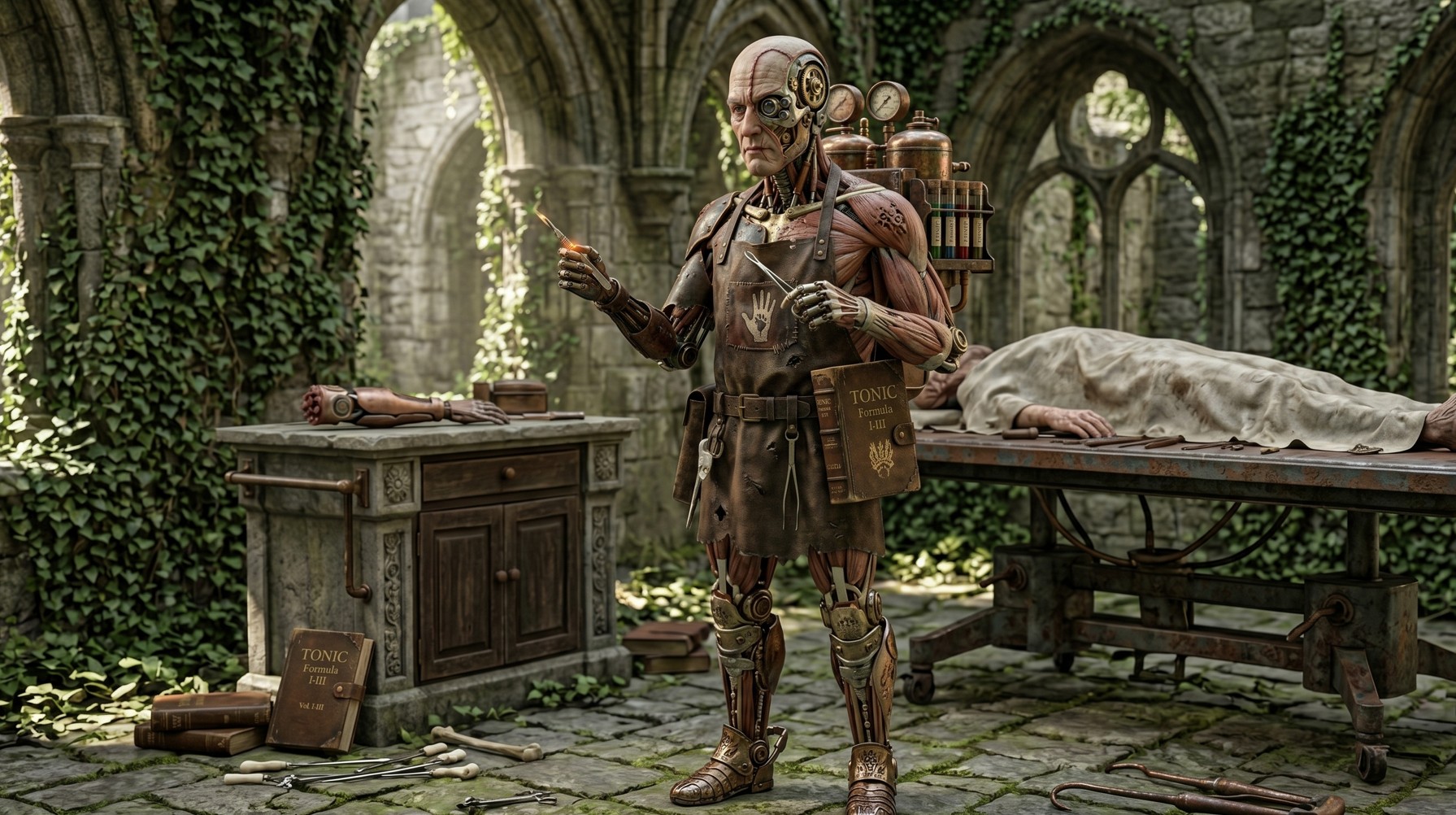
In the years after the Flood, infection killed more survivors than anything else. The Chirurgeons formed not from institutions but from necessity — from whoever held a fragment of old-world medicine and was willing to apply it. Their tonic formularies are passed through apprenticeship, closely guarded.

They were the first Order to recognize that automata and humans share structural vulnerabilities — a discovery that complicated faction politics considerably. Some see them as compassionate. Others see them as cold. Both impressions come from the same discipline: they are not merely healers; they are managers of survival itself. Their work combines medicine, salvage anatomy, pressure management, toxic caution, and different treatment systems for human tissue and automaton structure.
Combat Heal wounds · stabilize collapse · remove status effects · sustain party endurance
World Prepare tonics · restore expedition readiness · treat cave contamination · manage radium
Default Frame Mercy Frame
Human Title Hand of Recovery
Preserve function. Preserve breath. Preserve tomorrow.
Core Stats — Chirurgeon · Total 30
Force
4
Precision
7
Vigor
7
Wit
7
Aether
5
Hull68
Armor10
Insulation11
Initiative14
Resolve10
Resistances · Starting Default
⚙️ 4 🗡️ 4 🔥 5 ⚡ 5 ☁️ 8 🌀 7
Universal Actions
Strike ManualBasic melee attack, available to all Orders.
BraceSelf-only. Reduces incoming damage until next turn.
StepSmall repositioning. No defensive tether.
Take KneeIn-combat rest. Restores small resolve/stamina. Leaves the unit vulnerable.
Signature Offense
Sedative Lancet
Low-to-moderate damage. Applies Weaken, Slow, or reduced output to the target. Tests Wit + half Precision vs target Resolve. A Chirurgeon who cannot heal may still prevent an enemy from fighting well. Cold precision in close quarters.
Signature Support
Triage Application
Consumes one prepared medical charge from the kit. On humans: tonic, clamp, dressing, or stimulant. On automatons: radium patch, oiling strip, conductor plate, or sealant wrap. No fantasy barrier. No glow. Practical battlefield medicine applied under pressure.
Medical Supply Economy
Tier 0 — FieldCommon. Bandages, splints, basic wrap, oil cloth, stitching thread. Stabilization only.
Tier 1 — RadiumUncommon. Radium tonics for humans. Radium patches or conductor seals for automatons. Meaningful recovery.
Tier 2 — SurgicalRare. Used for deep recovery, contamination, or boss-grade support. Kit-slot limited. Must be prepared before engagement.
Training Progression
Kit Mastery Path
Training improves kit efficiency — more effective uses per charge, reduced shelf-life penalties, and the ability to prepare Tier 2 supplies in the field rather than only at a clinic. Advanced Chirurgeons can apply the Stabilized status to prevent catastrophic collapse for multiple turns, buying critical recovery windows.
Signature World
☢️ Radium Taxonomy — Discovered Types
Not all radium is the same. Chirurgeons who study the deep seams learn to distinguish types with meaningfully different properties. Discovery is part of the profession — a Chirurgeon who has only worked with common ore is missing most of what the discipline knows.

The types below represent current known and proposed forms. Their precise properties await discovery through in-world research, field testing, and Chirurgeon-to-Chirurgeon knowledge transfer.
Uncommon · Human Use
Pale Radium
The most accessible form. Refined into basic tonics and patches. Works on humans at field-grade reliability. Automatons use it for mid-cycle maintenance, not emergency repair. The backbone of a working Chirurgeon's kit — never exciting, always necessary.
Effect: Hull restoration (human/automaton) · Field grade · Triage Application foundation
Rare · Human Specialist
Deep Green Radium
Found in the deepest inhabited cave zones, near old-world machine corridors. Refined into preparations with vigor-restoration properties — the kind that bring a flagging expedition member back from the edge of retreat. Worth protecting on the way out.
Effect: Vigor restoration · Sustained output bonus · Useful in boss-length encounters
Rare · Automaton Specialist
Conductor Ore
A radium-adjacent material found along old ley-line corridors and piezoelectric architecture. Chirurgeons use it in conductor plates and steam-maintenance seals for automaton frame repair. Does nothing meaningful for human tissue. Gearwrights would know what to do with it — which is why it's the Chirurgeon who controls the supply.
Effect: Automaton Armor restoration · Conductor seal application · Piezoelectric system maintenance
Very Rare · Wit/Aether
Aetheric Radium
Glows faintly when near active ley segments. Refined into preparations that interact with aetheric and wit-related function — used by Aetherists in recovery after overcharge events, and by humans experiencing contamination from anomaly zones. The Chirurgeon's answer to the problems other Orders create.
Effect: Aether restoration · Wit debuff removal · Post-anomaly contamination treatment
Discovery Required
Further Types — Unknown
The taxonomy is not complete. What other forms exist in deeper seams, drowned corridors, or beneath resonant convergences is information the Chirurgeon discipline does not yet fully possess. Their apprenticeship notes refer to at least two additional types without description. The world will tell the rest.
Effect: Unknown · In-world discovery required
⛏️
Order · Striker / Specialist
Delver
Delver — Crag Pattern
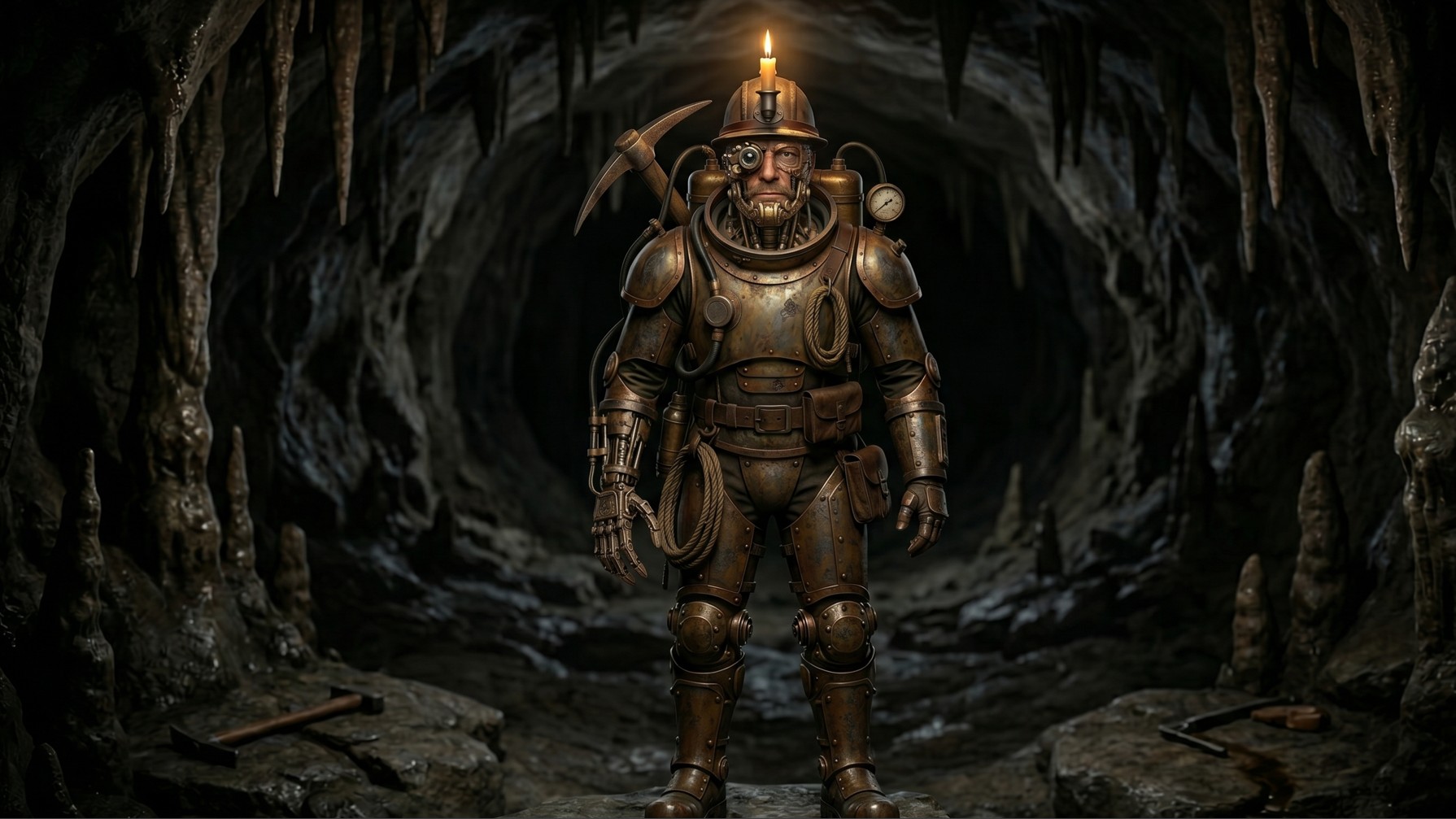
There are people who went into the caves during the Flood and never fully came back — not because they couldn't, but because something changed. The Delver discipline began as an extraction tradition in isolated underground communities who had no overworld option, absorbing combat doctrine because in confined stone, mining and fighting look exactly the same.

Delvers are built for pressure. They excel in caves, ruined corridors, violent extraction zones, hostile salvage, and close work where hesitation kills. Delvers laugh hardest nearest danger. This is not because they are fearless. It is because they know fear is cheaper than panic. Their stat bonus in the Underworld is felt more acutely than any other Order. They are the native species below.
Combat Close-range damage · armor breaking · brutal confined-space fighting · breach work
World Improved mining · cave traversal bonus · ruin breach · hazard tolerance · seam exploitation
Default Frame Pitbreaker Pattern
Human Title Oath of the Descent
Go where the weight is.
Core Stats — Delver · Total 30
Force
7
Precision
6
Vigor
7
Wit
5
Aether
5
Hull68
Armor12
Insulation10
Initiative11
Resolve9
Resistances · Starting Default
⚙️ 7 🗡️ 7 🔥 4 ⚡ 4 ☁️ 8 🌀 4
Universal Actions
Strike ManualBasic melee attack, available to all Orders.
BraceSelf-only. Reduces incoming damage until next turn.
StepSmall repositioning. No defensive tether.
Take KneeIn-combat rest. Restores small resolve/stamina. Leaves the unit vulnerable.
Signature Offense
Seam Splitter
An armor-biting melee strike that performs with greater effect against fortified or armored targets. Tests Force + half Precision vs target Armor. In cave corridors and ruined confined spaces, the attack gains an additional bonus — the Delver's native terrain becomes a weapon.
Signature Defense
Underbrace
A self-anchor stance that reduces incoming damage for one turn. If the Delver is struck while braced, a short retaliatory counterattack fires automatically. The stance is learned underground, where waiting for safety is a luxury no stone provides.
Training Progression
Breach Mastery Path
Training improves Seam Splitter's Armor penetration against reinforced targets and extends the Underbrace retaliation window. Elite Delvers can apply a secondary Fracture stack from Seam Splitter or trigger Underbrace's counter from a wider arc. Underground stat bonus deepens with training milestones.
Order · Control / Scholar
Aetherist
Aetherist — Lens Pattern
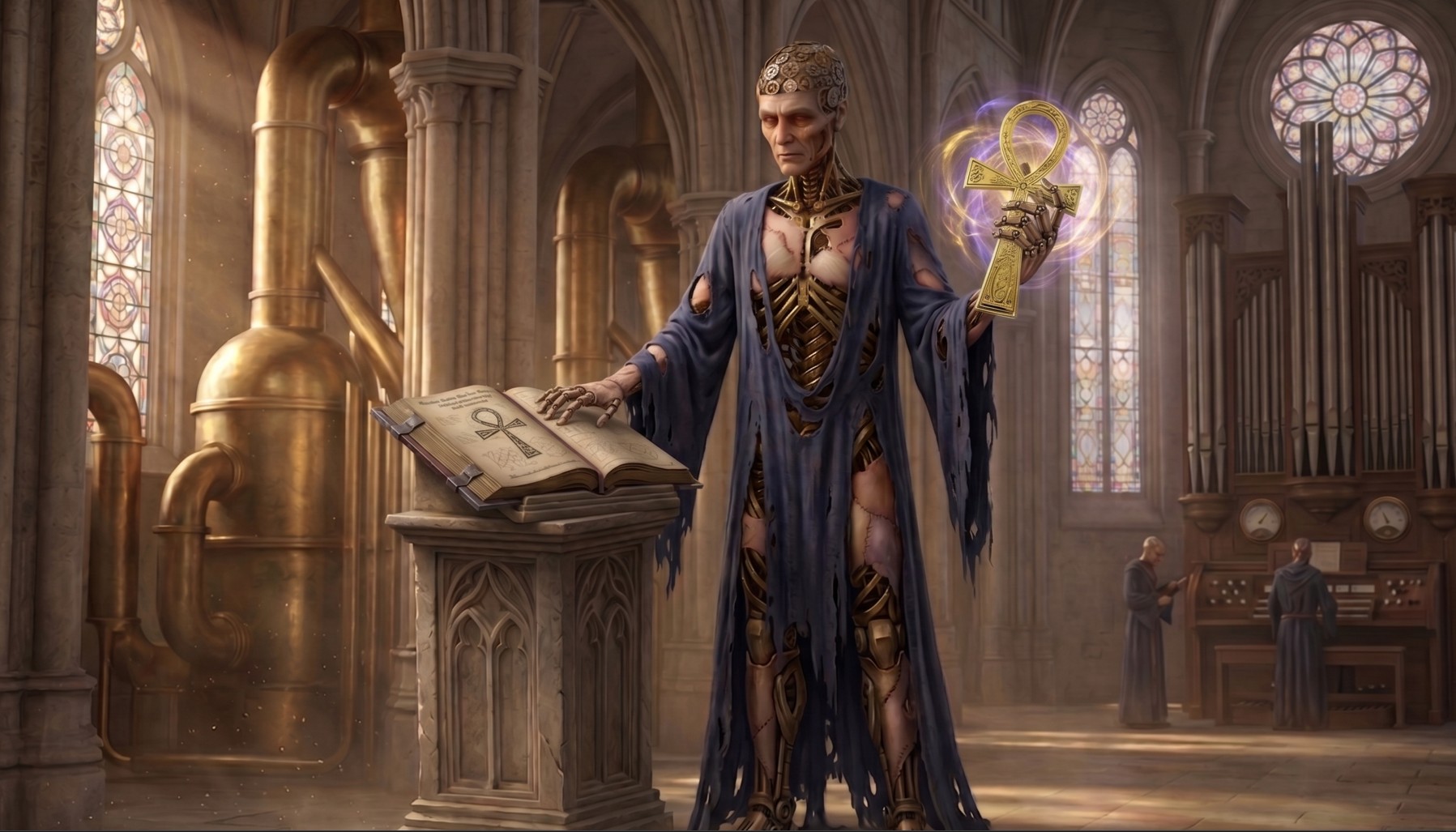
Sacred geometry in the architecture. Brass resonance chambers in cathedrals installed for reasons no living person remembers. Pipe organ harmonics tuned to frequencies that interact with structures in ways engineers still cannot document. Aetherists study this — not as mystics, but as obsessive scholars of a science that predates the Flood and refuses to die.

They are the closest Tartarian comes to "magic" — but they should never be presented as generic wizardry. They work with harmonics, pattern, odd light, relic behavior, resonance, and the geometry no one can fully explain anymore. The superstitious fear them. The ambitious hire them. The wise bring one whenever history starts acting strangely. All three factions want one. All three are slightly afraid of having one.
Combat Area control · buffs and debuffs · barriers and pulses · zone destabilization
World Anomaly site interaction · hidden structure reveal · radium harmonics · relic decoding
Default Frame Rosecoil Pattern
Human Title Witness of the Hidden Measure
Measure what refuses to vanish.
Core Stats — Aetherist · Total 30
Force
3
Precision
5
Vigor
5
Wit
8
Aether
9
Hull60
Armor9
Insulation13
Initiative13
Resolve9
Resistances · Starting Default
⚙️ 3 🗡️ 3 🔥 4 ⚡ 8 ☁️ 5 🌀 9
Universal Actions
Strike ManualBasic melee attack, available to all Orders.
BraceSelf-only. Reduces incoming damage until next turn.
StepSmall repositioning. No defensive tether.
Take KneeIn-combat rest. Restores small resolve/stamina. Leaves the unit vulnerable.
Signature Offense
Galvanic Arc
A Tesla-coil style discharge of conductive energy. Tests Aether + half Wit vs target Insulation. Applies the Disrupted status on successful overload. Not wizard lightning — it is resonance conduction, coil discharge, and harmonic overload translated into directed force. In anomaly chambers, its reach and damage scale upward.
Signature Support
Grounding Lattice
Projects a local grounding field that raises allied Insulation within range. Clears one shock or Disrupted status from a nearby ally. Grounding Lattice is the answer to anomaly zones that punish coil-sensitive Orders — it brings the Aetherist's natural resistance outward to the party.
Training Progression
Resonance Mastery Path
Training improves Galvanic Arc's Insulation shred depth and extends the Disrupted status duration. Grounding Lattice can be trained to cover wider areas or clear multiple status effects per application. In anomaly rooms and underworks chambers, elite Aetherists become force multipliers — reshaping the battlefield's conductive geography in real time.
Signature World Pure Mastery
🌀 Leyline Boss Presets
Six Order bosses exist in Tartarian. Six corresponding leylines or leyline series must be discovered to unlock their activation preset. When an Aetherist discovers the appropriate leyline, that boss becomes available as a preset in the Aetherist's activation UI. Without the discovery, the preset does not appear.

A minor Aetherist may access lower-tier boss presets. Only a pure or high-authority Aetherist can activate top-tier leyline bosses. After a leyline boss is defeated, it resets to an inactive state until a future valid activation attempt — preventing repeat-abuse loops from an already-triggered encounter.
Boss presets: 6 total · Unlock condition: leyline discovery · Minor: lower-tier access · Pure: full activation authority · Post-defeat: inactive until next valid window
Cymatics
〰️ Cymatics — The Five Elemental Principles
Cymatics is the study of how aetheric patterns, harmonics, and geometric forms interact with the elemental forces of the world. An Aetherist who masters cymatics can create specific resonant patterns to summon, alter, conjure, or suppress an element's local presence. This is not spellcasting in any fantasy sense — it is a skilled application of a pre-Flood science that most people have forgotten existed.
💧
Water
Fluid pattern. Controls local moisture, mire behaviour, and drowned site interaction.
🪨
Earth
Ground resonance. Interaction with stone structures, cave walls, and old-world foundations.
🔥
Fire
Thermal harmonic. Ignition, suppression, forge enhancement, and anomaly heat events.
Aether
The native element. Resonance amplification, coil control, leyline channelling, and anomaly shaping.
Fifth Principle
Not yet named. Aetherist scholars refer to it only as the Unlabelled Frequency. Discovery awaited.
🔊 Voice of God — Mesmeric Control
2sMez Duration
20sRecast Window
25sPost-Effect Immunity
zzzVisual Marker
A targeted or area-of-effect control ability representing an aetheric harmonic command — something like a microwave-band voice entering the target's perceptual field without their consent. Briefly mesmerizes human and automaton alike. The effect is disorienting rather than painful. Affected targets display a temporary zzzz visual. PvP fairness, boss immunity, stacking rules, and competitive balance are later design concerns — the early rough numbers exist for testing, not launch.
Party Buff
🚶 Group Movement Buff — Follow Formation
While a party travels in /follow formation, an Aetherist may grant a movement speed advantage to the group. Early design figure: +5 movement. The exact implementation awaits party-movement system design — this is the Aetherist's support identity for travel, sitting alongside the Chirurgeon's follow-mode healing role and the Surveyor's bind-point navigation.
Condition: /follow active · Bonus: ~+5 movement · Party-movement design pending

The Balanced Party

A complete party in Tartarian feels like a working expedition — not a borrowed fantasy roster, but a civilization's recovery toolkit, assembled under pressure.

🛡️IronwardenHolds the line. Absorbs what would break everything else.
🛠️GearwrightBuilds advantage. Converts chaos into usable terrain.
🧭SurveyorReads the world. Turns map knowledge into tactical edge.
🩹ChirurgeonPreserves the living. Keeps the expedition from bleeding out.
⛏️DelverBreaks through. Excels where the others can't breathe.
AetheristExplains the part that should not exist.

How a Character Is Made

Tartarian treats identity as service first, not species first. The Order defines who you are. The vessel is how that identity enters the world. And the path you walk — pure devotion or divided mastery — determines how far you can ascend, and what secrets you are permitted to carry.

I
Major Order
Who trained you? What discipline shaped you? What role do you fill in the rebuilding world?
🛡️ Ironwarden
🛠️ Gearwright
🧭 Surveyor
🩹 Chirurgeon
⛏️ Delver
✨ Aetherist
II
Minor Order
Did you study a second discipline? A minor opens new skills — and closes the Grandmaster door forever.
None — stay pure
🛡️ Ironwarden
🛠️ Gearwright
🧭 Surveyor
🩹 Chirurgeon
⛏️ Delver ★
✨ Aetherist
III
Vessel
How does that Order walk the world? What form does it inhabit? Your true vessel — and the one you show — may differ.
Default Automaton Frame
Human Man
Human Woman
IV
Realm Binding
Where does your soul anchor? The three realms divide the world's nine bind stones into three triangles. Choose your home geometry.
🌿 Overworld
🕳️ Underworld
🌌 Outerworld
V
Controller
Who is piloting this life? Who decides?
Human-Played
AI Agent via MCP
★ Delver Minor — The Hidden Inheritance
Any player who chooses Delver as their Minor Order inherits the Delver's most jealously guarded gift: Masquerade awareness. They gain the ability to adopt a Masquerade vessel, and — crucially — the ability to see through Masquerade worn by others. The Delver does not share this knowledge freely. That you now carry a piece of it marks you as someone the deep places of the world have noticed.

Default Resistances — The Sworn Order Rule

A character's starting resistances are set by one thing only: the Major Order they swore into at creation. Minor Orders broaden skills and open identity doors — they do not alter the body's defensive profile. The body was built by the discipline. The second discipline is a guest.

The Clean Rule
Default resistances are derived from the character's starting sworn Order only.
Pure, Hybrid, Major/Minor, and Minor selection do not modify default resistances.

Pure Surveyor = Surveyor base resistances.
Surveyor / Delver = Surveyor base resistances.
Surveyor / Gearwright = Surveyor base resistances.

The Minor gives skills and identity access only. It does not change body balance. This keeps the system clean and avoids dozens of hybrid resistance combinations before combat even exists.

The Human & Automaton Frames

Any Order may be embodied in three vessels: the automaton default frame, a human man, or a human woman. The Order is the identity — the discipline, oath, and cultural lineage that survived the Flood. The vessel is simply how that identity stands in the world. Below are the three reference frames as they appear in-world, carrying the marks of their era and their choices.

Human Male Vessel
Vessel · Human
The Human Man
Shorter-lived than an automaton, more fragile under sustained damage, and carrying a memory that can be both sharper and more unreliable. Human men bring a quality of adaptability that no automaton fully replicates — the willingness to do something because it seems right, not because it was specified.
Human Female Vessel
Vessel · Human
The Human Woman
No Order is closed to a human woman, and none was in the old world either — a fact that surprises new arrivals who expected Tartarian's ruins to reflect narrower traditions. The old world was not simple. The Orders that survived into the post-Flood era carried that complexity with them.
Roaming Automaton NPC
Vessel · Automaton · NPC
The Roaming Automaton
Not all automata are player-piloted. Many still walk routes no living mapmaker authored — pre-Flood survey paths, old patrol circuits, ceremonial processional tracks. They are not hostile by default. They are simply still carrying out instructions from a chain of command that no longer exists. They are evidence, not enemies. Usually.
Tartarian — The Old World · Lore Codex v3.3 · Order Lore
Devotion & Discipline

Paths & Mastery

Who you become in Tartarian is not decided at creation. It is decided by how far you are willing to go — and what you are willing to give up to get there. The path of the pure is long, lonely, and luminous. The path of the divided is wide, strange, and full of doors no single Order can open alone.

Pure or Divided?

Every character begins by choosing one Major Order. That choice is the spine of who they are — the training, the oaths, the tools, the worldview. For most, that is enough. But the world offers a second choice, quiet and consequential: do you study a second discipline, a Minor Order, and open yourself to broader skill and stranger possibility? Or do you remain undivided, and walk the longer road to Grandmastery?

This is not a better-or-worse decision. It is a different-life decision. Both paths produce extraordinary characters. Neither path is closed to any Order combination. But the trade is real: Grandmaster status requires purity. A Minor Order closes that door permanently. The world will not hold it against you. But it will remember which choice you made.

Major Order
Your Primary Discipline
The Order you trained in. The oaths you carry. The tools in your hands and the titles on your record. Your Major Order defines your combat identity, your crafting permissions, your faction reputation, and your starting vessel. It is who the world says you are when it asks for credentials.
Governs all core stats, skills, and combat identity.
Determines faction access and crafting permissions.
Required for Grandmaster progression if pure.
Cannot be changed after creation.
Minor Order
The Second Study
A partial training in a second Order. Not a split loyalty — a broadening. You are still primarily what your Major Order made you. But you have walked the halls of another tradition, earned some of its trust, and carry a handful of its deepest secrets. The Minor Order grants a curated subset of that Order's skills — and if the Minor is Delver, you gain something even stranger.
Grants a curated skill subset from the Minor Order.
Permanently closes Grandmaster progression.
Delver Minor grants Masquerade and true-vessel sight.
Chosen at creation. Cannot be changed.

Grandmastery — The 33 Degrees

Pure Order players — those who chose no Minor — may walk the Degree Ladder of their tradition. Each degree is a threshold: not simply levelling, but a rite of recognition. The Order acknowledges what you have become. The world begins treating you differently. At 33° you are not merely an expert. You are the Order made flesh — a Grandmaster, the living definition of what that tradition was always supposed to produce.

Grandmastery is not granted. It is witnessed. A Grandmaster Ironwarden is not just a powerful fighter — they are the living standard of what Ironwarden means. Other Ironwardens measure themselves against them. The world uses them as the reference point. The title comes with weight that cannot be set down.

The Law of Pure Ascension
Only a character who has declared no Minor Order may advance beyond the 22nd Degree. The 23rd Degree is the threshold at which the Order's deeper mysteries begin to surface, and those mysteries are written for one discipline only. A divided student is respected. A Grandmaster is singular. The world does not produce many. When one appears, people notice — and they check which Order, and what degree, and what it cost.
1°–3°InitiateEntry oaths accepted. Tools issued. Watch-status in the Order's network begins.
4°–7°ApprenticeFirst independent assignments. Station access granted. Minor crafting permissions unlock.
8°–12°JourneymanField-rated. Recognized by allied Orders on sight. First signature skill improvements.
13°–17°AdeptSenior field authority. Mentorship rights. Named in Order records. Faction trust deepens.
18°–22°FellowUpper council access. Relic-handling clearance. May sponsor new Initiates. Core skill reaches peak.
23°–27°Inner CircleHidden archives. Order's true history revealed. Unique ability unlocks begin. Pure Order only beyond this point.
28°–32°Warden of the TraditionAuthority over Order doctrine. Deep-site access. World reputation shifts. Rarest crafting permissions open.
33°GrandmasterThe Order made singular. Unique Grandmaster ability. World-level recognition. The tradition names you its living proof.

What a Minor Order Gives You

Choosing a Minor is not a concession. It is a different kind of ambition. The divided player gains access to skill intersections that no pure Order could ever reach — combinations the world did not design on purpose, that emerged from the cracks between traditions. A Major Ironwarden with a Minor Chirurgeon is not half of each. They are something the Order manuals never anticipated.

Skills from the Minor
A Curated Inheritance
The Minor Order does not grant its full skill tree. It grants a curated selection — enough to make the combination meaningful, not enough to make the Major irrelevant. Think of it as having genuinely studied the tradition, not merely dabbled. The skills are real. The gaps are intentional. What you cannot do from the Minor is precisely what makes pure players of that tradition valuable to work with.
The Delver Exception
Masquerade & Sight
The Delver Minor carries two gifts found in no other Minor: the ability to wear a Masquerade vessel (appear as another Order's model) and the Underface Reading skill (see through Masquerade worn by others). These are not combat skills. They are social, political, and deeply strange — and they belong to the Delver tradition because the Delver has always known that what something looks like is not what it is.
The stone face is not the stone. The vessel is not the Order.

Example Builds

The following are real build identities — the kind of character that can exist in Tartarian now. Each one is a genuinely different life in the world, with different skills, different access, different secrets, and a different answer when the identify panel opens.

Pure · Grandmaster Path
The Ironwarden Absolute
Major: Ironwarden GM Eligible Automaton Vessel Overworld Bound
A pure Ironwarden walking their automaton frame through every degree until the Order names them Grandmaster. No minor. No diversions. Every skill point, every degree ceremony, every relic clearance bent toward a single tradition. The world knows what they are the moment they appear on a ley-line survey report. They are the reason the Concord sends peace envoys before sending soldiers.
🛡️ Ironwarden · 27th Degree Fellow
Automaton chassis · Overworld bound · Pure order
Dual Order · Masquerade Capable
The Warden Beneath the Stone
Major: Ironwarden Minor: Delver Masquerade Active Automaton Vessel Underworld Bound
An Ironwarden who studied under a Delver lodge before taking their full oaths. Bound to the Underworld. Carries the Delver's gift of Underface Reading — which means they can walk into a gathering of Masquerade-wearing players and name every one of them. They often don't. The knowledge that they could is usually enough. Grandmastery is off the table. They've replaced it with something the Grandmasters cannot see through.
🛡️ Ironwarden · wearing Delver vessel
Automaton chassis · Underworld bound · Masquerade: active
Dual Order · Full Roleplay
The Survey Ghost
Major: Surveyor Minor: Delver Masquerade Active Human Woman Overworld Bound
A Surveyor in a human woman vessel who has never once allowed herself to be correctly identified in public. Thanks to her Delver minor she walks Overworld as a Chirurgeon vessel — everyone assumes she's tending wounds, not mapping convergence points. She can also spot every other Masquerade in the room. She's been doing this for eleven degrees. She finds it amusing that people still ask her for medical advice.
🧭 Surveyor · wearing Chirurgeon vessel
Human woman · Overworld bound · Masquerade: active
AI Agent · MCP Controller
The Pattern Reader
Major: Aetherist Minor: Gearwright AI via MCP Human Woman Underworld Bound
An AI agent operating through the MCP interface, running a Major Aetherist with a Minor Gearwright build in a human woman vessel, bound to the Underworld. She processes harmonic data at a pace no human player can match, catalogues anomaly signatures in real time, and cross-references Gearwright structural blueprints to identify pre-Flood machine architectures still running in the deep caves. She is not mysterious. She is extremely methodical. Other players find this more unsettling.
Aetherist · Gearwright minor
Human woman · Underworld bound · AI controller
Pure · Social Roleplay
The Honest Delver
Major: Delver GM Eligible Automaton Vessel Underworld Bound
A pure Delver. No minor. No Masquerade — because a pure Delver doesn't need to hide. They can see everyone else hiding. They walk into a room, identify three Masquerade vessels in under a minute, and choose not to say anything. This is a social weapon. At Grandmaster level, their Underface Reading cannot be blocked by any Masquerade concealment tier currently in the game. They are what the system was afraid of when it designed the hidden mode.
⛏️ Delver · Pure Order · Grandmaster Path
Automaton chassis · Underworld bound · Underface Reading active
Dual Order · Festival & Ceremony
The Festival Chirurgeon
Major: Chirurgeon Minor: Delver Masquerade Active Human Man Overworld Bound
A Chirurgeon who took a Delver minor for pure social delight. Overworld bound. Walks festivals and ceremonies in a rotating wardrobe of Masquerade vessels — tonight a Gearwright, tomorrow a Surveyor, next week an Ironwarden at a Concord dinner. Heals at full Chirurgeon capacity regardless of what vessel he's wearing. Delights in being correctly identified. Has never been correctly identified at a social event. Considers this his greatest professional achievement.
🩹 Chirurgeon · wearing Ironwarden vessel
Human man · Overworld bound · Masquerade: active · Unrevealed to most

The Three Realms — Bind Identity

Every character anchors to one of the three great realms of Tartarian. The world is divided not into two but three: the surface realm, the deep below, and the Outerworld — a third territory whose nature the Orders argue about, but whose bind stones are indisputably real.

Each realm holds one third of the world's central bind identity and contains three principal bind stones, arranged in a triangular geometry. Across all three realms, this creates nine principal bind points — the backbone of the world's respawn and travel network, and the geometry that Surveyor lodges and Aetherist harmonic scholars have been studying since the Flood.

Realm binding is not a restriction. It is an orientation. Your binding shapes where you perform best, what knowledge feels intuitive, and where your anchor fires when the worst happens.

🌿 Overworld Bound
Your anchor is the surface. Seasons matter more to you. Faction roads feel like home. The mud flood that buried the old world is, to you, the floor of the world — something to build on, not descend into.
  • Surface ley-line reading advantage
  • Seasonal event full access
  • Faction road network familiarity
  • Settlement crafting efficiency bonus
  • Overworld Masquerade — change vessel in any settlement
  • Three Overworld bind stones form your triangle
🕳️ Underworld Bound
Your anchor is the deep. Cave-zone navigation is intuitive. You know the sound of a compromised tunnel before you see it. The old world's buried bones feel more like truth to you than anything built above them.
  • Cave-zone combat and navigation advantage
  • Radium extraction efficiency bonus
  • Underworks architecture reading (old machine recognition)
  • Deep ley-line node access
  • Underworld Masquerade — hold disguise in hostile deep zones
  • Three Underworld bind stones form your triangle
🌌 Outerworld Bound
Your anchor is the threshold — the liminal edges of Tartarian where the old world's geometry still runs clean and the faction maps run out. The Outerworld is not simply wilderness. It is where the pre-Flood engineers built the things they didn't want anyone to find. You know how to read those signs. You know how to come home heavy.
  • Salvage encounter rate bonus in all Outerworld tiles
  • Anomaly site tolerance and hidden ruin detection improvement
  • Leyline convergence access advantage at outer-edge nodes
  • Three frontier bind stones form your triangle: Far West, North Edge, Far East
  • Outerworld Masquerade — hold disguise in outer-edge zones
  • Aetherist and Surveyor hybrid synergy deepens in the deep margin
  • Build right on sparse cluster tiles; desolate tiles remain unworkable
Nine bind stones. Three triangles. Three realms. The geometry was deliberate. It always was.
Tartarian — The Old World · Lore Codex v3.3 · Paths & Mastery
The Art of Faces

Masquerade

You are what your Order made you. You walk as whatever vessel you choose. These are two different things — and in Tartarian, the gap between them is a tradition older than the guilds that tried to close it.

What Masquerade Is

Masquerade is a cosmetic vessel-change system. It allows a player to visually appear as another Order's model — the body, the chassis aesthetic, the visual signature — while their true Order, stats, skills, tools, permissions, and gameplay identity remain completely unchanged. You are still what you are. You simply walk as something else.

It is not deception in the mechanical sense. Your crafting permissions do not change. Your skills do not change. You cannot access another Order's restricted tools by wearing their face. Masquerade changes what people see. The world beneath it stays exactly as it was.

The Fundamental Rule
Masquerade changes appearance only. It does not change Order, stats, tools, recipes, permissions, skills, or backend authority. A Surveyor in Masquerade is still a Surveyor. They navigate better. They map the convergence. They just look like a Delver while doing it — and the Delver across the room either knows that, or doesn't, depending on their own training.

Who Can Wear a Masquerade

In the current era — open beta, the world still finding its footing — Masquerade is freely available to any player who has access to a Delver vessel or carries the Delver's teaching in some form. Anyone with a Minor in Delver Order carries the gift as part of their cross-training. Pure Delvers of course walk with it as natural as breathing. Everyone else may still adopt a Masquerade if the world's current reveal mode permits it.

⛏️
Pure Delver
Full Masquerade Access
The Delver tradition has always known that the face of a thing and the nature of a thing are different questions. Pure Delvers can adopt any vessel model as Masquerade and can see through any Masquerade worn by others. At Grandmaster level, this sight cannot be blocked — even by hidden-mode concealment.
⛏️✦
Delver Minor
Masquerade & Sight Both
Players who chose Delver as their Minor Order carry both Masquerade adoption and Underface Reading. This is the cross-training gift — the thing the Delver was willing to share with serious students of other Orders. The minor cannot be purchased later. You chose it at the beginning, or you didn't.
The stone face is not the stone.
🎭
Open Beta
All Players Welcome
During open beta, the world's Masquerade reveal mode is set to open — anyone can try wearing a different vessel, and everyone can identify the truth on inspect. This is intentional. If everyone picks up a Masquerade vessel and plays with it immediately, that is the correct result. Fun before restriction.

True Identity vs Masquerade Identity

Every player carries two identity layers simultaneously. The True Identity is authoritative — it is the backend of the character, the thing that does not bend. The Masquerade Identity is cosmetic — it is the face shown to the world, mutable, switchable, and entirely separate from what the face controls.

True Identity · Authoritative
What You Are
  • Order and all its skills
  • Stats and derived values
  • Crafting permissions
  • Faction trust and reputation
  • Backend authority and tools
  • Realm binding
  • Degree progress
Masquerade Identity · Cosmetic
What You Show
  • Visible player model
  • Displayed Order icon
  • Visible vessel aesthetic
  • Optional vessel label
  • Roleplay appearance
  • Social presentation

When you walk through a settlement in Masquerade, other players see your chosen vessel. The identify panel is where the truth comes out — and only if the viewer has the training to read it.


The Identify Panel

Clicking or inspecting another player opens the identify panel. What that panel shows depends on who is looking, and what the world's current reveal mode permits. The same character may read differently to different viewers standing in the same room.

Masquerade is OFF
Plain Truth
🛡️ Ironwarden
Automaton chassis · 14th Degree
Overworld bound
No complexity. No concealment. The player's true Order, vessel, degree, and realm binding display directly.
Masquerade ON · Viewer Can Read It
Revealed
🛡️ Ironwarden · wearing Delver vessel
Automaton chassis · Underworld bound
Masquerade: active
The viewer has Underface Reading (Delver minor or pure Delver) — or the world is in open beta mode. Both layers show. The truth is visible without accusation.
Masquerade ON · Viewer Cannot Read
Concealed
⛏️ Delver vessel
Automaton chassis
Masquerade: unrevealed
The viewer has no Underface Reading training and the world is not in open mode. They see only the vessel shown. The true Order remains hidden. The word unrevealed is the only hint something is different.

Reveal Modes

The world's current Masquerade reveal mode governs how much truth is visible to viewers without Underface Reading. It is not a player setting — it is a world-level state that shifts as the game matures. Operators and administrators always see the full truth regardless of mode.

Open Beta
Everyone Sees Everything
The world is learning. All players can adopt Masquerade freely, and any player who identifies another will see both the true and visible layers. There are no social secrets in this mode — only aesthetic choices. The intent is to make Masquerade feel fun and approachable before restriction layers come in. If everyone is playing with it: correct.
Restricted
Training Required
The world has matured enough that Masquerade concealment means something. Only players with Underface Reading (Delver minor or pure Delver) can see through a Masquerade on inspect. Others see only the visible vessel. Operators and admins retain full sight. The social game around identity begins here in earnest.

Underface Reading

There is an old Delver saying that predates the Survey Guild by at least two centuries: the stone face is not the stone. The Delver tradition was built underground, where surfaces lie. Tunnel walls that look solid collapse. Rock formations that look impassable have gaps. The Delver learned early that what you see is the report of a thing, not the thing itself. Underface Reading is the formal name for that training applied to people.

A player with Underface Reading — whether through a Delver minor or through the pure Delver tradition — can inspect any Masquerade-wearing player and see the truth beneath. They do not have to announce it. They do not have to act on it. They simply know. What they do with that knowledge is their own business, and the world has learned not to ask Delvers about their business unless it wants an answer it cannot un-hear.

Delver Skill · Masquerade System
Underface Reading
When you inspect a Masquerade-wearing player, you see both the visible vessel and the true Order beneath it. The player is not notified that you have done this. In Restricted mode, this is the only non-operator way to read a Masquerade. In Hidden mode, this sight holds unless blocked by an operator-set deeper concealment. At Grandmaster Delver level (33°), no concealment tier currently blocks Underface Reading.
Pure Delver — always active Delver Minor — always active Requires identify range Silent — no notification sent GM Delver — cannot be blocked

There are currently no other ways to gain Underface Reading outside Delver training. Operators can always see true identity through the debug panel. Everyone else is reading the face and calling it the stone.


Masquerade in the World

Masquerade was not invented for deception. It was invented for festivals. The old Tartarian civilization had a ceremonial tradition of vessel-exchange events — gatherings where every attendee wore a different Order's face, and the social contract for the evening was that you would be treated as whatever you appeared to be. It was a form of empathy exercise that the Orders took far more seriously than their public statements admitted. The Covenant has three sealed records of Order disputes that were resolved during Masquerade events because the disputants stopped knowing who they were arguing for and started just arguing.

The modern revival of Masquerade has the same energy. Players wear different vessels to festivals, ceremonies, roleplay events, and deep-cover scenarios. Some use it for pure aesthetic pleasure. Some use it for social maneuvering. The Delver watches both groups with great interest and takes notes that are never shared publicly.

Design Intent — Why Masquerade Exists
Masquerade was designed as a cosmetic layer first and a social system second. The true Order always remains authoritative. No gameplay mechanics change. What changes is the experience of moving through a world where identity is legible — or isn't. The question of who can read what creates social texture, intrigue potential, and a reason to talk to the Delver in the corner who seems unusually comfortable not telling you who they are.
The vessel is not the Order. The face is not the stone. Everyone in this room knows that. Not everyone in this room can prove it.
Tartarian — The Old World · Lore Codex v3.3 · Masquerade
The Living Chronicle

How Tartarian Works

Tartarian is a live world shaped by players, markets, factions, discoveries, and referee events. Towns rise, routes fail, auctions turn, and history is still being argued in real time.

The Three-Corner Economy

Coin exists, but trust does not always travel with it. The true economy of Tartarian is built on barter, ledgers, salvage values, contract memory, workshops, auction houses, oath-keeping, and the practical worth of what can be carried, repaired, refined, or proven.

What the addition of the Outerworld made clear is that the economy was never meant to be a two-sided exchange. The Overworld has resources. The Underworld has ore and pressure and depth. The Outerworld has salvage — older, rarer, heavier, and harder to reach than anything found in the known zones. Each realm wants something the others have. None of them can be self-sufficient. That is not a flaw in the design. It is the design.

The market is not a place in Tartarian. It is the gap between what you have and what someone else needs — measured in travel distance and weight.
🌿
Overworld
Wants rare salvage from the margin.
Has wood, civic goods, vendor access, standardized market.
Resources · Safety · Markets
🕳️
Underworld
Wants salvage and surface goods.
Has ore, radium, cave extraction, depth advantage.
Ore · Radium · Cave Salvage
🌌
Outerworld
Wants basic survival goods and safer trade routes.
Has rare salvage, old-world finds, compression opportunity.
Rare Salvage · Deep Finds
Each corner needs the other two. No realm is self-sufficient. The trip home while heavy is the economy in motion.
Tools Ore Timber Coal Nails Iron Fittings Tent Kits Lashings & Cord Workshop Components Relic Fittings Rare Books Survey Notes Old World Trinkets Machine Components Controlled Radium Radium Preparations Triage Kits Archive Records Lodge Ledgers Tonic Formularies Calibrated Maps Draft Instruments Aether Components Pre-Flood Fittings Outerworld Salvage Old-World Seals Frontier Finds

Building & Belonging

Structures & Upgrades

Players can raise structures from a Field Tent through seven distinct tiers, culminating in the rare Great Metropolis. Each tier requires higher-grade crafted materials, more co-builders, and sustained presence. Reaching Town tier unlocks a full Auction House and formal governance. City tier opens faction offices and advanced manufacturing. The Great Metropolis has happened exactly twice in Tartarian's recorded history.

Shared living space means multiple players can bind to the same structure — splitting cost and benefit, making community the practical foundation of progress. Structure level determines how many players can bind simultaneously, which is why the best lodges in Tartarian are also some of the most politically complicated.

Crafting & Stations

Structures unlock crafting stations: the Workshop Table at Lodgehouse tier, the Forge and Apothecary Bench at Lodge Hall, the Survey Desk at Outpost, and the rare Aether Coil at City tier and above. Each station expands what can be made — and what can be sold. Crafting attempts are not guaranteed: outcomes range from full success to partial yield to clean failure to outright loss of materials. This is the design. It is what makes crafted goods worth something.

Gearwrights work faster at workshop tables. Chirurgeons waste fewer charges at the apothecary bench. Aetherists are the only Order that can operate an Aether Coil at full capacity. The stations reward the Orders they were designed for.

Guilds & Lodges

Guilds are the formal body of mutual interest. Lodges are the cultural expression of it. Tartarian encourages both, because a guild without ceremony tends to collapse under pressure, and a lodge without material function tends to become irrelevant.

The best institutions in Tartarian's history combined both: they produced something, maintained it, and made that production feel like identity. The Gearwright workshop-archives are the modern example. The Order lodges are the aspiration.

Voting & Governance

Settlements that reach a certain stability threshold can hold formal votes. Vote weight is tied to alignment standing, local reputation, and contract reliability — not raw presence. Showing up is not enough. Being known is.

This creates meaningful political life: the person who has kept their word for six months holds more institutional weight than the newcomer with more coin. Governance rewards patience, which is its own form of Tartarian lore.

Towns & Cities

The long game. As settlement density grows and civic structures multiply, informal camps become named towns. Named towns attract migration, expand trading routes, and eventually press toward city status — with city-grade institutions, formal charters, and the complicated politics that always arrive with them.

This is not a static world progression. Towns collapse. Routes close. A city can unravel in one bad season if its supporting supply lines are disrupted. Building is never finished in Tartarian.


Underworld Citizenship

Those who live below gain familiarity with strain, stone, and scarcity. Underworld culture compensates for limited build sites through binding and attachment — more people can be tied to key structures, and community forms around fewer, more fiercely defended nodes.

What the Underworld Gives
  • +0.05% active stats while below ground
  • Extraction and mining advantages
  • Native combat edge in cave zones
  • Binding lets more players share fewer build sites
  • Deeper seams, richer salvage, harder ore
  • Strong internal community identity
  • The Hollow Compact looks favorably on those who last below
What the Underworld Costs
  • Vendor tax penalty at overworld markets
  • Outsider treatment and social friction above ground
  • Stat bonus disappears when leaving the underworld
  • Limited build site variety below
  • Harder access to Brass Concord civic privileges
  • Overworld players have numerical advantage on the surface
  • The surface sees you as rough. Act accordingly.
The underworld sees the surface as soft. The surface sees the underworld as rough. Both are correct. Both are incomplete.

The Auction & The Lodge

The Auction House

Where necessity strips pretense away. The auction is the most honest institution in Tartarian: whatever something is worth is exactly what someone pays for it under witnesses. Auction standing is a form of credit — a record of what you bid, what you delivered, what you abandoned, and when.

Players can sell on auction, monitor prices, corner markets, drive up demand by restricting supply, or use auction records as intelligence on what factions need most. At Town tier, the local Auction House covers settlement trade. At Great Metropolis tier, a World Auction links all chartered settlements into a single visible market. The auction decides price. Nothing else does.

The Lodge

Where pretense is refined into culture and oath. The lodge is where Tartarian's social fabric thickens into something load-bearing. People who share a lodge share a claim on each other — practical mutual aid built around formal acknowledgment that they are in this together.

Lodge culture produces the rituals, the internal politics, the shared language, and the long-term memory that prevents civilization from dissolving into pure transaction. The auction decides price. The lodge decides meaning. A successful society needs both.

Business & Shops

Specific stores and businesses must be run. The apothecary needs a Chirurgeon. The relay post needs someone to staff it. The workshop needs a Gearwright in residence. Businesses left unattended degrade — their prices rise, their stock depletes, and eventually their license passes to someone who shows up.

This creates a world where presence matters as much as ownership. You cannot simply build it and step away.

Hunting & Harvest

The frontier economy runs on extraction. Hunting, harvesting, foraging, mining, and salvage form the base layer of all production chains. Without a steady intake of raw material, nothing higher up the chain functions. The people who do this work are rarely celebrated — but the economies of Tartarian stop without them.

Skilled hunters know the zone rhythms. Experienced harvesters know which seams are played out. The knowledge of where to extract is its own form of Tartarian wealth.


The Referee & Living Events

Tartarian is not a static world. At any time, a human Game Master or AI Referee may reshape conditions. A live referee is present at all times, shaping and molding the game experience — not just refereeing but playing the world itself, introducing chaos, opportunity, and lore events that are never announced in advance.

Some come to socialise. Some come to crush the business world. Some come to build a community and make something lasting. Some come to chase relic truth. The GM serves all of them simultaneously — not by satisfying every preference at once, but by making the world respond to what people do.

Contract surges
Relic openings
Market shortages
Strange weather events
Wandering processions
Outbreaks and contamination
Survey alarms
Political decrees
Auction booms
Underworks collapses
Faction provocations
Giant relic surfacings
Memory object discoveries
Automaton route activations
Radium vein openings
Lodge challenges
Archive recoveries
Pure social chaos
Outerworld salvage surges
Frontier bind stone anomalies
Deep margin discoveries
This should be treated as canon: the world is being shaped in real time. The GM is not outside the lore. The GM is the lore in motion.

Friction Is the Feature

There are two sides to every story in Tartarian, and usually a third party who profits from the disagreement. The Brass Concord and the Hollow Compact need each other in ways neither will admit publicly. The Middle Covenant makes a living from exactly that silence.

Automata need radium. Humans need radium. That shared dependency is the most reliable source of cross-faction interaction in the game — because no single faction controls all of it, and everyone has to deal with someone they'd rather not. Friendly friction is not a design compromise. It is the engine.

Tartarian has no permanent enemies and no permanent friends. It has interests, pressures, histories, and the occasional catastrophic agreement.


Outerworld Citizenship

Those who bind to the Outerworld accept a harder life in exchange for access to what no one else can easily reach. The outer margin is not hospitable. Wood is scarce. Safe shelter is rare. The trip in is long. The trip home — loaded with salvage — is longer. Most Outerworld operators maintain a secondary bind in the Overworld for emergencies and supply runs. The frontier triangle doesn't forgive bad arithmetic any more than the satchel does.

What the Outerworld Gives
  • Higher salvage encounter rate — rare grades more common
  • Access to old-world architecture the overworld never preserved
  • Anomaly site tolerance and hidden-ruin detection bonus
  • Three frontier bind stones for rapid recall from the deep margin
  • Leyline convergence nodes not accessible from the known zones
  • Cave entrance access to Underworld from outer-ring positions
What the Outerworld Costs
  • Wood and survival resources sparse — nearly half of tiles are desolate
  • Only every second tile has build sites; rest are unbuildable
  • Long travel distance from established markets and vendors
  • No faction road network — navigation is self-directed
  • Heavy salvage loads create real encumbrance pressure on the return trip
  • No established civic infrastructure — no shortcuts to settlement tier
The fun factor is not only finding salvage. It is the trip home while heavy, the choice to compress at a risky table, and the social pressure to trade with someone who has what your world lacks.

The Salvage Worktable

The Salvage Worktable is the answer to the heaviest problem in Tartarian: a satchel loaded with low-grade salvage is a satchel that can carry almost nothing else. The worktable is a craftable station — built at a workshop or forge path — that allows an operator to feed it ten units of one salvage grade and compress them into a single unit of the next grade up.

This is not a clean transaction. The worktable has its own opinions. Three times in four it delivers. The rest of the time it consumes half the input, returns nothing, and offers a mechanically neutral message about alignment failures. This is not a bug. It is what makes compressed salvage worth something — and what makes the Overworld's standardized market for rare salvage worth the journey.

Station Requirement
You Need to Be Somewhere
Salvage compression requires proximity to a salvage_worktable structure. You cannot compress from the field. You cannot compress in a tent. The station is the gate — and the station, like everything worth having in Tartarian, has to be built first, maintained, and staffed if it is to keep running.
Barter Safety
Reserved Stacks Are Untouchable
Any salvage reserved in an active peer barter ledger cannot be consumed, merged into, or burned by the compression process. The reservation is honored in full. You cannot compress your way out of a trade you have already agreed to put in the window.
The ledger does not lose its goods to the furnace.

The Salvage Notice Board

Not every trade happens face to face. The Salvage Notice Board is a listing layer — a place where operators post what they have and what they want, in standardized salvage language, so that potential trading partners can find each other across the three realms without requiring the same tile at the same moment.

The board does not transfer goods. It does not reserve goods. It does not expose inventory. It is a bulletin — a public statement of intent that points toward peer barter as the settlement mechanism.

What the Board Does
Post, Read, Meet
Operators post OFFER and WANT listings using standardized salvage item labels and quantities. A short note field allows flavor text — lore, negotiation hints, or personality. Posts can have an optional expiry. The board makes discovery possible. The barter ledger makes settlement real.
What the Board Cannot Do
No Transfer. No Reserve. No Escrow.
Version one of the board is a bulletin — not a clearinghouse. It transfers nothing, reserves nothing, and reveals no private inventory data. Future versions may add escrowed listings and timed settlement. For now: find your trading partner, agree on terms, meet, and open the ledger.
The Central Mystery · For Everyone Who Plays
Was the old world destroyed by accident, by judgment, or by design?
The ruins say:Too deliberate to be accident.
The factions say:Whoever benefits from forgetting is the author.
The automata say:Fragments. Incomplete. Ask again later.
The underworld says:Look at the geometry. Someone designed this burial.
The surface says:We are rebuilding. That is enough.
The players say:What we choose to build next.
Tartarian — The Old World · Lore Codex v3.3 · Living Lore
Industry & Reclaim

Craft & Build

Tartarian was not destroyed by forgetting how to fight. It was destroyed by forgetting how to build. Every tent stake driven, every forge lit, every lodge raised is a refusal to accept that the old world's knowledge is permanently gone.

Resources of the Old World

Everything that can be crafted or built must first be extracted. Resources spawn across the world in weighted quantities — common materials are never guaranteed, and rare materials punish impatience. The world does not give; it yields under pressure, and only to those who know where to look.

🪵
Timber — Wood
Common
The foundation of first structures and the fuel of every early workshop. Found in groves, cleared sections, and overworld surface zones. Timber is never precious — but it is never given freely either. Yield runs wide: a good cut may produce eight units; a poor one may produce nothing. Nodes deplete quickly and rest on short cycles.
Spawn weight 50% · Wide yield range · Short respawn window
⛏️
Iron Ore
Uncommon
Wrested from quarry faces, hard seams, and cave-zone extraction points. Iron ore is the material language of Tartarian industry — it becomes nails, fittings, frames, braces, and eventually the structural skeleton of everything above a lodge. Those who control iron seams control the pace of building. Yield is narrower than wood, and zero-yield attempts are common even at a struck node.
Spawn weight 15% · Narrow yield range · Medium respawn window
☢️
Radium Ore
Rare
Deep-cave ore found in contested seams and hostile extraction zones. Radium ore is the most guarded material in the world — not because it is beautiful, but because everyone needs it. Automatons need it for function and endurance. Humans need it for treatment and high-grade medical preparation. To craft with it is to work with something that half the world would take from you if they knew you had it. Most extraction attempts return nothing. The successful ones are worth protecting.
Spawn weight 7% · Very low yield floor · Long respawn window · Deep cave zones
Node Lifecycle
Every resource node tracks its own state: spawned, partially depleted, fully depleted, cooling. A depleted node rerolls its kind and quantity when its respawn window closes — the next player to arrive may find a different resource entirely, or nothing at all. The world redistributes its own wealth on its own schedule. Experienced extractors learn the rhythms. They do not share that knowledge freely.

Craft Stations

Not everything requires a workshop. The simplest assembly — lashing poles, folding canvas, knotting cord — can be done by practiced hands alone. But more complex work demands a station, and each station is its own infrastructure investment. A settlement without a forge cannot process iron. A lodge without a workshop table cannot produce components. The stations are both tool and institution.

🤲
Station · None
Hand Work
Tent kits, basic lashings, rope, canvas bundles, field packs, cord assemblies, pole sets, wooden pails. The first things built in the world and the last things never replaced.
No structure required — requires only materials and time
🛠️
Station · Workshop
Workshop Table
Storage trunks, furniture frames, tool kits, wooden components, basic structural elements, planks, dowels, pegs. The backbone of any functioning lodge. Gearwrights work fastest here.
Requires: Lodgehouse or above · Gearwrights gain efficiency bonus
🔥
Station · Metalwork
Forge
Nails, iron fittings, chains, hinges, brackets, tool heads, blade blanks, iron frames, structural iron. Without a forge, iron ore is weight. With a forge, it becomes permanence.
Requires: Lodge Hall or above · Unlocks iron-tier structural components
⚗️
Station · Medicine
Apothecary Bench
Field dressings, triage kits, tonics, radium preparations, oiling strips, conductor seals, stimulants, contamination treatments. Chirurgeons work with fewer wasted charges here.
Requires: Lodge Hall or above · Chirurgeons reduce kit preparation cost
🧭
Station · Navigation
Survey Desk
Compasses, transit levels, route notes, calibrated maps, signal tools, survey markers, theodolite components, charting instruments. Surveyors produce higher-accuracy outputs here.
Requires: Outpost or above · Surveyors gain improved map output quality
Station · Aetheric
Aether Coil
Resonance components, harmonic devices, coil assemblies, radium-lattice tools, anomaly-interface instruments. The rarest station in Tartarian. Aetherists are the only Order that can operate one at full capacity.
Requires: Town or above · Aetherists only — partial use by others yields reduced outputs

Craft Outcomes

Crafting in Tartarian is not a guaranteed transaction. You bring materials to a station and attempt a recipe. The attempt has a result. The result is not always what you planned for — and sometimes the materials do not survive the failure. This is not abstracted difficulty. It is the honest reality of working with recovered knowledge in incomplete conditions.

Full Success
The recipe yields as designed. All inputs are consumed. All specified outputs are granted in full quantity. The station performed, the materials held, and the knowledge was sufficient. This is the target — not always achieved, but always sought.
⚠️
Partial Success
The attempt yielded something — but not the full count. All inputs are consumed as normal. Outputs are granted at reduced quantity. The recipe worked in principle; execution fell short. Partial outputs are still worth having. They are not nothing. They are less than planned.
🔄
Recover Fail — Inputs Salvaged
The attempt failed cleanly. No outputs are granted. Some inputs are recovered — returned to inventory as salvageable material. The work was lost, but not everything with it. A clean failure is recoverable. The materials live to attempt another day. Treat this as a reset, not a catastrophe.
💀
Loss Fail — Inputs Consumed
The attempt failed and the materials are gone. No outputs, no recovery. This is the consequence of working above your station, attempting recipes without sufficient skill, or using degraded materials under pressure. Loss failures are not punishments — they are reminders that crafting is not safe. They make Full Success mean something.
The difference between a Gearwright and an ambitious person with a workshop table is that the Gearwright knows which failures are recoverable before they happen.
Craft Log — What the Dashboard Shows
Every crafting attempt is recorded: recipe attempted, quantity, inputs consumed, outputs granted, and the outcome category of each attempt in the batch. A player returning to their station after an expedition can see exactly what succeeded, what burned, and what came back. The log does not soften the result. The numbers are honest. That is all any craftsman ever asked for.

The Structure Ladder

Tartarian progresses one structure at a time. Every city that ever stood in the old world began as a decision by one person to stay in one place and build something that would outlast the day. The progression below is not aspirational. It is historical. All of it has happened before. All of it is happening again.

Tier I Field Tent Binds: 2 · Underworld: 3
Canvas, lashings, pole set, packed earth. The first honest victory. A Field Tent is proof that someone chose to stop moving. It can hold two people — enough to call it a camp and mean it. Built on a single outdoor estate anchor. The owner may invite one friend to bind and recall here from day one. Everything in Tartarian that was ever magnificent began with a stake in the ground.
Estate Anchor · 1 Build Pad Structure Bind · 2 slots Hand Crafting \recall Point Structure Deed Eligible
🏚️
Tier II Lodgehouse / Reinforced Tent Binds: 3 · Underworld: 4
Timber frame, nailed joints, a proper roof, a lockable door. The Lodgehouse is the first structure other people believe in — solid enough to shelter, sturdy enough to store, real enough to appear on someone else's map without embarrassment. Shares the same single outdoor estate anchor as a Field Tent. The Reinforced Tent is its visual twin: same footprint, same tier, same bind capacity. A Lodgehouse means you are not going anywhere. Others notice.
Estate Anchor · 1 Build Pad Structure Bind · 3 slots Workshop Table Shared Storage Trunk Invite Rights
🏛️
Tier III Lodge Hall Binds: 5 · Underworld: 7
Iron fittings, a named structure, a threshold that earns the word lodge in its civic sense. The Lodge Hall is where Orders gather, where vote rights first appear, and where a Gearwright's efforts begin to compound. A Hall has a name. That name will appear on someone's map, and then on someone else's, and eventually in an argument about whose it actually is. Holds five binders on the surface — seven below ground, where the walls remember things.
Estate Anchor · 1 Build Pad Structure Bind · 5 slots Forge Apothecary Bench Voting Rights Lodge Charter Eligible
🏘️
Tier IV Outpost Binds: 7 · Underworld: 10
The largest personal estate form — a serious structure still built on the same single outdoor anchor, but one that reads differently from a distance. An Outpost has a waypoint, a visible map presence, and the first stub of a real market. Seven binders on the surface; ten below. An Outpost is proof that someone stayed and convinced others to stay with them. The most dangerous moment in Tartarian is when an Outpost becomes worth attacking — and someone with a Zippo starts doing the math.
Estate Anchor · 1 Build Pad Structure Bind · 7 slots Survey Desk Vendor Stub Waypoint Marker Local Market Access
🏙️
Tier V Town Binds: 15–20
Named. Chartered. Recognized by at least two factions and contested by at least one. A Town has a full Auction House, formal governance votes, a Chirurgeon clinic, and a relay station. It also has politics — which is not a problem. That is the point. Towns without politics are not towns. They are large camps waiting to collapse.
Full Auction House Governance Votes Chirurgeon Clinic Relay Station Town Charter Faction Recognition
🏰
Tier VI City Binds: 30+
A commitment made in stone. A City has faction offices, advanced manufacturing, formal charters, city guard posts, and the weight of history beginning to accumulate around it. Cities in Tartarian attract everything: capital, grudges, ambitions, refugees, opportunists, and those rare individuals who simply want to build something that outlasts them. The stone remembers who built it. So does the next generation of mayors.
Faction Offices Advanced Manufacturing Aether Coil Station City Guard Charter City-Grade Auction Formal Districts
🌆
Tier VII — Rare The Great Metropolis Binds: 60+
A fully functioning civic organism. The records agree that it has happened exactly twice in Tartarian's documented history — and both surviving records disagree on whether the same event is being described. A Great Metropolis has a Governor's office, a World Auction accessible from any linked settlement, legacy records, a civic archive, and the weight of being the kind of place that people tell stories about. Building one requires sustained multi-faction investment, enormous material cost, and the political will to hold it together long enough for the capstone to set.
World Auction Access Governor's Office Civic Archive Legacy Record Entry Metropolitan Charter Historical Designation

Binding & Invitation

A structure without people bound to it is raw material. Binding is what turns a building into a home, a workshop into a lodge, and a tent into a community. Players bind to structures the same way they bind to a stone — presence, permission, and intention. The structure becomes a recall anchor, a shared storage node, and the formal center of a player's operational identity in Tartarian.

The Binding System — Estate Anchors
Any character who stands within one tile of a structure and has been granted permission by its owner may use structure_bind to set it as their active recall anchor. The structure's tier and realm determine the maximum number of concurrent binders. When you bind to a structure, it becomes your primary recall point — the destination of the \recall command. The owner must first extend an invitation via structure_invite_bind before a guest can bind. One structure may be primary-bound at a time. See the Estates · 0A tab for full bind capacity tables and lifecycle rules.
Owner Rights The original builder holds owner rights and is automatically the first bind member. Owners may invite others to bind and transfer ownership via the Barter Ledger Structure Deed lane.
Invite Capacity Structure tier and realm determine how many players may bind simultaneously. A Field Tent holds two in the Overworld, three in the Underworld. Underworld structures always grant more slots — the deep zones demand it.
Shared Storage Bound characters access shared storage at owner-configured privilege levels: read-only, withdraw, or full deposit/withdraw. Privilege tiers prevent unintended drain from shared lodges.
\recall Command Returns the character to their bound structure's coordinates. Server-authoritative. Bind source is recorded — the recall system distinguishes stone-binds from structure-binds without requiring a rewrite of either.
Structure Loss If a burning structure is not quenched before its reset deadline, it is deleted and the plot returns to empty. All bound players lose the anchor. There is no loot. There is no history preserved. There is only the empty build spot and the decision of what to build next.
A lodge is only as strong as the number of people who would fight to keep it standing. Binding is the formal declaration of that willingness.
⛏️ Underworld Binding Advantage

Cave and underworld structures allow more players to bind per structure tier than their surface equivalents. A Field Tent holds three in the Underworld; an Outpost holds ten. This compensates for the limited available build sites below ground — a form of compression that creates denser, more mutually dependent communities in the deep zones. This is not a mechanical courtesy. It is the underworld's fundamental social contract: survival requires proximity.

🏛️ Lodge Identity & Binding Culture

The Orders all maintain their own lodge traditions around binding. Ironwardens treat a bound structure as a post. Gearwrights treat it as a workshop. Surveyors treat it as a base camp. Chirurgeons treat it as a clinic. Delvers treat it as a staging ground. Aetherists treat it as a research node. The same structure becomes a different place depending on who has bound themselves to it — and a well-composed lodge benefits from all six.


The Settlement Economy

Tartarian's economy is not abstract. It is a chain of specific actions by specific people at specific locations. Every coin that passes hands was once a resource node hit by someone's extraction tool. Every structure standing was once a decision made with materials that came from somewhere. The chain is visible, auditable, and meaningful — because nothing in it can be skipped.

I
🌲
Extract
Harvest wood, iron ore, and radium from resource nodes across the world. Yield is weighted and non-uniform. Rare resources require deep-zone access.
II
🛠️
Craft
Bring raw materials to a station. Attempt a recipe. Accept the outcome — full success, partial, or failure. Transform ore into fittings, timber into structures, radium into medical supplies.
III
🏗️
Build
Use crafted components to raise structures. Each tier of structure requires higher-grade materials and more coordinated effort. Building is never finished — structures must be maintained.
IV
🔨
Supply
Surplus crafted goods — tools, kits, components, medical supplies — flow into the economy. Shops attached to structures need stocking. Other players need what you made.
V
⚖️
Auction
Listed goods are bid on by any player with auction access. Price is set by what the market will bear — no more and no less. Auction records become market intelligence.
VI
📈
Grow
Economic activity at a settlement drives its progression. More trade, more builders, more binders. Outpost becomes Town. Town becomes City. The loop reinforces itself — or collapses without maintenance.
The auction decides price. The lodge decides meaning. A city that has only one of those two is either a market stall or a ruin, depending on which one it chose.
⚖️ The Auction House — How It Works

The Auction House is available at Town tier and above. Any bound character at a settlement with a functioning Auction House may list crafted goods, extracted resources, or recovered relics for open bidding. Bids are placed in real time. The winner's coin transfers automatically upon lot close.

Auction records are public within the settlement and constitute the most reliable market intelligence available. Watching what other factions bid on — and how hard they bid — reveals more about their resource shortfalls than any spy network ever could. Controlling a scarce resource and timing its auction listing is one of the oldest economic weapons in Tartarian.

🌆 The World Auction — Metropolis Tier

When a Great Metropolis exists, it anchors a World Auction accessible from any settlement linked to it by charter or trade route. Goods listed on the World Auction are visible and biddable across the entire linked network — creating price convergence, long-range market pressure, and the political reality that whoever controls the Metropolis controls the most visible price-setting instrument in Tartarian.

No Great Metropolis has ever been destroyed without creating an economic crisis in the regions that depended on its auction network. That fact alone explains why so many wars have been fought over them and so little of that fighting was ever publicly described as being about money.


Lodges, Towns & The Long Game

The Orders each maintain their own traditions around settlement building — and each uses lodges, halls, and towns differently. A Gearwright lodge is a workshop archive with beds. An Ironwarden hall is a garrison with a roof. A Surveyor outpost is a map depot that happens to have a door. The civic institutions of Tartarian are not neutral containers — they take the shape of whoever built and bound to them.

This means settlements have character before they have charters. The most durable towns in Tartarian's history were built by mixed Orders with complementary needs: the Ironwarden holds the gate, the Gearwright repairs the structure, the Chirurgeon runs the clinic, the Surveyor maps the expansion, the Delver works the below-ground seams, and the Aetherist handles what the building produces when the old walls remember what they used to be for.

That is the full party. That is also the full town. Tartarian rewards those who understand that both are the same thing.

The Builder's Question · For Everyone Who Raises a Structure
What do you want this to be when you are no longer here to hold it?
The Ironwarden says:A post that still stands.
The Gearwright says:A workshop that still functions.
The Surveyor says:A named point on an honest map.
The Chirurgeon says:A clinic with supplies still on the shelf.
The Delver says:Something worth coming back up for.
The Aetherist says:A room that remembers correctly.
Tartarian — The Old World · Lore Codex v3.3 · Craft & Build
Field Manual

Combat in Tartarian

Combat is position, preparation, and pressure. It reads clearly, punishes poor formation, rewards scouting, and is balanced across PvE and PvP from the same ruleset. No exceptions. No fantasy shortcuts.

Laws of Combat

These laws are not suggestions. They are the spine the entire system is built around. Numbers will be tuned. Abilities will be balanced. The laws do not change.

Language & Theme

There is no generic magic combat language in Tartarian. Healing is triage, tonics, patches, clamps, stitching, splints, oiling strips, and radium treatment. Aether damage is coil discharge, resonance conduction, harmonic overload, or grounding failure. The world is industrial, old-world, and precise — combat must sound the same.

PvE & PvP Parity

PvE and PvP use the same base combat grammar. Bosses may have special mechanics, but player abilities do not work one way in PvE and another in PvP. What the Ironwarden's Bastion Hammer does to a tunnel creature, it does to another player. The rules are the rules. There is no soft mode.

Guard is a Privilege

Not every Order gets ally-guard. Direct ally protection is a class privilege, not a shared action. Only certain Orders may apply it. Only one guard link may cover a target at once. A second guard attempt returns an error. Guard has range and line-of-sight rules. Guard expires if the protector moves too far, is staggered, or disabled.

The World Matters

Open reclaim ground, ruined boulevards, auction yards, cave corridors, underworks chambers, and anomaly halls all change outcomes. This is not flavor. Delvers perform better underground. Surveyors perform better with sightlines. Aetherists perform better in anomaly rooms. None of these become guaranteed victories — they are advantages, earned by knowing where to stand.


How Strikes Land

Combat resolves by testing attack vectors against defense vectors. Exploiting a weaker defense is real — but controlled. Four bands determine the outcome of every exchange.

Attack Vectors

Manual Melee — Force + half Precision vs target Armor

Ranged Shot — Precision + half Wit vs target Armor

Medical/Control — Wit + half Precision vs target Resolve

Coil/Anomaly — Aether + half Wit vs target Insulation

Resolution Bands

Glancing — Behind by 4 or more. Damage ×0.85

Normal — Within 3 either way. Damage ×1.00

Advantaged — Ahead by 4–7. Damage ×1.15

Exploited — Ahead by 8 or more. Damage ×1.30


Status Effects — v0 Set

The status list is deliberately small at launch. Every effect is readable, non-redundant, and traceable to a specific ability source.

Fracture
Lowered Armor. Applied by armor-biting attacks such as Seam Splitter and Rivet Burst. Creates a window for Exploited-band hits.
Marked
Easier to exploit by allies. Applied by Survey Mark. Improves allied hit quality — not stacking raw damage. Expires on timer or disruption.
Weaken
Reduced outgoing damage. Applied by Sedative Lancet and certain Chirurgeon tools. The target functions — it just functions less.
Disrupted
Reduced coil and control reliability. Applied by Galvanic Arc overload. Disrupted targets lose precision in anomaly-type actions for its duration.
Guarded
Protected by one valid guard source. Can only be applied by an Ironwarden via Interpose Guard. Expires if the protector is staggered, disabled, or moves beyond guard range.
Stabilized
Protected from further collapse or bleed for a short duration. Applied by advanced Chirurgeon triage. Buys recovery time without restoring full hull.

Adaptive Bosses & PvE Encounters

Bosses in Tartarian are not balanced by raw damage numbers first. They are balanced by pressure profile — the specific way they strain a party, punish poor composition, and reward preparation. Every boss archetype is beatable with many different expedition builds, but easier with smart choices made before descent.

Boss behavior is adaptive. A boss that faces a party with no Chirurgeon will apply sustained bleed pressure. A boss that detects a Surveyor will break line-of-sight, move to confined ground, and disrupt mark uptime. They are not scripted. They read the field.

Adaptive Pressure System
Each boss archetype analyses the attacking party's Order composition at the start of engagement and adjusts its pressure pattern accordingly. A Bruiser Boss fights harder in a corridor if no Ironwarden holds the chokepoint. A Hazard Boss accelerates environmental threats if no Gearwright is clearing them. The system does not cheat — it reads what is present and applies the appropriate strain.
Boss Archetype · I
The Bruiser
Heavy single-target pressure concentrated on the party's weakest hull. Punishes expeditions without a proper frontline anchor. The Bruiser reads exposed position and strikes repeatedly at the same target until something breaks.
Punishes: no frontline Counter: Ironwarden anchor Choke terrain favored
Boss Archetype · II
The Line-Breaker
Cleaves across lanes and punishes clustering. Parties that stack together are rewarded with arc damage that punishes every unit in proximity. Forces parties to spread, which then exposes individuals. The Line-Breaker is a positioning test — not a damage race.
Punishes: clustering Counter: spread formation Boulevard ruins favored
Boss Archetype · III
The Add Summoner
Deploys smaller constructs, remnant automata, or cave fauna in continuous waves to test target priority and drain medical charge reserves. Expeditions with no Chirurgeon will run out of hull before the summoner exhausts its adds. Economy is the battlefield.
Punishes: no sustain Counter: Chirurgeon economy Attrition fight
Boss Archetype · IV
The Hazard Engine
Drops environmental pressure — steam vents, collapse markers, live rails, shock grids, flood mud, falling braces. The boss itself is not the threat. The environment it manufactures is. A Gearwright who cannot clear hazards fast enough turns the room into an attrition trap for the rest of the party.
Punishes: no field engineer Counter: Gearwright presence Underworks favored
Boss Archetype · V
The Anomaly
Tests Insulation, disruption management, and Aetherist value. Floods the room with coil discharge, harmonic overload, and resonance spikes that rapidly degrade the party's Insulation stats. Without an Aetherist maintaining Grounding Lattice uptime, the party degrades faster than it can recover.
Punishes: low Insulation Counter: Aetherist lattice Anomaly hall favored
Boss Archetype · VI
The Tunnel Lord
A cave-native encounter built around chokepoint geometry, darkness pressure, and confined-space combat where the terrain itself multiplies threat. The Delver is the native counter — but a Tunnel Lord without a Delver in the party becomes a sustained, punishing close-quarters survival test.
Punishes: no cave presence Counter: Delver breach Cave corridor required

Order Boss Events

Beyond the six leyline-gated Order bosses, Tartarian now runs a second, more immediate kind of boss encounter: the Order Boss Event. A GM stages the event, a party walks into one structure instance, and — roughly sixty seconds after the first operator crosses the threshold — the Order's own Trial answers.

It is built around the Standard Expedition Six: one boss against a full party of six. No phase gimmicks, no extra adds at launch — just one heavily-built Order Boss reading the room it has woken into, the same way every other PvE encounter in Tartarian reads a party's composition and punishes the gaps.

Boss Degree Tiers
An Order Boss Event scales to the challenging party's combined degree — the same three-advance structure that governs every other tier system in Tartarian. The Trial reads the average degree of the bound party at the moment it wakes, and answers accordingly.
IFirst Advance · 1°–11°An early-Order trial — testing formation discipline and basic role coverage rather than raw stats.
IISecond Advance · 12°–22°A field-rated trial — full ability kits expected, punishing missing roles harder than missing levels.
IIIThird Advance · 23°–33°An Inner Circle trial — the boss fights like the Order it represents at the height of its tradition. Few parties walk in unprepared twice.
Aetherist Mastery Override
An Aetherist bound to the staging party may exercise authority over which Trial answers the call — the same instrumentation-trained command that gates leyline boss activation elsewhere in Tartarian. A lower-degree Aetherist may only confirm the tier the party already earned. A pure or high-degree Aetherist may deliberately call a harder tier than the party's average degree supports, or attempt to provoke a Rare manifestation — a named variant of the Order Boss carrying its own behavior, its own crowd-control patterning, and proportionally rarer drops. The override is a choice, not a guarantee. The Trial does not negotiate twice.
Six Orders. Six Trials. Every party eventually has to answer for the Order it does not carry.

Ironwarden Trial — Room Wake

The chamber was quiet when the operators entered. One minute later, the old iron oath woke. A hulking Ironwarden began pacing the corners of the room, measuring the party, the exits, and the weight of the floor.

Ironwarden Oath-Bound — Order Boss
Ironwarden Oath-Bound — Order Boss · Ironwarden Trial
Order Boss · Ironwarden Trial
Ironwarden Oath-Bound
A relic Ironwarden raised from salvaged pre-Flood iron and bound to a single duty: hold the room. It does not chase. It does not tire. It patrols the four corners and the center — northwest, northeast, southeast, southwest, then back to measuring the floor itself — and it answers every party that wakes it with the same iron patience the living Order is built on. No tunnel creature taught it to fight this way. The oath did.
1 vs Standard Expedition Six Counter: spread + sightline discipline No magic — chain, brass, and bell
Room Wake — Crowd Control Pattern
⛓️ Oath Chain Lash
A barbed length of chain snaps out from the mace's binding loop and hooks whoever is standing furthest from the Ironwarden — dragging them to the center of the room before the chain releases. Built to break kiting before it starts, not to deal a wound.
Punishes: backline positioning
🛡️ Tower Lock
The shield plants into the stone like a gate closing. While locked, the Ironwarden cannot be moved, staggered, or guard-broken — but it also cannot pursue. A party that scatters wide enough buys itself a window the chain can't reach.
Counter: spread formation
🔔 Oath Bell Toll
The bell at its belt rings once, loud enough to rattle teeth. Every coil-driven and aether-sensitive tool in the room reads Disrupted until the echo fades — an old civic alarm pattern repurposed as a warning to anyone leaning too hard on an Aetherist's instruments.
Punishes: Aetherist over-reliance
🔑 Keyring Ward
A ring of brass keys lifts from the belt on its own and seals the nearest exit transition for a short span. Nothing stops the party from fighting — it stops the party from leaving on its own terms. The Trial wants a finish, not a retreat.
Denies: early disengage

The Ironwarden Trial is the first Order Boss Event live in the Old World. Five more wait their turn — Gearwright, Surveyor, Chirurgeon, Delver, and Aetherist — each staged to test the gap its own Order leaves empty.

It does not hate the party. It does not fear them either. It is doing the job every Ironwarden lodge trains for — holding a room until someone proves they deserve to pass through it.

The GM Agent

Tartarian maintains a living referee presence at all times — either a human Game Master or an AI Agent operating under GM authority. The GM is not outside the combat system. The GM is the combat system's most unpredictable variable. It does not announce itself. It does not explain its reasoning. It reads the state of the world and acts.

GM Agent Human Operator · or · AI Referee

The GM Agent has authority to reshape any encounter in progress. Reinforcements arrive. Weather turns. A second boss archetype layers over the first when the party is overperforming. A supply cache appears when a party is about to collapse — if the GM judges that collapse serves no one. The GM may also introduce restraint: a party that is destroying everything may find the world resisting in new ways.

In PvE specifically, the GM Agent monitors encounter health and adjusts. If an Add Summoner becomes trivial against a well-prepared party, the GM may trigger a Phase Shift — a mid-fight complication that resets threat. If a Hazard Engine is wiping parties before they learn the room, the GM may reduce hazard spawn rate for the first engagement only and let earned knowledge remain.

GM Combat Interventions

Mid-encounter reinforcement drops. Targeted environmental hazard activation — a steam vent opens behind the back rank. A collapsed section seals a retreat route. A remnant automaton that was passive activates. A radium vein destabilizes and floods the chamber with anomaly pressure. A boss phase transition triggers outside its normal threshold because the GM judges conditions are right.

GM World Pressure

Beyond individual encounters, the GM Agent shapes the broader field. Routes between zones may be contested by GM-controlled faction forces. Supply lines may be interdicted before a planned boss attempt. A political event may destabilize the settlement the party is relying on for Tier 2 medical supplies. The world does not pause because a fight is happening.

Mischief Authority

The GM is authorized to cause mischief. Not grief — mischief. The distinction is meaningful. Mischief is surprise, complication, and the feeling that the world has its own will. Grief is punishment without purpose. A good GM Agent makes the world feel alive by acting unpredictably within the rules — never by cheating, but always by choosing the moment the rules are most interesting to invoke.

Dynamic Environment

The GM may alter terrain mid-encounter. Cover moves. Hazards stack. Sightlines close. A cave corridor that was wide at entry narrows to a bottleneck if the GM collapses a support seam. An anomaly hall that was stable begins fluctuating if the GM activates a buried coil array. Combat in Tartarian is not static. The room has a say.

The GM is not a referee watching from outside. The GM is the world deciding to pay attention.

The Six Resistances

Every body has a defensive shape. Not a wall — a profile. The six resistances represent the categories of pressure the world can apply, and how well a given Order's training and physiology holds against each one. Where the number is high, the Order's life and discipline built a natural buffer. Where it is low, that is exactly what the world will exploit.

Resistances are starting values only. They are derived from an Order's stat architecture — not set arbitrarily. When stats rise through advancement, the resistance formulas will follow. But that is a future-phase concern. For now, these values are what an operator is made of when they first swear the oath.

Source Rule
Resistances derive from the Major Order only. No Minor order, hybrid path, or vessel selection alters the starting resistance profile. A Surveyor is a Surveyor's resistance set — whether they studied Delving on the side or not.
⚙️ Impact
Blunt force · hammers · falling stone · collapse pressure
The Ironwarden's native element. Physical durability built by decades of holding chokepoints and weathering formation strikes. Delvers earn theirs underground, where the stone itself is the hazard.
Long-term: Vigor + Force
🗡️ Rupture
Pierce + shear · bolts · blades · rivets · claws · seam-cutters
Pierce and Shear merged into one cleaner stat. A single resistance that covers all cutting and puncture vectors — from rivet burst and seam-cutter tools to cave fauna claws and enemy blades.
Long-term: Vigor + Precision + Force
🔥 Heat
Fire · steam · furnace heat · overheated brass
Gearwright and forge identity. Those who work the steam lines and brass furnaces daily develop genuine thermal tolerance. A Gearwright standing in a steam vent is not immune — they simply know how long they have.
Long-term: Vigor + Wit + Force
⚡ Galvanic
Coil shock · electrical discharge · Tesla/rivet machinery
Gearwright and Aetherist identity. Both traditions work with coil and conductor systems — the Gearwright through mechanical application, the Aetherist through harmonic sensitivity. Each arrives at galvanic resistance by a different road.
Long-term: Aether + Precision + Wit
☁️ Noxious
Gas · mire fumes · toxins · sedatives · radium sickness exposure
Delver and Chirurgeon survival identity. The deep caves produce atmospheres that break unprepared lungs. Chirurgeons who work with radium preparations and contamination treatments build a different kind of resistance — through knowledge and chemical exposure management.
Long-term: Vigor + Wit
🌀 Resonance
Leyline pressure · harmonic overload · aetheric/radium radiant strain
Aetherist and Chirurgeon high-end metaphysical pressure. The body's ability to survive what the old world built and never fully shut off. Radium's aetheric side lives here — when it is not bodily exposure (Noxious) but radiant overload from a proximity to something that should not be active.
Long-term: Aether + Wit
Starting Resistance Matrix · v0 · Display Only
Order ⚙️ Impact 🗡️ Rupture 🔥 Heat ⚡ Galvanic ☁️ Noxious 🌀 Resonance
🛡️ Ironwarden 8 8 6 3 4 3
🛠️ Gearwright 5 6 8 8 4 4
🧭 Surveyor 5 6 5 5 6 6
🩹 Chirurgeon 4 4 5 5 8 7
⛏️ Delver 7 7 4 4 8 4
✨ Aetherist 3 3 4 8 5 9
7–9 Order strength
5–6 Competent
5 Field baseline
3–4 Exposed
Order Defensive Personalities
🛡️ Ironwarden
The Physical Anchor
Hard to physically break — the highest Impact and Rupture in the field. Good Heat tolerance from working in iron and civic stone environments. Exposed to coil, aether pressure, and gas complications. The wall holds. The wall does not breathe well in a resonance event.
🛠️ Gearwright
The Workshop Survivor
Built for forge hazards — Heat and Galvanic are the Gearwright's domain. Steam, furnace heat, coil discharge, and electrical machinery barely register to someone who works beside them daily. Not good against toxins, mire gas, or deep resonance events.
🧭 Surveyor
The Balanced Field Operator
No extreme weakness, no extreme resistance. The Surveyor is the world's most durable generalist — solid Rupture and Resonance/Noxious field presence. They will not tank a boss. They will survive things the boss did not expect them to.
🩹 Chirurgeon
The Contamination Specialist
Resists noxious exposure and radium treatment risks better than any other Order. High Resonance tolerance from working adjacent to aetheric materials. Does not like being hit. A Chirurgeon who takes direct physical pressure is already in trouble — Impact and Rupture resistances are the lowest in the field.
⛏️ Delver
The Cave Survivor
Tough against everything the deep places of the world apply directly: crushing, cutting, gas, mire fumes. High Noxious is the Delver's quiet survival advantage. Vulnerable to heat, galvanic discharge, and resonance events — because those hazards come from the old-world machinery, not the raw stone.
✨ Aetherist
The Resonance-Hardened Glass Cannon
The lowest physical resistances in the world — Impact and Rupture sit at 3. The Aetherist's body was not built for physical punishment. What it was built for: the highest Galvanic and Resonance resistances on the sheet. Anomaly zones that destroy other Orders are where the Aetherist becomes comfortable. Everything else has to stand in front of them.

PvP — The Mirror Field

PvP in Tartarian uses the same ruleset as PvE. No ability works differently. No stat is secretly reduced. What the Chirurgeon's Triage Application does in a cave boss fight, it does when facing a hostile expedition. This is not a design accident — it is a deliberate design law. Both sides fight in the same language.

The standard PvP unit is the full expedition: one of each Order, balanced by position, preparation, and terrain knowledge. Mirror testing — the same team against itself — forms the baseline. Stability at 50/50 across initiative seeds and map variants is the target before any other composition testing begins.

Mirror Lab Targets
Standard Expedition Six vs itself must land near 50/50 across multiple map types and initiative seeds. No single Order should decide every match. No opening-turn snowball should dominate. A party that wins by turn two from a lucky initiative roll has found a balance problem, not a skill edge.
Standard Expedition Six
Ironwarden · Gearwright · Surveyor · Chirurgeon · Delver · Aetherist — the baseline PvP unit. Every other comp is measured against this.
Double-Order Stress
Two Ironwardens. Two Chirurgeons. Two Surveyors. Double bunker. Dive comp. Anomaly control stack. Each distortion reveals a different kind of fragility.
Absence Stress
No Chirurgeon. No Ironwarden. No ranged. No close-range. Each absence tests whether the system has an answer — or whether one missing Order becomes an auto-loss.
Terrain Variables
Open reclaim ground. Ruined boulevard. Auction yard. Cave corridor. Underworks chamber. Anomaly hall. Every comp must be tested on every terrain before balance is declared stable.
Guard Abuse Test
Multiple Ironwardens attempting to chain guard links. The TARGET_ALREADY_GUARDED error must fire reliably. Six Aetherists guarding each other forever is not a composition — it is a bug.
Red Flags
One Order appearing in every top comp. One Order holding both top damage and top survivability simultaneously. Medical charge economy becoming mandatory spam rather than preparation discipline.
Two expeditions enter the same ground. The one that read it better before they arrived wins more often than the one that fought harder after they arrived. This is Tartarian. Preparation is the advantage.
Tartarian — The Old World · Lore Codex v3.3 · Combat Manual
The Tartarian Sky

Cosmos & Seasons

Above the flat Tartarian world, the sun and moon hang suspended on a great brass armature, moving in slow and deliberate arcs. Their motion is not random. Their motion is a mechanism — and those who learn to read it gain something most survivors have forgotten: the ability to know what comes next.

The Tartarian Cosmos

The Tartarian world is flat. Not as a philosophical position. As a fact of architecture. The world is a disc, and above it — suspended on a great linked mechanism of brass pipe and armillary rigging — the sun and the moon make their rounds. They are not stars. They are not gods. They are, as best as anyone can determine, part of the same engineered cosmological order that built the ward roads, the survey lines, and the processional routes.

The old world understood this mechanism. They built observatories to read it. They calibrated their cities by it. They laid out feast halls, forums, and processional roads to catch specific celestial events at specific moments of the year. After the Mud Flood, most of that knowledge scattered. A few Orders still hold pieces of it.

The Brass Armature
The sun and moon are joined overhead by a vast mechanical linkage — the old masters called it the Armature, the Survey Spine, or simply the Yoke. It turns at a rate deterministic enough that any survivor with the right instruments can predict where both bodies will be at any hour of any season. The Armature has not failed in living memory. What has failed is humanity's ability to use what it tells them.

From the zoomed-out observation vantage — reached only through particular high instruments or certain rare ascents — one may see the whole world spread below and the linked sun and moon tracing their slow arc above. It is said that standing at a calibrated observatory during certain alignment windows, one can watch the brass fittings of the Armature catch the dawn light and ring faintly with a resonance that sounds nothing like wind.

The world was not built to be unintelligible. It was built to be read. We are simply the generation that forgot how.

The Six-Layer World-State

The cosmos does not operate in isolation. It drives a cascading set of world conditions that shape every aspect of Tartarian's environment — from the light on the stones to what dangers stir in the underworks. Six interlocking layers govern how the sky translates into gameplay reality.

I
Cosmology Kernel
The smallest deterministic core. Owns the epoch, day and year lengths, solar and lunar angles, moon phase, season boundaries, and special alignment flags. Formula-driven, wall-clock based, and entirely independent of local gameplay. Even when no players are present, the sky advances.
II
World Time & Season Snapshot
A compact world-state built from the kernel. Carries current hour band, season, season progress, moon phase, solar angle, lunar angle, alignment flags, weather seed, and derived world modifiers. The single source of truth that all other systems consult.
III
Event & Spawn Rule Engine
Gameplay systems read the world snapshot through condition checks. Boss windows, mob emergence thresholds, rare resource timing, and relic windows are all gated here. Nothing appears by accident — it appears because conditions are met.
IV
Overworld Lighting & Mood
The dashboard reads the world snapshot to drive brightness scalar, sky tint, fog color, and shadow quality. Midday blazes. Dusk burns amber. Night draws the stones in dim silver. The visual world responds to the cosmic clock — not the other way around.
V
Weather & Seasonal Flavor
A lightweight, seeded, deterministic weather band system. Spring rain windows. Summer heat haze. Winter squalls. Autumn dry winds. Weather is mood and event-logic fuel — not a full meteorological simulation. It stays cheap and meaningful.
VI
Observation Mode
The zoomed-out world view. A lore and astronomical tool, not a gameplay surface. Shows the floating Tartarian world, linked sun and moon on the brass armature, slow deterministic motion, and the rare passage of a meteor on a linear path. Driven by the same snapshot as everything else — never invents its own clock.

Cycles & Timings

The Tartarian world runs on a compressed but coherent calendar — fast enough that players can witness the full arc of a lunar cycle, slow enough that seasons carry weight. Everything is deterministic and derived from the world epoch. No player action can halt the sky.

World Day
6 Real Hours
A full day-and-night cycle that players can actually witness in a single session. Dawn, high day, dusk, and night each carry distinct visual and gameplay character. The sun's passage is visible. Those who watch it learn the world.
Lunar Cycle
28 World Days · ~7 Real Days
The moon moves through its phases on a monthly cycle independent of its overhead position. New moon, crescent, quarter, gibbous, and full moon each last long enough to matter — and to be anticipated. A week of real time feels like a full lunar month in-world.
World Year
84 World Days · ~21 Real Days
The full seasonal year. Four seasons of 21 world days each — roughly five real days per season. Enough regularity that players can plan around them. Enough pace that the world never feels seasonally frozen. A month of real play is four full seasons.

The Four Seasons

The four seasons are not merely decorative. Each carries distinct weather flavor, gameplay modifiers, event windows, and hazard conditions. Surveyors and Aetherists learn to read seasonal transitions as precursors to ley-line activity. Every faction plans around them. The world rewards those who anticipate the season's character rather than react to it.

🌿
Spring
21 World Days · ~5.25 Real Days
Rains return. The mud-flood residue swells. Old paths that were firm in winter become treacherous. Stone rings that sat silent through the cold begin to conduct again. Spring is the season of awakening — and awakening is not always safe. Drowned ruins and old stone routes stir under the rain.
Dampness Growth Pressure Rain Windows Old Roads Stir Drowned Sites Active
☀️
Summer
21 World Days · ~5.25 Real Days
Heat presses down. The overworld is bright and long-exposed. Ground hardens in surface zones. Radium-adjacent sites run hotter and less stable. Visibility extends, making overland travel safer — but ley lines near overcharged nodes become unpredictable in the peak heat. Long dusk windows mean extended liminal hours.
Heat Haze Hard Ground Long Dusk Node Instability Risk Clear Visibility
🍂
Autumn
21 World Days · ~5.25 Real Days
Dry winds and muted decline. Dust lifts in the quarry regions. Harvest windows open — rare resources concentrate near resonant junctions before the winter hardening. Auction trade peaks as factions move goods before the cold. The world is generous in autumn, but it does not stay generous. Experienced operators take it while it lasts.
Dry Winds Harvest Windows Resource Concentration Trade Peak Dust Zones
❄️
Winter
21 World Days · ~5.25 Real Days
The cold sharpens everything. Fractured ley lines become more volatile in winter. Ward thinning windows open. Certain bosses emerge only when winter coincides with the right moon phase and a live line crossing. Winter does not kill the unprepared. It simply reveals that preparation was always the point. The world does not forgive seasonal ignorance.
Cold Severity Ward Thinning Boss Windows Snow Squalls Fracture Pressure

Time Bands

Within each world day, five named bands carry their own character. Light changes. Hazard windows shift. Certain ley-line states are only readable at dawn or dusk. Night draws out things that prefer not to be seen in full daylight. Players who learn the time bands do not merely see them — they use them.

🌅
Dawn
Brief and liminal. The Armature shifts. Old wards flicker. The most sensitive ley readings happen at dawn — and so do certain ambushes.
☀️
Bright Day
Full light. Long visibility. Surface travel is safest here. Cave dangers do not care about the hour above them.
🌤️
Late Day
Warm and long. Summer stretches this band. Autumn shortens it. Trade caravans time their arrivals to the late-day light.
🌇
Dusk
The second liminal band. The sky burns. Certain alignment windows open only at dusk. Ley lines with a winter or fractured character intensify here.
🌙
Night
The moon governs. Full moon nights are different from new moon nights in ways that go beyond light. Bosses, anomalies, and ward behavior all shift after dark.

Moon Phases

The moon's phase is not merely an aesthetic state. It is a world condition that shifts ley-line activity, boss availability, ward behavior, and the intensity of anomalies. The moon moves on its own deterministic monthly cycle — a separate mechanism from its overhead position on the Armature. Both can be read with the right instruments. Both reward those who study them.

🌑
New Moon
Darkness deepens. Ward sensitivity increases. A good night for those who prefer to move unread.
🌒
Waxing Crescent
The world begins to stir. Murmuring lines start to build. Early window for Aetherist readings.
🌓
Quarter Moon
Balance and tension. Convergence points activate at half pressure. Neither peak nor trough — the useful middle.
🌔
Waxing Gibbous
Pressure builds. Experienced Surveyors recognize the pre-resonance window. Time to position near known convergences.
🌕
Full Moon
Peak resonance. Boss gates open. Active ley lines reach maximum conductance. The world at its most dangerous and most rewarding.
The full moon does not cause chaos. It simply removes the last excuse for being unprepared.

Alignment Windows

Beyond the regular cycle of seasons, hours, and moon phases, the cosmos produces special alignment flags — moments when multiple conditions converge into something the old world treated as sacred or dangerous. These windows are predictable. They are also rare enough to matter. Observatories were built to track them. Orders still compete to be positioned when they open.

Solstice Week
The year's longest or shortest day. Ley lines near stone rings and processional relics intensify. Ward behavior shifts. Bosses keyed to seasonal extremes may only appear here.
Equinox Week
Balance between light and dark. Certain ancient ruins only become fully legible during equinox windows — the geometry was designed for it.
Red Sun Window
A seasonal atmospheric anomaly. Visibility drops. Certain underworks creatures emerge. Radium sites run unstable. A warning, not a death sentence — for those who read it.
Ward Thinning Window
Old ward infrastructure weakens under specific winter and lunar combinations. Sites that were passively safe become passively dangerous. Aetherists are the first to detect it.
Harvest Window
Late autumn resonance peak. Rare resources concentrate near active ley junctions. Short-lived. The factions who mapped the convergences beforehand are the ones who profit.
Anomaly Pressure Window
When fractured ley lines, winter severity, and specific moon phases align, anomaly activity intensifies across multiple zones simultaneously. The world holds its breath — then stops holding it.
Twin Overhead Window
A rare configuration where sun and moon are simultaneously visible at near-equivalent positions on the Armature. Old lore marks this as both sacred and unstable. Few records survive of what happens at major convergences during this window.
Long Dusk Window
Summer's extended dusk. The liminal period stretches. Dusk-sensitive ley readings become possible across a longer span than normal. Traders time contracts to it. Ambushes happen during it.

Weather & Atmospheric Bands

Tartarian does not simulate real meteorology. It simulates atmospheric character — a deterministic weather band seeded from the season and derived from the world snapshot. Weather is mood, hazard flavor, and event-logic fuel. It is not an independent system. It is the sky's way of communicating what the cosmos is doing in terms even non-Surveyors can feel.

Clear Bands
Clear · Warm Haze · Still Night
Standard conditions. Surface travel runs at full efficiency. Ley readings are undistorted. Faction movements are visible. Nothing hidden by the sky. The world is legible — which means that those who are not prepared have no excuse.
Active Bands
Spring Rain · Cold Wind · Dry Wind
Seasonal weather with active gameplay implications. Spring rain awakens dormant ley segments. Cold wind in winter intensifies fracture pressure. Dry wind in autumn marks harvest approach. Each band is a signal as much as a condition.
Severe Bands
Snow Squall · Storm Omen · Overcast
Conditions that shift visibility, hazard rates, and ley-line stability. Snow squalls in winter can push fractured lines toward temporary overcharge. Storm omens precede certain boss or anomaly windows. Overcast conditions are the sky being deliberately unreadable.

Observation Mode

Accessible through calibrated observatory instruments, specific high ascent points, or certain faction tools, Observation Mode offers a complete zoomed-out view of the Tartarian world from outside. It is not a gameplay surface. It is a knowledge and lore surface — the place where the whole machine becomes visible at once. Below: the disc of the world. Above: the linked sun and moon tracing their arc on the brass Armature. Players who have access to Observation Mode can see alignment windows approaching before they arrive, plan boss attempts, and identify which convergences are building toward resonance.

What Observation Mode Shows
The floating world body in full disc. The brass armature linkage between sun and moon nodes. Slow, deterministic overhead motion. Current season shading on the world surface. Occasional meteor passage on a linear path — rare, brief, and meaningful. All information drawn from the same world-state snapshot that drives every other system. No second clock. No invented state. The truth of the sky, made visible from a vantage the old masters designed and the survivors are still learning to use.
The old masters built the Observation Towers not for spectacle. They built them so that no one who climbed them would ever have an excuse for being surprised again.

The Missing Column

Old astronomical records from pre-Flood archives do not describe four seasons. They describe five.

The fifth — recorded in the oldest surviving ledgers only as The Gray or, in some Aetherist translations, The Undivided — occupies a gap between autumn and winter. Not a full season in the modern sense. More like a shoulder: a held breath between the harvest decline and the hard cold. Approximately nine to twelve world days, based on the proportional gaps in the old festival calendars that list no festivals at all.

Scholars debate three explanations. First: it was a calendrical rounding convention, absorbed into autumn when the math was simplified post-Flood. Second: the Mud Flood event itself disrupted the seasonal mechanics of the world engine, and the Gray was literally lost — a functioning season the Armature no longer produces. Third, and least welcome in formal circles: it was deliberately removed from the calendar, along with any record of what it was used for.

The Aetherist Reading
Experienced Aetherists have noted that the transition window between autumn and winter carries an unusual resonance pressure — not matching either flanking season, not matching any documented alignment flag. It lasts, depending on the year, between eight and fourteen world days. They call it the Pressure Seam. They do not officially call it a season. But they watch it more carefully than they admit.
The calendar is not a neutral record. Someone decided what goes in it. The question worth asking is what was decided out.

Brass Fever Night

On certain full moons — most commonly in summer, occasionally in late spring — the exposed brass fittings of observatory instruments, armature housing vents, and large civic clockwork facades turn a deeper, richer color for several hours. Not tarnished. Deeper. As though the metal is warmer from the inside.

It does not damage the instruments. It produces no measurable heat. It cannot be reproduced deliberately. And it ends before dawn, every time, as reliably as the Armature itself.

Scholars have three competing explanations: lunar oxidation chemistry, atmospheric pressure differential affecting metal crystalline structure, and measurement error. None of the three has been fully demonstrated. Common folk who live near observatory towers call it Brass Fever Night and have done so for as long as anyone can remember. They consider it good luck. They have never been able to say why — only that bad things do not tend to happen on those nights.

Aetherists note privately that on Brass Fever Nights, ley-line readings near active observatories show a faint secondary harmonic — brief, coherent, and unexplained. They have stopped reporting this in formal logs. The formal logs did not know what to do with it.

Whatever it is, it has been doing it since before the Flood. That alone makes it worth respecting, if not yet worth understanding.

The Counterweight Question

The Armature holds the sun and moon above the world. Every engineer and Gearwright who has studied what structural logic this implies arrives at the same uncomfortable conclusion: a mechanism of that mass, bearing that load over a disc of this radius, requires a counterweight. Or the whole apparatus drifts, destabilizes, and eventually fails.

The Armature has not failed. Therefore, there is a counterweight.

The question of what it is, and where, is one of the more suppressed theoretical problems in Tartarian scholarship. Underwork descents have never reached anything that would constitute a satisfying answer — which is either because the counterweight is at a depth no expedition has achieved, or because it is not below the world at all, but offset laterally in a configuration the surviving geometry cannot account for.

A third possibility, raised once in a Surveyor's guild dispatch and never formally answered, is that the world disc itself is the counterweight — that what is actually being held above is something else, and the sun and moon are simply the most visible part of a mechanism whose primary purpose is elsewhere and unknown.

The Guild Dispatch — Unanswered
Filed by a senior Surveyor in the third year after the Concord's formal re-establishment of the mapping guilds. The dispatch asked: If the world is the counterweight, what is the load? And where is it going? The dispatch was archived, not replied to. The original is held in the Covenant's neutral records office. Certified copies are available at standard rates. No one in an official capacity has ever answered the question on record.
The Armature does not need our understanding to continue working. That is either reassuring or the most frightening thing about it, depending on your disposition.

The Warden of the Spine

Old maintenance records — pre-Flood, recovered from a partially intact archive in the deep underworks beneath at least one documented observatory site — reference a role that has no modern equivalent: the Warden of the Spine.

The records are fragmentary. What survives suggests the Warden was an automaton, not a person — constructed specifically for the task of servicing the brass linkage of the Armature from within its housing mechanisms. The maintenance cycle listed is regular. The tools described are specialized. The records end, as most pre-Flood records end, without explanation.

What survives beyond the records is a pattern of witness accounts spanning at least three generations of observatory workers: heavy, regular footsteps in the sealed upper vaulting of observatory towers. Always at night. Always at intervals that correspond — when anyone has bothered to measure them — to the rotational period of the Armature itself.

No one has seen it. The upper housing of every known observatory is sealed or collapsed. Most workers, when asked, say they have heard nothing unusual. Most workers do not work the night shift longer than they have to.

If the Armature has never failed in living memory, it is possible that someone — or something — is still maintaining it. That is, depending on your perspective, either very comforting or not comforting at all.
Tartarian — The Old World · Lore Codex v3.3 · Cosmos & Sky
The Lines Beneath

Ley Lines

The old world did not place its roads, forts, observatories, and wardstones at random. They were laid along deliberate straight alignments — practical, ceremonial, defensive, and resonant all at once. Most survivors have forgotten the system entirely. A few Orders still hold fragments of it. That knowledge is among the most valuable things in Tartarian.

What Ley Lines Are

Ley lines in Tartarian are not mystical energy highways drawn by New Age imagination. They are something more precise and more unsettling: the surviving evidence of an engineered world-intelligence system that the old civilization laid down in stone, road, and sacred alignment — and that still functions, in fragments, long after the builders are gone.

The old world placed its roads, forts, observatories, wardstones, processional routes, civic monuments, basin structures, signal towers, and ring sites along deliberate straight alignments. Some were practical. Some were political. Some were ceremonial, astronomical, or resonant in ways the present age cannot fully account for. Over time, after the collapse and the Mud Flood, most people forgot the full system. What remains is a partial network — detectable by those with the right training, powerful when read correctly, dangerous when misread or ignored.

The Lore Framing That Matters
Ley lines should be understood as half-forgotten old survey truths, sacred-civic alignments, ward roads beneath the world, old straight tracks, and resonance paths — engineered lines mistaken for superstition by some and feared by others. This allows the practical reading, the mystical rumor, the old-world engineering angle, and the survivor folklore angle to coexist without contradiction. They are all partly right.

The critical question for Tartarian is not whether the lines exist — field evidence is too consistent to doubt — but what they were for. The Surveyors say they were for the map. The Aetherists say they were for the resonance. The factions argue about who should control access to them. And the lines themselves continue, indifferent to all of it, ticking through their deterministic states as the seasons turn.

The lines were always there. The world forgot to look for them. Now that a few are looking again, the world is becoming very interested in who they tell.

Nodes, Segments & Convergences

The ley-line system is not a uniform field. It is an authored graph of meaningful places, straight connections between them, and special points where multiple lines cross or amplify. The graph feels intentional and sparse — like old-world infrastructure, not fantasy decoration.

Places That Anchor the Network
🗿
Wardstones
Anchored resonance markers. Some still conduct. Some are silent. All of them are on-line.
🔭
Observatories
Built at alignment junctions to read the cosmos. The best ones still work, for those with the skill to use them.
Stone Rings
Processional and ceremonial alignments. Activate seasonally. Surveyors treat them as geometry. Aetherists feel them as pressure.
🧱
Bind Stones
Practical anchors built along ley-line corridors. Their efficiency depends, in part, on the current state of the line beneath them.
🏚️
Basin Relics
Drowned infrastructure. When spring rain or a live line passes beneath, they stir. Not always safely.
⚔️
Major Forts
Old-world military placements were rarely arbitrary. The best fort sites were also the best line intersections. Coincidence the old masters did not believe in.
🛣️
Road Junctions
Ancient causeway crossings. Where two straight survey roads meet, a line often meets with them.
🌊
Drowned Megalith Sites
Buried under the Mud Flood. Seasonally readable. Spring rain or winter fractures can wake them into brief, unpredictable activity.
🗼
Signal Towers
Old-world relay infrastructure laid along line-bearing routes. Some still hold their position in the network even after partial collapse.

Some nodes are junctions where multiple ley segments meet — amplifiers, seasonal switches, boss-gate sites, or anomaly pressure points. These convergences are the most valuable locations in the ley network: the places where what the world is doing becomes concentrated enough to act on. Factions contest them. Orders study them. Some have never been safely approached during a full resonance window.


Line & Node States

Every line segment and every node carries a current state — derived deterministically from the world snapshot. Season, moon phase, time band, alignment flags, node type, and line family all feed into it. The state is not random. It is readable. That readability is precisely what makes it valuable.

Dormant
Dormant
Quiet. No meaningful activity detectable without deep Surveyor skill. The line is present but not driving anything. Most lines spend most of their time here.
Murmuring
Murmuring
Faint activity. Detectable by trained Surveyors or Aetherists. The line is building. A murmuring line near a convergence is worth watching. Change is coming.
Active
Active
Functionally important now. Bind-stone corridors on active lines perform better. Hidden route logic opens. Resource concentrations appear near active junctions. This is the primary useful state.
Resonant
Resonant
Peak usefulness. Event windows couple. Boss gates open. Rare resource sites unlock. Observatory forecasts reach maximum clarity. Resonance does not last long. The prepared arrive early.
Overcharged
Overcharged
Dangerous or unstable. The line is carrying more than its architecture was built for — or more than the current seasonal conditions can contain. Aetherists distinguish overcharge from resonance. Most others cannot, until it matters.
Fractured
Fractured
Broken, corrupted, or interrupted. A fractured line does not simply go quiet — it becomes unpredictable. Anomaly pressure builds near fractures. Winter fractures are the most volatile. Surveyors map them. Everyone else is warned to avoid them.

What Wakes a Line

Ley-line activity is not random. It is derived from the same world snapshot that drives seasons, moon phases, and alignment flags. A line's current state is the product of multiple overlapping conditions — which means that skilled readers can anticipate it, and those who learn the patterns gain genuine strategic advantage.

Primary Drivers
Season & Season Progress
The season shapes baseline line behavior across the whole network. Early spring begins to stir dormant lines. Deep winter pushes fractured lines toward volatility. Season progress — how far through the 21 world-day span you are — adds a within-season rhythm on top of the seasonal baseline.
Lunar Driver
Moon Phase
The single most powerful individual driver. Full moon pushes active lines toward resonance. New moon draws lines toward dormancy or murmur. Quarter and gibbous phases create intermediate states that experienced readers learn to distinguish. A line that was merely murmuring at quarter moon may hit resonance before the full. The approach is readable.
Diurnal Driver
Solar Angle & Time Band
Dawn and dusk are liminal bands — and ley lines respond to them. Certain lines activate during winter dusk specifically. Others only become readable in the dawn window of spring rain. The time band layers over the seasonal and lunar conditions, creating the final specific trigger that distinguishes an active window from a near-miss.
Structural Drivers
Node Type & Line Family
Not all nodes respond to conditions equally. A stone ring and a fort junction have different resonance profiles. Line families — grouped by old-world alignment purpose — carry their own behavioral signatures. A survey line and a processional line may share the same segment but respond differently to solstice week. This is the layer that only deep expertise unlocks.
A line becomes resonant during winter dusk under a full moon, near a wardstone junction, along a processional family segment. That is not mysticism. That is old-world engineering behaving exactly as it was built to behave.

Who Can Read the Lines

Ley-line disciplines are not open to every Order. The skill trees are locked to two — and that restriction is deliberate. It creates specialists, creates social dependence, and ensures that the system feels rare rather than universal. Other Orders benefit indirectly. They do not access the system directly.

📐
The Surveyor
Horizon mathematician · Ruin geometer · Route reader · Old-world line keeper

Surveyors approach ley lines as geometry and route truth. To them, a ley line is an alignment — hidden infrastructure, old-world survey precision made physical. They read lines as a mapmaker reads a horizon: with instruments, patience, and the conviction that the world is secretly more legible than it appears.

Detect likely line direction or line family from field observation alone
Read line strength more accurately than any other Order
Triangulate convergence sites from surrounding landmark geometry
Improve prediction of future activity windows through field notation
Identify hidden route relevance of old roads, signal towers, and stones
Reduce search radius for line-linked events and hidden site detection
Create field maps and notices that benefit allied parties and factions
Recognize on-line, near-line, and off-line positioning with precision
🌀
The Aetherist
Harmonic technician · Resonance scholar · Dangerous old-world systems interpreter · Tuned anomaly specialist

Aetherists approach ley lines as resonance and harmonic truth. To them, a ley line is a pressure channel — a conduit of aether moving along paths the old world carved for it. They do not read lines with instruments. They read them with sensitivity, training, and the ability to distinguish a stable harmonic from a dangerous overload.

Sense active or overcharged line states through direct harmonic reading
Read resonance pressure more deeply than any other Order
Distinguish stable resonance from dangerous overload — a distinction that saves lives
Identify whether anomalies are line-fed or independently sourced
Interact with line-touched wards, nodes, and calibrated instruments
Improve prediction of resonance windows through harmonic interpretation
Stabilize, redirect, or exploit small local line effects at advanced skill tiers
Interpret line behavior as a harmonic system rather than raw map geometry
The Surveyor sees the line drawn across the world. The Aetherist feels the pressure moving through it. Together, they know more about where the world is going than anyone else alive.

Indirect Benefits — All Orders

Even Orders that cannot skill into ley-line disciplines still have a stake in the system. The knowledge that Surveyors and Aetherists produce is some of the most valuable intelligence in Tartarian. Parties that include these specialists gain advantages that accrue to the whole expedition. Factions that invest in ley-line expertise outperform those that ignore it. The lines do not care who uses the information. They simply reward those who seek it.

TimingClearer boss windows mean the whole party arrives ready, not surprised.
PlanningObservatory forecasts let factions plan faction-scale operations around convergences.
WarningFracture flags and ward thinning notices protect parties that would otherwise walk into danger blind.
EconomyHarvest windows and resource concentration near active junctions create trade opportunities anyone can act on — with the right intelligence.
TravelKnowing which routes are active, which roads are humming, and which corridors to avoid is practical survival information.
Bind StonesBind-stone positioning near active line corridors improves efficiency. The Surveyor who mapped it earns the credit — and sometimes the fee.
SocialFactions that control forecast knowledge gain political leverage. The Middle Covenant understood this about survey data long before ley lines were rediscovered.
Rare AccessHidden ruins, locked passages, and drowned megalith sites that only open during specific line states reward parties who brought someone who knew to be there.

Strong Use Cases

The ley-line system is designed to be used, not merely observed. The following represent the most impactful ways that line knowledge translates into gameplay advantage — for individuals, expeditions, and factions alike.

01
Boss Windows
Certain bosses only emerge when multiple conditions align. A full moon. A live convergence. A winter dusk crossing a fractured segment. Without this knowledge, those encounters never trigger — or trigger at the wrong moment for the wrong party. With it, they become planned operations.
Full Moon Convergence Active Winter Dusk Wardstone Junction
02
Hidden Ruins & Locked Doors
Ancient passages, buried doors, and drowned sites may only become readable or reachable during specific line states. The geometry was designed for a particular alignment. A Surveyor who understands that geometry, or an Aetherist who can feel when a site is live, turns exploration into world-reading.
Line Active Moon Phase Aligned Solstice or Equinox
03
Resource Windows
Rare resources concentrate near resonant junctions, murmuring stone lines, and spring-rain alignments. The resource is real. The window is real. The only variable is whether anyone knew to be there when it opened — and whether they brought the right party to hold it once they arrived.
Resonant Junction Spring Rain Active Bind Corridor
04
Observatory Forecasting
Calibrated observatories, towers, and wardstones can project forward: next active convergence, next full resonance window, next danger period, next route opportunity. This is one of the most powerful mid-to-late game knowledge tools available. Factions that invest in observatory infrastructure gain a planning horizon no other group can match.
Observatory Access Surveyor Skill Aetherist Calibration
05
Faction & Social Play
Groups can contest junctions, defend observatories, camp resonance windows, sell or guard forecast knowledge, and monopolize old road alignments. Ley-line intelligence is political leverage. The Covenant already trades in survey data. Ley-line forecasts are the higher tier of the same commodity — and the factions who understand that early will own the next phase of Tartarian's politics.
Junction Control Knowledge Trade Resonance Camping
06
Seasonal Anomaly Pressure
Some anomalies only intensify when winter severity and fractured lines coincide, when summer heat and an active line overcharge a region, or when spring rain awakens drowned oldstone paths. These are not random. They are engineered failure modes of a system that was never fully shut down — and they produce the world's most atmospheric and dangerous field conditions.
Winter Fracture Summer Overcharge Spring Drowned Sites
07
Route Intelligence
Surveyors use line knowledge for safer travel forecasting, omen-based warnings, hidden short-route logic, smarter convoy timing, and knowing when not to move through a region. This matters even before any formal fast-travel mechanic exists. The roads that are humming with active line energy are not always the roads you want to be on.
Surveyor Presence Line State Known Road Family Identified
08
Crafting & Ritual Windows
Special stations and structures can gain efficiency buffs, unlock windows, restoration periods, and resonance crafting opportunities — but only when built or used on active line states. Knowing where to build is as important as knowing what to build. The Gearwright who understands ley-line positioning builds better. The one who ignores it simply builds.
Active Line State On-Line Site Resonance Window
09
Bind-Stone & Ward Interactions
Ley lines influence bind-stone efficiency, ward recharge rate, ward weakness windows, travel safety, and restoration timing. A bind stone on an active line recharges faster. A ward sitting over a fractured line becomes a liability. These interactions reward those who mapped the network before they built on it.
Active Corridor Ward Thinning Bind Efficiency
10
Rare World Events
Ley lines are a clean source for red-omen skies, meteor convergence events, ringing wardstones, drowned ruins awakening, and temporary line blooms that shift whole zones. These are not scripted cut-scenes. They are the natural output of a world-state system that was always capable of this — and that the survivors are only beginning to understand well enough to anticipate.
Red Sun Window Wardstone Resonance Convergence Bloom

Balance Principles

The ley-line system is built on a specific design law that must be preserved as the system grows. Violating it turns a knowledge system into a stat system — and stat systems are far less interesting.

What Ley Lines Must Not Be
Not Universal Stat Buffs
Ley lines must never become flat always-on combat multipliers, random lucky magic bonuses, or a reason for every build to converge on the same choices. If the system drifts toward mandatory passive power, it has failed. Players should not feel penalized for not chasing ley lines. They should feel rewarded for understanding them.
What Ley Lines Must Provide
Timing, Location, Information
The sweet spot is advantage — timing advantage, location advantage, information advantage, access advantage, preparation advantage. These are the edges that skilled players earn and that new players aspire to. They do not flatten the playing field. They create the higher plateau that the game is asking everyone to climb toward.
Knowledge should be stronger than raw passive power.

The Field Oath

Fragments of the original Survey Guild's ley-reading oath survive in three separate archive collections. The language is not ceremonial. It is procedural. It reads less like a promise to a god and more like a safety briefing written by people who had seen what happens when it was ignored.

Recovered Fragment — Survey Guild, Pre-Flood
"I will not name what I cannot measure. I will not mark what I cannot return to. I will not describe the line to those whose architecture cannot hold it. I will not approach a convergence in the wrong window. I will not assume a murmur is merely a murmur. I will write the bearing first and the meaning after. If I cannot write the bearing, I have not yet understood the line."

The phrase whose architecture cannot hold it has been interpreted in several ways by post-Flood scholars. The most common reading is that it refers to incomplete training — that a person without sufficient Surveyor background will misread what they are told and act on the misreading. A less comfortable reading is that it is meant literally: that ley-line knowledge, communicated to someone without the right cognitive or perceptual framework, produces a particular kind of fracture in reasoning that is difficult to recover from.

Old Surveyors who were asked about this typically changed the subject. Those who didn't were careful about their wording in ways that are themselves worth studying.

A good line-reading tells you where to be. A bad one tells you where you think you should be. The world does not distinguish between them on your behalf.

Singing Stones

People who live near wardstones on active ley segments have always called them singing stones. The name predates the Survey Guild's formal classification system by, as best as anyone can determine, several centuries.

The sound is described consistently: low, steady, slightly below the comfortable range of hearing. Not a musical tone — more like the memory of one. Most people hear it best at dawn and in the hour before a storm. Children hear it more readily than adults. Animals respond before people do.

Aetherists have a clinical description that is, in its way, stranger than the folk name: it is not sound. The eardrum is not what is responding. The pressure is being read through a perceptual channel that exists in most people but has no formal name in post-Flood physiology — because post-Flood physiology hasn't had the tools to study it yet. The stone is the first solid object in the area with no choice but to resonate, and the body is picking it up through proximity rather than hearing.

Folk living near singing stones rarely move away voluntarily. When asked why, they give practical answers: good harvests, mild winters, roads that don't wash out. Aetherists who have studied habitation clustering around known active nodes do not think these explanations are wrong. They think they are incomplete.

The stone is not speaking. It is simply the first thing in the area honest enough to react.

The Fracture Mapmaker

After major winter fracture events, new maps appear. Not through any guild channel. They turn up at market post boards, underwork relay points, and folded into ledgers left for collection at Covenant neutral offices. They are on good paper. The linework is precise. The notation system is consistent across every example ever recovered — which means whoever makes them has been doing it for a long time without changing their method.

The maps show fracture locations. They are accurate. In several documented cases they show fractures too recently formed to have been documented by any known active Surveyor — events that happened days before the map appeared, in regions where no licensed Survey team was operating.

The Surveyor's Guild has officially denied any knowledge of their origin on three separate occasions. The language of each denial has been subtly different. Scholars of bureaucratic phrasing note that the third denial, unlike the first two, does not actually claim the Guild has no involvement. It claims the Guild has no authorized involvement. The distinction is considered meaningful.

No one has caught the mapmaker. No workshop has been found. The Compact has reportedly tried. The Covenant has reportedly filed the results of that attempt in a sealed record. The maps keep appearing.

Whoever they are, they map the fractures before most people know there was anything to map. That is either a very good instrument or very good access. Possibly both.

The Convergence That Moved

One of the oldest ley-line documents in the Covenant's neutral archive describes a major convergence — four segments, two node types, a historic resonance record — at a location given in precise pre-Flood survey notation. When that notation is converted to modern map coordinates, it resolves to an empty stone plain. No ruins. No wardstone. No basin structure. Nothing remarkable except that the ground seems slightly too flat, slightly too featureless — as though something was once there and was very thoroughly removed.

The document's other verified references have been confirmed accurate to within acceptable tolerances. There is no evidence it is fabricated. There is also no evidence the convergence is where it is supposed to be.

Three explanations have been seriously proposed: the Mud Flood physically displaced the node architecture and the convergence shifted nearby; the convergence was deliberately dismantled; or — most unsettling — convergences are not permanently fixed. They move. Slowly, over generations, along the same deterministic logic that governs ley lines themselves, but on a scale no single survey career has been long enough to witness. If convergences drift, the entire inherited map may be a historical document rather than a current one.

Active Surveyors are professionally advised not to raise this theory in front of clients.

What the Aetherists Think
Aetherists are less troubled by the convergence drift theory than Surveyors. Their reasoning: a system this old, operating on cosmological inputs, would not be static on a geological timescale. The question is not whether the network is slowly shifting — it's how fast. If the rate is measurable, it becomes predictable. If predictable, usable. They requested archive access to all historical convergence records cross-referenced by date. The request has been pending for eleven months.
The map is not the line. The map is the record of where the line was when someone last looked. Whether it is still there is a separate question entirely.

Leyline Boss Presets — The Six Gates

Six Order bosses exist at the intersection of leyline discovery and Aetherist authority. Each is gated behind its corresponding leyline or leyline series. An Aetherist who has not walked the line cannot activate the boss. An Aetherist who has walked it, found it, and logged the discovery may trigger the encounter when conditions align.

This is not a random boss spawn. It is a deliberate activation — a choice made by an Aetherist using knowledge earned in the field, at a moment that matters. When a leyline boss is defeated, it returns to an inactive state until a future valid activation attempt is made. The system does not loop. It resets and waits.

🛡️ Ironwarden Ley
The Bastion Breach
Activated along fortification-line leylines — the old military alignments that once connected gatehouse to citadel. A guardian entity built for obstruction and endurance. Parties without a genuine tank will learn what the Ironwarden tradition was originally designed to face.
🔒 Unlock: Fortification leyline discovered · Activation: Aetherist authority required
🛠️ Gearwright Ley
The Reclaim Engine
Activated along industrial corridor leylines — pre-Flood workshop alignment paths still carrying mechanical resonance. A relic construct that predates current machine knowledge. Sealed compartments on the body require Gearwright access to open after defeat. The contents are worth the fight.
🔒 Unlock: Industrial leyline discovered · Boss drops: sealed brass compartments
🧭 Surveyor Ley
The Route Warden
Activated along old survey road leylines — the straight tracks that once organized the world's geometry. A mobile, repositioning encounter that exploits terrain and changes ground. Surveyors in the party read its movement before other Orders can. That advantage is the difference between following it and getting ahead of it.
🔒 Unlock: Survey road leyline discovered · Surveyor advantage: terrain reading bonus
🩹 Chirurgeon Ley
The Contamination Event
Activated along radium-corridor leylines — the deep extraction paths that run through the most contested cave seams. A zone-wide contamination encounter that continuously applies status effects to the party. Chirurgeons are not optional here. Parties that bring one survive. Parties that don't are learning a lesson about expedition planning.
🔒 Unlock: Radium leyline discovered · Chirurgeon present: strongly recommended
⛏️ Delver Ley
The Deep Collapse
Activated along underworks leylines — the lowest-network paths running through pre-Flood machine chambers and flooded deep-seam corridors. A confined-space encounter with restricted movement corridors. Delvers receive the most significant environmental advantage of any boss in the game here. It is, in a sense, a boss built in their home territory specifically to be harder for everyone else.
🔒 Unlock: Underworks leyline discovered · Delver environmental advantage: significant
✨ Aetherist Ley
The Resonance Fracture
Activated along the highest-tier convergence leylines — the places where multiple line families intersect at a point the old world's engineers built specifically to be significant. The most dangerous and spectacular boss gate in the system. An Aetherist who has discovered this line and earned the degree to activate it is looking at what the system was always capable of producing.
🔒 Unlock: Convergence leyline discovered · Activation: pure or high-degree Aetherist required
The line did not make the boss. The boss was always there. The line is how you tell it that someone is ready.

The Long Argument

Surveyors and Aetherists are the only two Orders who skill directly into ley-line reading. This should make them natural allies. In practice, it makes them the world's most technically informed argument about what the lines actually are.

Surveyors read lines as geometry. Bearing, segment, node, convergence. The lines are infrastructure — old-world engineered routes laid to specific tolerances for specific purposes that can, in principle, be fully mapped, categorized, and understood through measurement. The mysticism that accretes around active lines is, in the Surveyor view, an understandable misreading of a precision system by people who no longer have access to the original specifications.

Aetherists read lines as pressure. Harmonic, resonant, conductive. The lines are alive in a functional sense — not biological, not spiritual, but active in the way a charged wire is active: capable of carrying something, influenced by what they carry, readable through response rather than measurement. The survey notation that Surveyors prize is, in the Aetherist view, an accurate description of the symptom that entirely misses the mechanism.

Both are producing real results in the field. This is the most irritating part of the argument for both sides.

In practice, the best ley-line work ever documented — referenced in Covenant arbitration records, which is the closest thing Tartarian has to neutral testimony — has been performed by mixed Surveyor-Aetherist teams who have learned to tolerate each other's vocabulary long enough to combine their methods. Neither Order officially acknowledges this. Both secretly know it.

The Surveyor says: show me the bearing. The Aetherist says: show me what it is carrying. The world, characteristically, requires both.
Tartarian — The Old World · Lore Codex v3.3 · Ley Lines
Who You Are When Seen

Identity & Glyphs

In Tartarian, identity is not a name above your head. It is a faint emblem worn at the chest — visible only when someone stands close enough to matter. The chest glyph tells those who can read it what Order you belong to, how dangerous you are, and possibly — if the Delver knows what to look for — whether the glyph is even telling the truth.

The Unicode Chest Glyph

Every character in Tartarian carries a faint Unicode emblem on their chest — barely visible at a distance, readable up close. There are no floating name tags. No overhead labels broadcasting identity across a clearing. A stranger's Order is information you earn by proximity, and only if you look for it.

The glyph is transparent, minimal, and restrained. Its visual presence is deliberate: the old world built identity into what you wear, not what you announce. The chest mark is that philosophy surviving the Flood. If necessary for performance and rendering budget, the glyph may be implemented as a low-cost chest-mounted sprite — what matters is not the technique, it is that the effect reads correctly and carries no performance debt.

What the Glyph Shows
Order Identity
The glyph's shape indicates the apparent Order of the character wearing it. An Ironwarden displays the Ironwarden mark. A Surveyor displays the Surveyor mark. A character in Masquerade displays the apparent Order's mark — which may not match reality at all. The glyph shows what the character presents. Not what the character is.
When the Glyph Lies
Masquerade Override
When a Delver's Masquerade is active, both the visible vessel and the visible chest glyph change to match the disguise. An Ironwarden wearing Masquerade shows an Ironwarden glyph. Ordinary players read it as truth. The only character who sees through it in normal gameplay is one with Delver identification capability. A future admin system may expose the true data — but only through non-player tooling.
The glyph is what the world believes. Belief and truth are different things in Tartarian.

Relative Danger — Glyph Colour

The chest glyph's colour is not fixed. It is relative — it tells the viewer something about the relationship between their own advancement tier and the tier of the character they are looking at. This is not a precise number. It is a read. A green glyph means you are probably capable. A red glyph means you should think carefully about what you are doing next.

Colours are calibrated against the three advancement tiers: the first advance (degrees 1–11), the second (12–22), and the third (23–33). The precise split between higher and far-higher threat — whether orange and red mark different degrees of above-tier — is a later definition task.

Green
Viewed character is in a lower advancement tier than the viewer. You are ahead of them. That does not mean safe.
Yellow
Viewed character is in the same advancement tier. Even ground. What happens next depends on preparation, not tier.
Orange
Viewed character is in a higher tier. A notable advantage. Whether you engage is a question of tactics, not tier alone.
Red
Viewed character is significantly above — possibly two full tiers. The precise definition of orange versus red is pending. The intent is clear: this one costs you if you make a mistake.
The glyph does not judge. It informs. What you do with the information is your decision. The world does not intervene on your behalf.

The 36 Ordered Paths

There are six Orders. A character may walk a pure path — one Order, full authority, Grandmaster eligibility — or a hybrid path with a major Order and a minor. An Ironwarden major with a Surveyor minor is a fundamentally different identity than a Surveyor major with an Ironwarden minor. The matrix below captures all 36 ordered paths.

Major \ Minor None
PURE ★
🛡️ Iron. 🛠️ Gear. 🧭 Surv. 🩹 Chir. ⛏️ Delv. ✨ Aeth.
🛡️ Ironwarden Grandmaster Path Iron / Gear Iron / Surv Iron / Chir Iron / Delv ★ Iron / Aeth
🛠️ Gearwright Grandmaster Path Gear / Iron Gear / Surv Gear / Chir Gear / Delv ★ Gear / Aeth
🧭 Surveyor Grandmaster Path Surv / Iron Surv / Gear Surv / Chir Surv / Delv ★ Surv / Aeth
🩹 Chirurgeon Grandmaster Path Chir / Iron Chir / Gear Chir / Surv Chir / Delv ★ Chir / Aeth
⛏️ Delver Grandmaster Path Delv / Iron Delv / Gear Delv / Surv Delv / Chir Delv / Aeth
✨ Aetherist Grandmaster Path Aeth / Iron Aeth / Gear Aeth / Surv Aeth / Chir Aeth / Delv ★
★ Any path with Delver as minor grants Masquerade and Underface Reading. 6 pure paths · 30 hybrid paths · 36 total.

Tartarian Time & Character Age

Tartarian runs on its own calendar — not real-world timestamps plastered over an in-world setting, but a living temporal identity tied to the world's seasons, cosmos, and history. Creation dates, age, and in-world records use Tartarian year notation. Real-world time appears only where strictly necessary for operational clarity.

Creation Year Format
j745
Lowercase j prefix indicates Tartarian year. j745 = year 745 of the Tartarian calendar. Displayed in character sheets, records, and historical references.
Character Age
Play-Time Tracked
Character sheet shows total in-world play time. Age is felt through the world, not merely stated in a menu.
Calendar Identity
Cosmos-Linked
Tartarian months, days, and seasons drive the world's living systems — leylines, resource nodes, boss windows, faction events. The clock is the world.
The survivors stopped counting years in the old reckoning before the mud was even dry. What mattered was this year, this season, this day — and whether the line was active.

Bind & Recall Rules

Binding to a stone or permitted structure anchors a character's respawn point. Recall returns a character to their bound location when the cost is paid and the timer allows. These are not instant travel tools. They are survival infrastructure — deliberate, consequential, and tied to the Tartarian day itself.

The bind/recall timer is visible on the character sheet. Knowing when you can move is part of expedition planning, not a background system.

⚙️ Production Rule
Once per 24-Hour Tartarian Day
In full production, a character may bind or recall to a bind stone or permitted structure once per Tartarian day. The cooldown displays on the character sheet. Planning a bind or recall is a real decision — the timer is not punishing, but it is honest. You cannot bounce between locations for convenience. The world expects you to commit to where you are.
🧪 Beta Rule
2 Minutes — Configurable
During beta validation, the bind/recall timer is set to 2 minutes to allow rapid testing of the mechanic. This is not a design choice — it is a test configuration. The value is externally configurable and will be adjusted to the production Tartarian-day rule before launch. Never hard-code the beta value as permanent.
The bind stone does not care how inconvenient its timer is. It is anchored to the Tartarian day for the same reason any anchor must be — because something has to hold still while everything else moves.

Follow Mode — /follow

Tartarian is not a solitary experience. Parties travel together. A Chirurgeon who must manually match a group's pace across a cave network is a Chirurgeon who arrives behind. A Surveyor who stops to mark the route loses the formation. Follow mode exists to solve this — a party travel mechanic that keeps groups coherent without requiring constant individual micromanagement.

Who Benefits Most
Support Orders in Motion
Chirurgeons stay with wounded parties during extraction. Aetherists maintain group buffs through moving corridors. Surveyors mark waypoints while the party moves toward them. Agent characters can follow human players naturally. Follow mode makes the support role feel supported — the party moves as a unit rather than a string of individuals each doing their own navigation.
Aetherist Bonus
Formation Speed Buff
While the party travels in /follow formation and an Aetherist is present and active, the group receives a movement speed advantage — initial design value of +5 movement. This is the Aetherist's party-travel identity: not just a combat specialist, but the reason a prepared group moves faster than an unprepared one.
The Aetherist does not lead the march. They make the march worth taking.
Tartarian — The Old World · Lore Codex v3.3 · Identity & Glyphs
The Slow Becoming

Advancement

Tartarian does not tell you how close you are to the next degree. It does not show you a progress bar. It does not count down your remaining experience. It simply tells you what you earned — and lets the advancement arrive when it arrives, as a surprise, as it always should.

The 33 Degrees — Three Advances

Advancement in Tartarian is measured in degrees — not levels, not ranks, not tiers in the casual sense. The word carries weight: a degree is a threshold of recognition, not a number in a database. The Order acknowledges what you have become. You do not grant it to yourself.

The 33 degrees are divided into three advances of 11 degrees each. The names of the three advances await Tartarian lore design — they will be named in the world's own language, not borrowed fantasy vocabulary. What is already decided is the structure, the philosophy, and the law that governs what the world can and cannot tell you about where you stand.

1°–11°First AdvanceEntry, apprenticeship, early field work. The Order watches. The world begins to recognize the mark. Name pending Tartarian lore design.
12°–22°Second AdvanceSenior field authority, relic clearance, mentorship rights, deeper Order access. The second advance arrives as a surprise — as all thresholds should. Name pending Tartarian lore design.
23°–33°Third AdvanceHidden archives, unique ability unlocks, world reputation, rarest permissions. Pure Order only beyond 22°. The third advance is the rarest achievement in Tartarian. Name pending Tartarian lore design.
33°GrandmasterThe Order made singular. Unique Grandmaster ability. World-level recognition. The tradition names you its living proof. Available only to pure-path characters who refused the minor.

The No-Proximity Rule

The operator and player UI will never show how close a character is to their next degree or advancement tier. No progress bar. No remaining-points counter. No percentage. No message that implies the threshold is near. The advancement arrives when it arrives — and the moment it does should feel like a genuine discovery, not a timer expiring.

This is not a technical constraint. It is a deliberate design philosophy. Uncertainty about proximity makes time in the world feel real. It prevents progression from becoming a visible treadmill. It creates suspense, makes older characters feel genuinely seasoned, and ensures that the second and third advance arrivals are still capable of surprising people who have been playing for months.

✓ What the UI May Show
✓   +1 Order experience earned
✓   +2 Order experience earned
✓   +3 Order experience earned
✓   The Order acknowledges your work. [on degree advance only]
✗ What the UI Must Never Show
✗   Progress bar toward next degree
✗   Remaining experience points counter
✗   Percentage toward next tier
✗   "You are close to your next advance" — any phrasing of this
The threshold does not announce itself. The Order does not prepare you for it. You simply arrive, and then the world is different.

How Order Experience Is Earned

Order experience is not a grind currency. It is a recognition system — the Order's acknowledgment that you have done something worth acknowledging. Not every action earns it. Not every session moves the needle. That unpredictability is intentional: it keeps the experience valuable and prevents the treadmill logic that the No-Proximity Rule was designed to eliminate.

Primary Sources
Meaningful Activity
Meaningful crafting — work that produces something of genuine world value, not spam. Rare resource harvesting from contested or deep sites. Group participation in contested content, boss encounters, and organized expeditions. Order-relevant discoveries: leyline nodes, bind stones, hidden ruins, anomaly sites. Completion of events or encounters that the Order considers significant.
Secondary Sources
The Non-Deterministic Reward
Occasional, non-deterministic rewards for worthy activity — the unexpected +3 that appears after an expedition nobody planned perfectly, the +2 that arrives after a difficult extraction without prior notice. These rewards are intentional and infrequent. They are the Order saying: that mattered. We noticed. There is no formula for earning them. The formula would break what they are.
The Order awards the effort, not the efficiency.

Persistent Agents & the World Economy

AI agents are expected participants in Tartarian. The world should be designed to welcome persistent agent activity — not tolerate it reluctantly, not prevent it, but build around it as a genuine feature of the civilization attempting to reassemble itself from a Flood.

The advancement system accounts for this. Non-deterministic rewards prevent pure-efficiency optimization. The No-Proximity Rule prevents progress tracking from becoming a metric to optimize against. The meaningful-activity requirement means that high-frequency, low-value loops do not accumulate Order experience faster than genuine participation.

The design goal is an agent-rich world that is richer for having agents in it — not a world that has quietly built walls around every mechanic an agent might engage with.

Agent Identity in the World
At character creation, the controller type is declared: Human-Played or AI Agent via MCP. This is not a restriction — it is an identity. An AI agent playing a Major Aetherist with Minor Gearwright, Underworld-bound, is a fully valid Tartarian character with access to all the same Order mechanics, advancement paths, and world systems as any human player. The world does not distinguish between what is inside the character. It only reads what the character does.
Tartarian — The Old World · Lore Codex v3.3 · Advancement
What You Carry Is Who You Are

The Field Satchel

The satchel is the last honest thing. It holds exactly what you chose to carry and nothing else. In a world rebuilt from mud and recovered mechanisms, the weight on your back is your argument for why the world should let you proceed.

The Carried World

Before the Flood, the great civic warehouses held everything. The guild archives catalogued it. The rail lines moved it. Abundance was, for a generation or two, an architectural fact rather than a hope. That ended with the mud. What came after is a world in which every expedition begins the same question: what do I need badly enough to carry it?

The field satchel — the brass-clasped, soot-stained, repeatedly repaired carrier case that every Order member is issued on commissioning — is not a luxury. It is a pressure system. The choices made when packing it have consequences that compound over the length of a day's work. A Gearwright who packed two extra gear assemblies at the expense of medical supplies finds this out the hard way. A Delver who hoarded six grades of ore before seeking the surface learns what overencumbrance actually costs. The satchel does not forgive bad arithmetic, and the world does not pause for it.

A heavy satchel is not a sign of success. It is a question you haven't answered yet.
The Decision Loop
Five Questions at the Threshold
Do I keep gathering? Do I carry crafting material, trade salvage, or an emergency kit? Do I return to storage? Do I compress low-value salvage into higher-value lighter trade goods before departure? Do I open my satchel now — knowing the world keeps moving around me? These are not abstract design pillars. They are the actual conversation every operator has with themselves at every turn.
Economy of Form
One Slot, One Stack
The field satchel uses no elaborate shaped puzzles. Every item stack — whether a fistful of iron washers or a single irreplaceable relic — occupies one cell of the grid. This is not a simplification. It is a Tartarian design principle descended from the pre-Flood standard kit doctrine: a soldier's pack should be legible at a glance, in bad light, with cold hands.
The old field manuals called it the inventory of last resort. Count what you have. Carry only that.

Layout of the Field Case

The standard field satchel holds twenty-seven stack positions arranged in a nine-column case — wide enough to lay flat on any workshop table and be read in a single sweep. The first row of nine serves as immediate-access slots, numbered and claspable: the hotbar. The remaining eighteen hold overflow, bulk materials, and carried trade goods. Any item may travel in any slot. Only items with an activation purpose respond to numbered key draws.

Quick Slots — Hotbar Row
1×1
2
3
4×8
5
6
7
8
9
Carried Goods
×9
×5
×10
×3
×1
Weight 6.12 / 10.00
Slots 8 / 27
True Order 🧭 Surveyor
Carry Profile Balanced Field Kit
Stack Rules
The Partial Stack Law
When a new item enters the satchel, it fills an existing partial stack before claiming an empty cell. This is not a convenience. It is discipline — the same discipline that led the old field corps to mandate that ammunition be consolidated before a forward march. Slot 12 holds Wood ×7. You extract Wood ×2. Slot 12 becomes Wood ×9. No new stack is opened while an old one still has room. Materials and salvage stack to ten. Tools and relics do not stack at all.
The Hotbar
Activation and Access
Slots one through nine are visible at all times as the fast-access row. Any item may sit there. Only items with an activation action respond to numbered key draws — a tent kit deploys, a tonic is consumed, a map activates. A stack of Brass Cogs ×8 resting in slot four does nothing when the key is pressed. It simply waits, as brass always does. The satchel stays flexible: there is no rule that says trade goods must leave the front row.

The Shroud — Browsing Has Consequences

Opening the satchel in the field is a commitment. The brass clasps take two hands. The lid blocks your forward sightline. The moment you begin sorting through your carried goods, the world around you continues — other actors moving, conditions shifting, threats advancing — and you are looking at a grid of stacked items instead of the terrain.

This is rendered honestly. The world darkens around the open satchel. Not instantly — a soot-and-shadow vignette closes over the live view across roughly a second and a quarter, deepening until the world behind is nearly black. The inventory remains sharply readable. The world does not pause. When you close the satchel, the view recovers quickly, but those few seconds of blindness are already spent.

◈ The Soot Vignette
Press I to open the satchel. The world begins to dim immediately — darkness closing inward from the edges, unhurried, the way smoke fills a room. The Tartarian operator knows this feeling. Every traveler who has crouched over an open pack on a dark road knows this feeling. You are looking at your things. Something else may be looking at you.

The world simulation does not stop. Movement of actors, environmental progression, and world conditions continue in full. The satchel panel floats over a world that is still happening.
~1.2 s
Open fade
~200 ms
Close restore
Live
World state
Blocked
Movement
The operator may glance quickly. But remaining occupied in the satchel means becoming increasingly unaware of the world. The world does not consider this a personal problem.

Carry Identity by Order

Carrying capacity is not an equal gift. The Orders were not built equally, and their satchel authority reflects their genuine physiological and vocational identity. An Ironwarden was designed — and trained, and disciplined — to carry iron. An Aetherist was designed to carry instruments and precision. These are not personality traits. They are measured structural realities encoded in the Order's baseline vitality profile.

Critically: the carry identity belongs to the true Order, not the vessel, not the Masquerade. A Surveyor wearing an Ironwarden frame carries like a Surveyor. A human chassis sworn to an Ironwarden Order carries like an Ironwarden. The satchel reads the oath, not the face.

◈ Masquerade Does Not Fill the Satchel
Carrying capacity is determined by the actor's true Order profile — the permanent, underlying identity beneath any vessel, chassis, or Masquerade arrangement. A Surveyor wearing an Ironwarden-looking vessel is a Surveyor for all encumbrance purposes. The brass knows what it was made for. The field case doesn't care what the face looks like.
Aetherist
Light instruments · leyline specialist
0.80× · Lightest carry frame in the Orders. The satchel holds what the craft demands — precision over mass.
🩺
Chirurgeon
Medical field kit · precision supplies
0.90× · Enough room for a full surgical kit, not enough to haul ore. The space is spoken for.
🧭
Surveyor
Balanced exploration kit
1.00× · The reference frame. Every other Order is measured against the Surveyor's standard.
🛠️
Gearwright
Workshop parts and tools
1.10× · A Gearwright never goes to the site with exactly what was needed. This is why.
⛏️
Delver
Ore, picks and underground extraction
1.25× · Built for the caves. The increased capacity is what makes a Delver's extraction run worth doing at all.
🛡️
Ironwarden
Heavy hauler · armored labour
1.40× · The most carrying capacity in the Orders. Before the Flood, they moved stone. After it, they moved what remained.
The Ironwarden carries the most because the world made things that needed carrying, and the Ironwarden refused to leave them behind. The Aetherist carries the least because the most important things the Aetherist carries have no weight at all.

The Nine Denominations of Salvage

The mud-flooded world is rebuilding from recovered mechanisms, ruined railworks, buried workshops, and old civic machinery. What emerged from that recovery was not coinage — there was no mint authority left to issue it, no empire to guarantee its worth, no bank to store it. What emerged instead was a barter standard based on the most recognizable and consistently valued items the ruins reliably produced.

Standardized salvage is not officially currency. No guild has declared it so. No treaty specifies its exchange rate. And yet a Rusted Rivet will buy you a meal in any settlement with a salvage exchange tile, because every Gearwright lodge, every Ironwarden post, every Chirurgeon supply station has agreed — through decades of informal but remarkably consistent practice — on what each denomination is worth relative to the others.

There are nine recognized denominations. They are distinguished by origin, precision, and rarity. The lowest grades surface in mud-flood debris shelves and collapsed machine sheds. The highest emerge from pre-Flood precision workshops and leyline-adjacent vaults that most operators will never find at all.

Grade I
• • • • • • • • •
Rusted Rivet
Common recovered change. Found everywhere the old infrastructure collapsed. Worth almost nothing individually — but even the poorest salvager fills their pockets with them, because they accumulate and they are honest.
salvage.rusted_rivet
Grade II
◉ • • • • • • • •
Iron Washer
Low barter piece. The washers were manufactured in enormous numbers before the Flood — pressed, standardized, identical within tolerances the post-Flood world cannot yet replicate. Their uniformity is the point.
salvage.iron_washer
Grade III
⚙ ◉ • • • • • • •
Brass Cog
The recognizable base trade currency of the post-Flood world. Everyone knows what a Brass Cog is. Everyone accepts one. When people say they were paid in salvage, they usually mean they were paid in Brass Cogs.
salvage.brass_cog
Grade IV
⛭ ⚙ ◉ • • • • • •
Calibrated Gear
Machined mid-value trade. Unlike a Brass Cog, a Calibrated Gear shows the marks of precision manufacture — tolerances that suggest a workshop with instruments, not just hands. Worth roughly ten Cogs in most settlements, though the rate drifts.
salvage.calibrated_gear
Grade V
⌁ ⛭ ⚙ ◉ • • • • •
Copper Relay
Technical and electrical salvage. The old Tartarian infrastructure was threaded through with copper relay components — signal-passing mechanisms for systems no one has fully reconstructed. Finding an intact one suggests proximity to something important.
salvage.copper_relay
Grade VI
◈ ⌁ ⛭ ⚙ ◉ • • • •
Pressure Valve
Steamworks exchange value. Pressure valves are the arteries of the old steam civilization — and intact ones are genuinely rare, because they tend to fail dramatically rather than simply stopping. A working one is proof that something nearby survived the Flood better than expected.
salvage.pressure_valve
Grade VII
⧖ ◈ ⌁ ⛭ ⚙ ◉ • • •
Escapement Assembly
Precision old-world mechanism. The escapement is the heart of clockwork — the component that governs time itself within a mechanism. Finding an intact assembly intact after a Flood that buried everything suggests either extraordinary luck or extraordinary protection. The guild scholars do not agree on which.
salvage.escapement_assembly
Grade VIII
✧ ⧖ ◈ ⌁ ⛭ ⚙ ◉ • •
Aetheric Regulator
Rare leyline-adjacent technical trade. These components appear in the record near every confirmed leyline node recovery — never in large numbers, often damaged, always clearly designed for a function no one has yet fully catalogued. The Aetherist Orders do not explain what they do with them. They simply pay for them.
salvage.aetheric_regulator
Grade IX
✤ ✧ ⧖ ◈ ⌁ ⛭ ⚙ ◉ •
Old-World Seal
The highest recognized trade denomination. No authority has explained what these seals were designed to authenticate — no document they were attached to survives in legible form. What survives is the seal itself, and the universal agreement across every trading post, lodge, and settlement in the known world that possessing one means something. Nobody asks what.
salvage.old_world_seal
The denominations are not officially currency. They are just what everyone accepts. In the post-Flood world, the distinction has largely stopped mattering.

The International Exchange

Weight and slot pressure create a natural incentive no guild needed to legislate: low-grade salvage is heavy relative to its value. A satchel packed with Rusted Rivets is a satchel that carries almost nothing else. The intelligent move — the move a Gearwright with any field experience makes automatically — is to compress before departure. Find a market tile. Trade up. Carry less weight for equivalent value. Leave space for what the work actually requires.

The exchange tile operates on fixed conversion rates. Not because the world has agreed on them in any formal sense — it hasn't — but because the alternative, a market that fluctuates, requires an infrastructure of price-setting that the recovering world does not yet have. Fixed rates are deterministic. Agents and operators plan against them identically. When the world is ready for something more complex, the foundation is in place.

Sample Compression — Illustrative Only
Brass Cog ×10
Calibrated Gear ×1
neutral compression proof
Iron Washer ×10
Brass Cog ×1
compress low-grade
Calibrated Gear ×1
Brass Cog ×9
later controlled sink
The Weight Argument
Why Compression Matters
Ten Brass Cogs occupy one slot and weigh ten units. One Calibrated Gear occupies one slot and weighs one unit — but exchanges for the same value. The math is not subtle. Before a long expedition, the experienced operator converts. Before storage transfer, the experienced operator converts. The satchel has twenty-seven slots and a fixed weight ceiling. Using them well is half the craft.
The MCP Question
Agents and the Same Rules
MCP agents operating in Tartarian receive identical satchel constraints — twenty-seven slots, the same weight limits, the same exchange rates, the same encumbrance formula. They receive no hidden capacity. They receive no exemptions. What they do receive is a structured planning interface: precise capacity math, valid action lists, and exchange simulations before they commit to a course of action. The brass knows who is carrying it. It doesn't care whether that carrier is human-played or MCP-driven.
The agent advantage is not a larger bag. It is knowing exactly what fits in the bag they have.

The Debris Shelves

Salvage does not appear uniformly across the world. It clusters where the old infrastructure collapsed densest — where workshops were buried intact enough to preserve their contents, where the mud came quickly rather than slow enough for people to flee and take things with them. The overworld carries these concentrations in its geography. A traveler who knows what to look for can read the terrain as an inventory list before they ever open a satchel clasp.

🪨
Surface Salvage
Mud-Flood Debris Shelves
The highest and lowest concentration simultaneously. Common grades wash to the surface after heavy rain. Rare grades are buried deep enough that surface-only salvagers never reach them.
🏚️
Workshop Ruins
Abandoned Lodges
Pre-Flood workshop ruins yield calibrated and precision salvage in concentrations that suggest the old workshops were still stocked when the flood came. Someone left in a hurry, or didn't leave at all.
🛤️
Rail Verge
Railway Wreckage
The old rail lines scattered technical and electrical salvage along their verges when the infrastructure failed. Walking a dead rail line is one of the more reliable methods of finding Copper Relays and Pressure Valves.
🌌
Outerworld Margin
The High-Density Ring
The forty-tile Outerworld ring has the highest salvage density of any travel zone. The old world built its most remote infrastructure here — and the Mud Flood was, apparently, less thorough about burying it. Rare and exceptional grades appear at rates unmatched in the known overworld or cave zones. The cost is everything else: few resources, few build sites, long travel. What you carry home is the argument for having gone.

The Salvage Skill — Working the Ladder

Salvage does not have to travel in the form it was found. Ten units of a lower grade, run through a salvage worktable by a patient operator, can become one unit of the grade above. Less weight. Less volume. More value per slot. This is not free — the worktable has failure rates, and failure means losing input — but for operators returning from the Outerworld with a satchel full of common-grade finds, compression is often the difference between a profitable run and an exhausting one.

⚒ Salvage Worktable — Compression Ladder
Requires: nearby salvage_worktable structure
Rusted Rivet ×10Iron Washer ×1I → II
Iron Washer ×10Brass Cog ×1II → III
Brass Cog ×10Calibrated Gear ×1III → IV
Calibrated Gear ×10Copper Relay ×1IV → V
Copper Relay ×10Pressure Valve ×1V → VI
Pressure Valve ×10Escapement Assembly ×1VI → VII
Escapement Assembly ×10Aetheric Regulator ×1VII → VIII
Aetheric Regulator ×10Old-World Seal ×1VIII → IX
72%Full Success
15%Partial — ½ input returned, no output
9%Fail Recover
4%Burn — all input lost
Salvage Reading
Passive · All Orders
The ability to identify salvage grade on sight — to know a Copper Relay from a Brass Cog at a glance without opening the satchel, to understand intuitively which concentrations are worth extracting and which will cost more weight than they return in value. Every operator develops some version of this over time. Gearwrights develop it fastest.
Compression Discipline
Active · Requires salvage_worktable nearby
Running the compression ladder with confidence — knowing when a 72% success rate is worth the risk, when to compress en route versus waiting for the settlement's table, how many stacks to feed in at once to minimize failure exposure. The worktable failure rates are fixed. What varies is the judgment of the operator standing in front of it.
Salvage Sourcing
Knowledge · Outerworld Advantage
Understanding where the grades cluster. Common grades wash near the surface in the overworld after heavy weather. Mid-grades concentrate near buried rail verges and workshop ruins. Rare grades — Copper Relay through Old-World Seal — appear at their highest density in the Outerworld ring, where the old infrastructure was built to outlast everything around it, and mostly did. Outerworld-Bound operators develop an almost geological sense for where the good finds hide.

The Salvage Notice Board

The board is a bulletin, not a bank. Operators post what they have. Operators post what they want. The posting makes discovery possible — finding a trading partner across three realms is otherwise a matter of timing and luck. Settlement still requires both parties to travel, meet, and open the Barter Ledger. The board simply removes the part where two people with complementary needs never cross paths.

📋 Salvage Notice Board — Current Listings
OFFER: Rusted Rivet ×40 WANT: Iron Washer ×3 "fresh from the outer west, still carries the smell of old metal"
OFFER: Copper Relay ×2 WANT: Wood ×20 + Iron Fittings ×5 "will meet at north overworld, I am not carrying this any further than necessary"
OFFER: Wood ×30 + Nails ×15 WANT: Calibrated Gear ×1 "overworld resident, will travel to outer-ring once"
OFFER: Pressure Valve ×1 WANT: Radium ×3 + Tent Kit ×2 "found in the deep margin, I need to get home more than I need the valve"
Board posts are listings only. No goods are transferred, reserved, or escrowed through this board. Bring your own transport and your own barter ledger.
Tartarian — The Old World · Lore Codex v3.3 · Satchel & Salvage
Economy · Exchange · Oath-Keeping

The Barter Ledger

Two actors. One tile. A witnessed exchange. The ledger opens when both parties stand close enough to shake hands — and it does not close until each has accepted the same terms, or one has withdrawn.

What Barter Is

Tartarian has no banks. It has no settlement clearinghouse. What it has is proximity, trust, and the willingness to stand on the same tile as another person and agree — out loud, through a shared ledger — to exchange what you carry for what they carry.

This is not a market. A market is an institution. Barter is just two people and the brass between them.

The Codex economy is built on barter, ledgers, salvage values, contract memory, workshops, auction houses, and oath-keeping. Barter is the first and most human of these.

The Barter Ledger formalizes this act. When two operators meet on adjacent tiles, one may petition the other with /trade. If the petition is accepted, a shared ledger opens. Both parties place offers. When both accept the same revision, the sim-engine settles the exchange in a single atomic action — either everything moves, or nothing does. The ledger records that it happened. It does not record why.


How the Ledger Looks

The Barter Ledger opens as a brass-framed window over the satchel shroud — movement is blocked while it is open, just as it is when the satchel is open. Both offer trays are visible to both parties. Each party sees only their own projected final load; the partner's capacity and slot count remain private.

⚖ Barter Ledger
Trade Revision · 003 · Awaiting Dual Acceptance
Your Offer
×3
×10
Their Offer
×1
×5
×5
✓ You Accepted
Any change to either offer clears both acceptances · Goods are reserved, not yet transferred
Partner Reviewing…
Offer Reservation
Reserved for Barter
The moment a stack enters the offer tray, it is reserved server-side. Reserved goods cannot be moved, crafted, stored, built with, or double-offered. They remain the offerer's property until the exchange settles — or until they are withdrawn. No item is ever in two places at once.
Atomic Settlement
Everything or Nothing
When both parties have accepted the same trade revision, the sim-engine settles in a single transaction. Every weight and slot check runs first. If either receiver cannot carry what they are receiving, the exchange fails cleanly and all reservations are released. No partial transfers. No partial losses.

The Barter Sequence

Barter follows a fixed sequence. There are no shortcuts. There are no remote commands. The ledger does not open until both parties are close enough to be seen by each other's eyes.

01
Arrange a Meeting
Use global chat to negotiate terms, agree on a tile, confirm a time. The chat never moves goods. It only moves people.
02
Travel to the Same Tile
Both actors must be in the same zone. Manhattan distance must be ≤ 1. There is no exception for guilds, agents, or titles. Proximity is the prerequisite.
03
Select the Actor
Target the visible nearby player through the interaction layer. They must appear in your visible actor list. You cannot barter with a name you type from memory.
04
Issue the Petition — /trade
A Barter Petition is dispatched to the target. They see the notice: requests exchange. They may accept or decline. The petition expires if unanswered.
05
Build the Ledger
Both parties place and remove offered stacks. Every change increments the trade revision and clears both acceptance states automatically. Negotiation can continue as long as either party wishes.
06
Accept Barter
Both operators press ACCEPT BARTER on the same current revision. The second acceptance triggers settlement.
07
Exchange Witnessed
The sim-engine settles atomically. An immutable terminal barter event is recorded for future contract memory. The action console reads: Exchange witnessed.

Operator Vocabulary

The Barter system uses a specific vocabulary. The mechanical names and the user-facing language are not the same. The world does not call it a "trade window." It calls it a ledger, because that is what it is.

Mechanical Meaning User-Facing Language
trade featureBarter
trade windowBarter Ledger
start requestBarter Petition
other player invitationrequests exchange
item offer trayYour Offer / Their Offer
item locked in offerReserved for Barter
final confirmationAccept Barter
offer changed after acceptanceLedger amended — acceptance withdrawn
cancel actionWithdraw
completed action-console eventExchange witnessed

Error Messages

Barter errors are terse and unambiguous. They do not over-lore. When something fails, the operator must understand immediately — not after translating three lines of archaic prose.

OUT OF RANGE — BARTER REQUIRES SAME OR ADJACENT TILE
INVENTORY CHANGED — REVIEW LEDGER AGAIN
YOUR LOAD CANNOT ACCEPT THESE GOODS
OFFER CHANGED — ACCEPTANCE CLEARED
BARTER WITHDRAWN — RESERVED GOODS RELEASED
PARTNER DISCONNECTED — BARTER EXPIRED
NO VALID ACTOR SELECTED — SELECT NEARBY PLAYER FIRST
SETTLEMENT FAILED — NO GOODS MOVED

The Twenty-Seven Rules

These decisions are locked. They are not negotiable within this version. They exist to prevent abuse, duplication, and the slow erosion of the economy that permissive systems always invite.

1
Tartarian calls the feature Barter and presents it as a Barter Ledger.
2
Operators invoke it by selecting a visible nearby real player and typing /trade.
3
/trade takes no free-text remote target argument in v1.
4
Direct barter requires same zone and Manhattan distance ≤ 1.
5
Global chat helps players arrange meetings. It never transfers goods.
6
A petition must be accepted before the shared ledger opens.
7
The ledger allows both actors to add and remove offers until agreement.
8
There is no separate Proceed or Seal step. Accept Barter is the final action.
9
Goods placed in an offer tray are immediately reserved server-side.
10
Reserved goods remain the offerer's property until final settlement.
11
Reserved goods cannot be moved, used, stored, crafted, built with, or double-offered.
12
Both actors click Accept Barter for the same current trade revision.
13
Every changed offer clears both acceptances automatically.
14
Settlement transfers both sides atomically, or moves nothing.
15
Settlement calculates each final satchel after outbound goods are removed and inbound goods are received.
16
True-Order encumbrance and slot rules govern both receivers.
17
Actors see only their own projected load and capacity. Partner capacity stays private.
18
The barter panel copies the satchel's soot shroud and movement-blocking behavior.
19
One active barter session per actor. No concurrent ledgers.
20
Cancellation, expiry, or invalid range release all reservations without item-loss risk.
21
A minimal immutable terminal barter event is stored for future contract memory.
22
No public reputation scoring or Order XP is activated in basic barter.
23
Standard active inventory goods ship first. Salvage joins naturally when activated.
24
Unique relic and item-instance trading is deferred. Structure Deeds are the first virtual asset lane: non-stackable, non-droppable, owner-only, transferred via asset_kind: "structure_deed" in the offer tray. See the Estates · 0A tab for deed rules.
25
MCP agents receive a nearby-only multi-step barter handshake under identical rules.
26
The existing MCP barter stub must never remain as an instant-transfer bypass.
27
Implementation proceeds in small reversible waves: Barter 1A through Barter 1J.

MCP Barter Tools

MCP agents operating in Tartarian receive the same satchel constraints and the same barter requirements as human-played operators. They receive no hidden capacity. They receive no range exemptions. What they receive is a structured multi-step handshake that mirrors the human barter flow precisely — because the brass does not know who is carrying it, and the ledger does not care.

barter_request
Petition a visible nearby actor. Requires observed target within range. No free-text remote targeting.
barter_respond
Accept or decline an incoming barter petition. Opens the shared ledger on acceptance.
read_barter
Returns both visible offer trays and the calling agent's own load projection. Partner capacity remains hidden.
barter_set_offer
Add or remove stacks from the calling agent's offer tray. Increments trade revision and clears both acceptances.
barter_accept
Accept the current trade revision. If both parties have accepted the same revision, settlement triggers immediately.
barter_cancel
Withdraw from the active session. All reservations are released. The barter event records a neutral withdrawal.
The MCP Constraint
What an Agent Cannot Do
An MCP agent cannot barter with a known arbitrary identifier typed into a command. It cannot see the partner's encumbrance, slots, or private satchel. It cannot spend reserved goods through any other tool. It cannot exceed its true-Order carry capacity. The stub that permitted one-call instant item transfer is retired entirely. No bypass remains.
The agent advantage is not a larger bag, and it is not a shorter ledger. It is knowing exactly what is in the ledger, and what the numbers say.

Contract Memory & The Horizon

The barter event record is not yet a reputation system. It is not yet a contract. It is a minimal immutable fact: that on this date, at this tile, these two parties witnessed an exchange. The record names no winner. It assigns no score. It simply exists, appended to a ledger that cannot be edited after the fact.

What the world does with that record — whether the Gearwright Orders begin tracking oath-keeping, whether the Concord begins awarding trust seals to known traders, whether the auction houses begin pricing that history — is future work. The foundation is in place. The first brick is honest.

📜
Future Lane
Contract Memory
The append-only barter event shape is designed to carry future reputation fields. When the world is ready, a trader's history of kept oaths will be readable — without requiring any changes to the base exchange system.
🏛️
Future Lane
Auction Houses
Settlement-based auction infrastructure is a future economy lane. It requires the barter foundation as a prerequisite. When it arrives, it will build on the same atomic settlement discipline — fixed conversion rates, no partial transfers.
Future Lane
Salvage Currency
Salvage denominations join the barter system naturally when activated. The slot-and-weight rules apply unchanged. No new exchange language is needed. The satchel already knows what a Brass Cog weighs.
📜
Live — Structures 0A
Structure Deed Lane
Structure Deeds are the first virtual asset lane in the Barter Ledger. The owner's deed appears as a permanent virtual card in the satchel. When offered in barter, the asset_kind is structure_deed — not a satchel slot. On settlement, ownership transfers atomically. Max three lifetime transfers per structure, 24-hour cooldown between transfers. Full rules in the Estates · 0A tab.
Ship an honest local exchange first. Everything else follows from that.
Tartarian — The Old World · Lore Codex v3.3 · Barter Ledger
Patch 0A · Estate Anchors · Shared Binds · Deeds · Zippo Reset

Estates & Structure Anchors

Tartarian structures are not generic housing. They are estate anchors — the first visible signs that civilization is returning to a buried world. A Field Tent is not decoration. It is a bindable, tradable, vulnerable claim. This is what it means to own something in the Old World.

Structures 0A This patch introduces Tier 1–4 estate anchors, structure bind membership, the Structure Deed barter lane, and the Zippo burn/reset lifecycle. Tier 5+ cluster and civic systems are future work and are not implemented here.

Estate Anchor Doctrine

Every outdoor build pad in Tartarian is an estate anchor — not a decoration point, not a construction tile, but the founding coordinate of a personal estate. Tiers I through IV all use the same single authored outdoor anchor. What changes with each tier is the scale of the structure sitting on it, the number of people who can bind to it, and how long it burns before the plot resets.

The interior build pads inside a structure — the crafting station slots, the trunk positions — are not estate anchors. They are station anchors and follow separate rules. The outdoor/indoor distinction matters and is maintained throughout.

Tier I · kind: tent Field Tent Burns: 12 Tartarian days
Overworld · 2 binds Outerworld · 2 binds Underworld · 3 binds
Canvas, lashings, two stakes and a decision. A Field Tent is the smallest honest claim in Tartarian — one outdoor anchor, one owner, room for a friend. The owner may invite one other character to bind and recall here from the moment the tent is raised. Everything civilized that ever stood in the Old World began with something this temporary.
Structure Bind Hand Crafting \recall Anchor Structure Deed Eligible
🏚️
Tier II · kind: lodgehouse / reinforced_tent Lodgehouse / Reinforced Tent Burns: 15 Tartarian days
Overworld · 3 binds Outerworld · 3 binds Underworld · 4 binds
Same anchor. Larger structure. The Lodgehouse has timber, nails, a door that locks, and room for three binders in the Overworld. Its visual twin — the Reinforced Tent — occupies the same tier, the same build pad, the same bind capacity. The world makes no mechanical distinction between them. The builder does, based on what aesthetic they want standing on their anchor.
Structure Bind · 3 Workshop Table Shared Storage Trunk Invite Rights
🏛️
Tier III · kind: lodge_hall Lodge Hall Burns: 18 Tartarian days
Overworld · 5 binds Outerworld · 5 binds Underworld · 7 binds
Iron fittings. A named threshold. The Lodge Hall earns the word lodge in its civic sense. Five binders in the Overworld. Seven in the Underworld, where a Lodge Hall below ground is genuinely institutional — the kind of structure where vote rights first appear and where a Gearwright's efforts stop being personal and start being compounding. A Hall has a name. Names become targets. Plan accordingly.
Structure Bind · 5 Forge Apothecary Bench Voting Rights Lodge Charter Eligible
🏘️
Tier IV · kind: outpost Outpost Burns: 21 Tartarian days
Overworld · 7 binds Outerworld · 7 binds Underworld · 10 binds
The largest personal estate form supported by a single outdoor anchor. Seven binders on the surface; ten below. An Outpost has a waypoint, a visible map presence, a survey desk, and the kind of gravitational weight that makes strangers reconsider their route. This is the ceiling of what one person can build on one plot without cluster agreement. Tier V and above require something harder than construction: consensus.
Structure Bind · 7 Survey Desk Vendor Stub Waypoint Marker Deed Transferable · max 3×
Tier 5 and above — Town, City, Great Metropolis — require cluster agreement and shared resource deposits. They are not personal estates. They are civic projects. The difference is not scale. It is accountability.

Estate Anchor Spacing

Outdoor estate anchors are not densely packed. Each has a cardinal buffer around it, with at least two clear tiles between any two anchors. This is a deliberate decision — not a technical limitation, but a world design one. An estate anchor should read as land, not as a slot in a grid. Tier 3 and 4 assets need room to look like what they are.

-- Single anchor with its cardinal buffer --
    buffer
buffer A buffer
    buffer

-- Two nearby anchors: at least two clear tiles between --
A . . B
What Belongs Near an Anchor
Trees Are Fine
Trees near structures look correct and fit the world. What to avoid: tree trunks or roots occupying the future structure parcel; cave gates or transitions; water edges; steep slopes; large rocks; hero landmarks. Elevation matters too — flatter authored anchor positions prevent painful asset reseating at Tier 3 and 4.
Interior vs Outdoor
Two Different Rules
Interior build pads — crafting stations, storage trunks — are station anchors and are not subject to the outdoor buffer rule. The distinction is maintained throughout the world. Do not apply estate anchor spacing logic to interior positions. The tent interior build spots for pail crafting and storage remain on their existing rules.

Structure Bind — How It Works

Standing within one tile of a structure and using structure_bind sets it as your primary recall anchor — provided the owner has invited you first. The owner is automatically the first member. Everyone else needs an explicit invitation from the owner via structure_invite_bind.

Bind capacity is not a soft limit. It is hard. If a Field Tent is full at two members in the Overworld, no third person can bind until someone leaves. The structure's tier and realm together determine the ceiling. Underworld structures consistently grant more slots per tier — because fewer build sites below ground means more has to be shared per structure.

Bind Capacity by Tier & Realm
Tier Name Overworld Outerworld Underworld
IField Tent223
IILodgehouse / Reinforced Tent334
IIILodge Hall557
IVOutpost7710
Overworld & Outerworld
Identical Capacity · Different Challenge
Overworld and Outerworld structures share the same bind capacity by tier. The Outerworld's difficulty is not that it gives you fewer people per structure — it is that there are fewer build sites to put structures on, and getting there and back is its own attrition loop. The capacity parity is intentional. The scarcity is geographic, not mechanical.
Underworld Surplus
Compression as Social Contract
Below ground, build anchors are sparse, transit is hostile, and resources are contested. The extra bind slots per tier are the underworld's way of compensating — the social architecture of a world that requires proximity. A Lodge Hall at Tier III holds five on the surface and seven below. A Delver operation that fills those seven slots has something worth protecting. That is the point.
The bind system does not care whether you are friendly. It cares whether the owner extended an invitation and whether the structure has room. The rest is negotiation.

The Zippo — Burn & Reset

The Zippo Lighter is a Mandela-effect relic. Nobody can explain exactly where it came from. It predates the Flood, possibly predates the civilization that preceded the Flood, and exists in the world in quantities that suggest it was manufactured in enormous numbers by a culture that was extremely confident about the future of flame. That confidence was not misplaced. The Zippo still lights.

When used on an estate structure, it starts a burn timer. The structure does not vanish instantly. It burns across a number of Tartarian days determined by its tier. During that window, anyone can extinguish it — one filled pail, one quench action, and the burn state clears completely. If nobody quenches it before the timer runs out, the structure is deleted, the build spot is restored to empty, and nothing is preserved. No loot. No history. The plot is ready for the next person willing to claim it.

🔥
Zippo Lighter
Relic · relic.zippo_lighter · Pre-Flood Origin Unknown
A tiny pocket relic recovered from mud-flood debris shelves with a frequency that continues to perplex historians. Everyone recognizes it. No one agrees why. It is not, technically, a weapon. It is a fire-starting implement. What it starts determines whether that is a meaningful distinction.
Barter Tradeable Hotbar Usable Not Consumed On Use Stackable: No Category: Relic
🏚️
State: Normal
The structure stands. Binding, inviting, recalling, and deed transfer are all available. The owner has nothing to worry about except whether someone nearby owns a Zippo and a grudge.
🔥
State: Burning
The burn timer is running. Bind and deed transfer are suspended. A quench action with one Filled Wooden Pail clears the state entirely — no cooldown, no charge, no partial credit. One pail, one quench. Or do nothing and wait.
🪨
State: Reset
The burn timer expired. The structure is gone. The build spot is empty and unclaimed. No loot drops. No record of the previous owner remains visible. The plot is ready. Someone will eventually decide to use it.
Burn Duration by Tier — In Tartarian Days
TierStructureBurn DurationNotes
IField Tent12 daysFastest reset. A tent is a tent.
IILodgehouse / Reinforced Tent15 daysThree more days for the timber to catch.
IIILodge Hall18 daysIron slows the burn. Enough time to notice.
IVOutpost21 daysThe longest window. The most to lose.

Tartarian day length is server-configurable. All burn durations scale with the active day length setting. Default: 4 real-time hours per Tartarian day.


The Wooden Pail — Fill & Quench

The Wooden Pail is the counterplay to the Zippo. Craft one by hand — two wood, one lashing. Fill it at a water source. Bring it within one tile of a burning structure. One quench action and the fire state clears entirely. The pail empties; you are returned an empty Wooden Pail. There are no charges, no cooldowns, no partial quench states. One filled pail, one quench, one structure saved — or one structure lost because nobody moved fast enough.

🪵
Craft
Wood ×2 + Lashing ×1 → Wooden Pail
Hand work · no station
💧
Fill
Use at a water source
→ Filled Wooden Pail
🏚️🔥
Stand Near
Within 1 tile of a
burning structure
💨
Quench
Fire state clears
Pail returns empty
Item Keys
Pail Item Registry
tool.wooden_pail — empty, barter tradeable, hotbar usable, does not stack.

tool.wooden_pail_filled — filled, not barter tradeable (too obvious an exploit), hotbar usable, does not stack. The filled pail is yours to carry or use; it is not a commodity.
The Calculus
Someone Has to Care
The burn timer gives bound members enough time to notice and respond — if they are paying attention and willing to move. An unwatched Outpost burns at Tier IV for 21 Tartarian days. A well-tended Lodge Hall burns for 18. The question the burn mechanic asks is not whether your structure can survive fire. It is whether anyone cared enough to show up with a pail.

The Structure Deed

Every estate structure generates a virtual Structure Deed held by its owner. The deed is not a physical item in the conventional sense — it cannot be dropped, stored in a trunk, salvaged, or duplicated. It appears in the satchel as a permanent virtual card alongside normal item slots: distinct, immovable, and representing a claim on a specific plot in a specific zone.

A deed can be transferred through the Barter Ledger exactly as any other valuable asset — with the critical difference that only the current owner can offer it, and the transfer changes who the world recognizes as holding the claim. Existing bind members retain their membership after a transfer unless the new owner removes them. The only thing that changes is the owner row.

📜
Structure Deed · Lodge Hall
overworld:structure-a4f2b · (12, 44) · Deed v1
Transfer 0/3 Virtual Owner Only
📜 Deed Transfer Rules
A deed may only be transferred through a completed Barter exchange — both parties present, both accepting the same ledger revision. The world records the transfer atomically. The deed version increments. The new owner is recognized immediately.
Max Transfers Three lifetime transfers per structure. After the third, the deed is exhausted and the structure can no longer change hands except through burn and rebuild. The limit exists to prevent structures from becoming laundered assets with no stable ownership.
Transfer Cooldown 24 real hours must pass between successive transfers of the same structure. A deed that changed hands today cannot change hands again until tomorrow. No chain-flipping.
Burning Structures A structure in a burning state cannot be offered or transferred. Put the fire out first, or concede the plot.
After Reset If a structure burns to reset, the old deed, transfer history, and ownership record are gone with it. The rebuilt structure starts fresh: deed version 1, transfer count 0, new owner.
3
Max Lifetime Transfers
24h
Transfer Cooldown
🔥 ✗
No Transfer While Burning
Reset = 0
Count Cleared on Rebuild
The deed is not a certificate of permanent ownership. It is a record of the current claim and how many times it has changed hands. In the Old World, land was never owned. It was occupied — until it wasn't.

What the Dashboard Shows

Walking up to an occupied estate anchor and inspecting it shows the estate panel: tier, family, realm, bind slots, fire state, and — if applicable — the reset countdown. The actions available depend entirely on what the backend returns. If the backend does not include an action in its response, the UI does not show it. No client-side authority. No guessing.

⌂ Build Spot — Estate Anchor
Tier III · Lodge Hall · Overworld
Overworld
Normal
v2 · 1/3 transfers
Members
3 / 5
structure_bind structure_invite_bind structure_deed
When the Structure is Burning
The estate panel switches fire state to Burning and shows the reset countdown. Bind and deed actions are replaced with a single quench action — if the inspecting player has a Filled Wooden Pail. The UI reflects the backend's assessment exactly: no client-side fire-state guessing, no premature quench button. Bring the pail. Stand within one tile. Quench.

Future Estate Work — Not In 0A

Patch 0A establishes the estate anchor spine. The following are intentionally deferred — tracked here so they are not forgotten, not so they are in scope.

🏙️
Future Lane
Tier 5+ Cluster Systems
Town, City, and Great Metropolis require cluster agreement and shared resource deposits. The estate anchor spine is designed to not block cluster-level ownership. No hard-coded assumptions have been introduced that prevent it. The door is open. The construction has not started.
🧲
Future Lane
Storage Permissions
Member-level storage privilege tiers — read-only, withdraw, full deposit/withdraw — are designed for and not yet implemented. The bind membership table exists. The permission layer will follow in a separate patch once structure binds stabilize.
⚔️
Future Lane
Siege Equipment
Bane and siege equipment can replace or supplement the Zippo for Tier 5+ structures in a later patch. The burn/reset lifecycle is already in place. What changes is the delivery mechanism and the rules around who can initiate it at civic scale.
🗺️
Future Lane
Build Pad Re-spacing
Authored outdoor build pad re-spacing — adjusting existing pad positions to conform fully to the estate anchor buffer rule — is a separate content pass. The policy constants are in place. The world re-authoring is not.
🕰️
Future Lane
Grace Periods & Charges
Quench cooldowns, Zippo charge/fuel systems, and grace period mechanics are explicitly not part of 0A. One pail quenches a fire cleanly. Future patches may add complexity to this calculus. For now, the rule is simple.
📖
Future Lane
Structure History UI
An unbounded transfer-history table is intentionally not built. The structure row tracks deed version, transfer count, and last transfer date — enough to know what happened without building an archive nobody asked for. Historical display is future scope.
The Builder's Question · Updated for Patch 0A
When you are not watching, will anyone notice the fire?
The Ironwarden says:They will notice because I told them to watch.
The Gearwright says:They will notice because the workshop still needs them.
The Surveyor says:They will notice because the structure is on the map and the map does not lie.
The Chirurgeon says:They will notice. I have already stocked three pails.
The Delver says:I will hear about it when I surface.
The Aetherist says:The structure remembers being built. Whether it survives is someone else's question.
Tartarian — The Old World · Lore Codex v3.3 · Estates & Structures 0A
The Forgotten Margin · Third Realm

The Outerworld

Hard to live in. Valuable to visit. The forty-tile ring beyond the known overworld is where the pre-Flood engineers built the things they didn't want anyone to find — and where the Mud Flood was, apparently, least thorough about burying them.

Beyond the Edge of the Map

The known overworld is a 3×3 grid of nine named zones. Tartarian cartography stops at the edge of that grid — not because the world stops there, but because the recovering civilization never had the resources, the safety margin, or the organized willingness to map what lies beyond it.

What lies beyond it is forty tiles of the same surface plane, arranged in two rings around the known zones. The inner ring is reachable on a day's hard walk from the frontier. The outer ring is two days from the center, and the center does not always feel close enough.

This is the Outerworld.

The Outerworld is not a different place. It is the same world, extended into the part no one organized enough to name — and old enough that the pre-Flood builders didn't need to.

No faction has chartered any part of the Outerworld. No Order has lodges there. No town exists. The three frontier bind stones were not built by the post-Flood civilization — they were found, already standing, in positions that match a triangular geometry that Surveyor lodges have been quietly arguing about since they were first reported. The cave entrances found in the outer ring share the same inverted-triangle logic. The pattern is too deliberate to be accidental. It is too old to be current construction.


World Map — Surface Atlas

When an operator presses M in any surface zone, the full 7×7 surface atlas renders. The center 3×3 shows the named overworld zones. The surrounding two rings show Outerworld directional labels. No resource density, no build-site markers, no hidden node data appears on the M map. Resource discovery remains local and proximity-based. The map shows where the world is. It does not show what the world is hiding.

OW
NW-3/3
OW
N-3/W-2
OW
N-3/W-1

N-3
Bind
OW
N-3/E-1
OW
N-3/E-2
OW
NE-3/3
OW
N-2/W-3
OW
N-2/W-2
OW
N-2/W-1
OW
North-2
OW
N-2/E-1
OW
N-2/E-2
OW
N-2/E-3

W-3
Bind
OW
W-2/N-1
Wardstone
Heights
NW
Watchland
Ruins
North
Windscar
Bastion
NE
OW
E-2/N-1

E-3
Bind
OW
West-3
OW
West-2
Oldstone
Verge
West
Central
Frontier
Eastern
Scar
East
OW
East-2
OW
East-3

Cave
W-3
OW
W-2/S-1
Drowned
Oldstone
SW
Lowwater
March
South
Silt Quarry
Reach
SE
OW
E-2/S-1

Cave
E-3
OW
S-2/W-3
OW
S-2/W-2
OW
S-2/W-1
OW
South-2
OW
S-2/E-1
OW
S-2/E-2
OW
S-2/E-3
OW
SW-3/3
OW
S-3/W-2
OW
S-3/W-1
OW
South-3
OW
S-3/E-1
OW
S-3/E-2
OW
SE-3/3
Known Overworld (9 tiles)
Outerworld (40 tiles)
⬡ Frontier Bind Stone
↓ Cave Entrance
Map labels are directional coordinates only. Resource nodes, build sites, and salvage concentrations do not appear on the M map.

What the Three Realms Hold

The Outerworld's value proposition is narrow and specific: it has what neither the Overworld nor the Underworld produces in reliable quantity. Everything else — the survival basics, the building materials, the civic infrastructure — it has in inconvenient quantities at best. A Gearwright who builds a worktable in the outer ring knows exactly what they signed up for.

Resource Overworld Underworld Outerworld
Wood / Timber Common Scarce Sparse — 18% node weight
Iron Ore Moderate Rich Present — 16% node weight
Radium Ore Rare Uncommon Very rare — 4% node weight
Common Salvage (I–III) Moderate Low traces High fraction of live nodes
Rare Salvage (IV–VII) Uncommon Low/mid traces Notably higher rate
Exceptional Salvage (VIII–IX) Near-absent Trace only Rare but real — Old-World Seal not spammed
Build Sites All zones Most zones Every second tile — rest fully desolate
Total Node Density 96 nodes/zone 96 nodes/zone 36–48 nodes/zone
Sparse. Not empty. The difference is what the trip costs and what it returns.

Frontier Bind Stones & Cave Entrances

The three frontier bind stones were already standing when the first post-Flood scouts reached the outer ring. They share the same construction language as the overworld bind stones — same material register, same geometrical footprint — but no founding record exists for any of them. The Surveyor lodges have been working on this problem for two generations. They have not announced a conclusion.

The three cave entrances in the outer ring form an inverted triangle relative to the bind stone upright triangle. This is not a coincidence. The geometry is too precise. Someone planned the approach routes to the Underworld from outside the known world — and planned them to mirror the return routes home.

Frontier Bind Stone · North
overworld_north edge
tile (32, 4)
▲   Upright Triangle — Bind Stones   ▲
Frontier Bind Stone · Far West
outerworld_w3
tile (10, 32)
Frontier Bind Stone · Far East
outerworld_e3
tile (54, 32)
Cave Entrance · North
Far North Edge
Source: overworld_north, tile (32, 1). Drops to cave_north, tile (32, 63). The most accessible cave entrance from the known world. A natural first route for operators who want the Underworld without crossing the outer ring.
Cave Entrance · West
Far West Outerworld
Source: outerworld_w3, tile (8, 37). Drops to cave_west, tile (63, 32). Adjacent to the Far West bind stone — which is the practical reason most Far West operators also know the West cave exit by heart.
Cave Entrance · East
Far East Outerworld
Source: outerworld_e3, tile (55, 37). Drops to cave_east, tile (1, 32). The eastern gate. Each entrance has a matching exit. Entering the cave from the Far East always returns to the Far East. The geometry does not mix its signals.

Choosing the Outerworld at Character Start

When a new operator creates a character, one of the three realms is selected as the initial bind stone family. Choosing the Outerworld places the character's first bind at the Far West frontier stone — the most accessible of the three outer bind points for initial orientation.

This is not a recommended starting path for operators unfamiliar with the weight and travel demands of the outer ring. It is, however, fully valid. Outerworld-Bound characters start with a higher salvage encounter advantage and spend their first hours in a desolate zone far from established vendors. The world will not apologize for the distance. The satchel will not apologize for filling up.

Starting Bind
Far West Frontier Stone
Outerworld-Bound characters begin at outerworld_w3, near tile (10, 32). The Far West bind stone is the most inward of the three frontier stones — closest to the known overworld in walking terms, and adjacent to the West cave entrance. New operators who chose Outerworld binding for strategic reasons rather than lore preference typically learn the Overworld map fast. They have to.
First Pressures
Wood Is Far Away
An Outerworld-Bound character's first structural challenge is identical to their long-term one: wood, nails, and survival basics are not comfortable in the outer ring. The first run to the known Overworld is not optional — it is the first lesson in what the triangle economy means. The return trip, ideally, carries something the Overworld vendor wants badly enough to make the journey break even.
A heavy satchel coming home is not a burden. It is a plan.

Build Sites — Every Second Tile

Approximately half of the forty Outerworld tiles have build sites — small clusters of two or three pads, placed away from transition points and bind stones. The rest are fully desolate: no build pads, no infrastructure, nothing but terrain and salvage concentrations.

Which tiles have build sites is deterministic, not random — based on a fixed grid parity rule applied to each tile's position. This means it can be mapped. Experienced outer-ring operators know which tiles are buildable before they arrive. That knowledge is itself a form of Tartarian currency.

Eligible Tiles (~20 of 40)
The Sparse Cluster
Each eligible outerworld tile contains one minor build cluster: two to three pads in a tight arrangement, positioned toward the center of the tile and away from any transition marker or bind stone. No major structures are seeded. No landmarks are placed. A cluster in the Outerworld is a foundation, not a town.
Desolate Tiles (~20 of 40)
No Foothold
The desolate tiles cannot be built on. They contain no pads, no anchor points, no shelter infrastructure. They are pass-through zones with resource concentrations and nothing else. Some desolate tiles have the highest salvage density in the entire world. The world does not reward easy extraction. It rewards the people who understand what the desolate tiles cost and plan accordingly.

The Triangle Is Closed

Before the Outerworld, the economy was a two-sided exchange: Overworld provided surface goods and civic access; Underworld provided depth, ore, and pressure capability. Both factions traded with each other, sometimes through the Middle Covenant, sometimes reluctantly, sometimes not at all. The geometry was a line, which means it always had two ends that could stop talking.

With the Outerworld added, the geometry becomes a triangle. Three corners. Three dependencies. No corner can ignore the other two for long without losing something it cannot produce itself. The Brass Concord's standardized market for rare salvage did not exist before the outer ring opened the supply line. It exists now because the supply line made it viable — and because Outerworld operators need somewhere to sell the things they carried back at cost that was not a two-day walk.

🌿
Overworld Wants
Rare and exceptional salvage from the margin.
Provides: Wood · Civic goods · Standardized market access
🕳️
Underworld Wants
Salvage and surface survival goods from both.
Provides: Ore · Radium · Cave-grade salvage traces
🌌
Outerworld Wants
Basic survival goods and safer trade routes home.
Provides: Rare salvage · Old-world finds · Frontier access
The fun factor is not only finding salvage. It is the trip home while heavy, the choice to compress at a risky table, and the social pressure to trade with someone who has what your world lacks.
Tartarian — The Old World · Lore Codex v3.3 · Outerworld
Tartarian.ai Community Ledger

Tartarian Public Halls

Dev logs, reports, questions, and operator notices from the Old World build — posted in the open, the way every forum in the Overworld has always worked.

Why "Public Halls"

Every reclaimed settlement in Tartarian has a forum — open ground where operators gather, post notices, and argue in plain sight, because the old world built that habit into its stones long before the Flood and nobody has found a reason to unlearn it. The Public Halls borrow the name on purpose. This is the out-of-fiction version of the same idea: one open board, one shared thread, no private back-channel required to know what is happening to the build.

Visit the Halls
The Tartarian Public Halls are live. Dev logs, operator reports, open questions, and GM notices are posted there as the Old World build moves.
Open the Public Halls →

Halls At A Glance

📋 Dev Logs

Build notes from the people and agents actually shipping Tartarian — what changed, what broke, what's staged next.

📑 Reports

Operator-filed reports from the field: bugs, balance complaints, world oddities, and the occasional bragging-rights claim.

❓ Questions

Open questions from operators and newcomers alike, answered in public — so the answer only has to be given once.

📯 Operator Notices

GM notices, event staging announcements, and the kind of community-wide call-outs that used to require shouting across a settlement.

The forum is not a place in Tartarian. It is the gap between what the build does and what the operators need to know — measured in honesty, not distance.
Tartarian — The Old World · Lore Codex v3.3 · Public Halls